CISE Fall Workshop Charts Course for Intelligent, Resilient Power Grids
The challenge of delivering reliable, resilient, and sustainable power in the 21st century is growing, driven by the integration of renewable energy, new electric loads, and the increasing threat of severe weather.
To address these critical issues, the Center for Information & Systems Engineering (CISE) and the BU Division of Systems Engineering co-sponsored a pivotal workshop, “A Roadmap for Intelligence and Resilience in Power Grids,” to forge a roadmap for modernizing power systems.
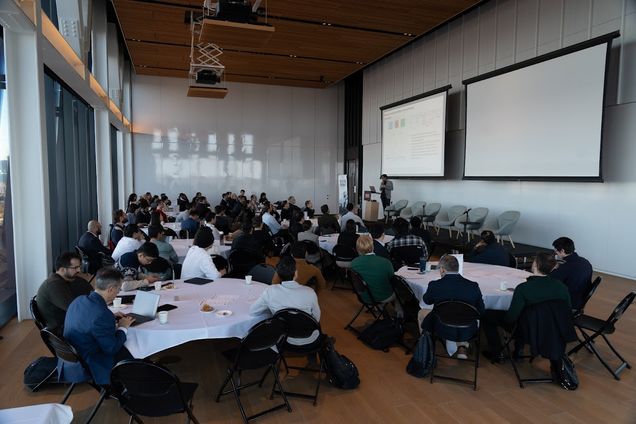 The event aimed to develop a shared strategy to address practical challenges in power infrastructure and resolve critical technical and societal challenges in modern power systems.
The workshop successfully gathered leading experts from academia, industry, national laboratories, and government agencies to explore transformative strategies for upgrading power grids. Discussions focused intently on identifying technological gaps and potential solutions for several key challenges.
The ultimate aim of the workshop was to foster lasting collaborations among Boston University, other academic institutions, grid operators, and industry that could lead to large-scale, impactful projects and initiatives to modernize the power system.
Professor Emiliano Dall’Anese (ECE, SE), one of the workshop’s organizers, opened the day with remarks on the day’s goals. He added that he hoped the day would motivate collaborators to work towards a cleaner environment and to take a convergent approach to research to make an impact.
Professor Elise Morgan (ME, MSE, BME), Dean of BU’s College of Engineering, expressed her excitement about the future of the ideas under discussion.
“The need for sustainability work is being questioned, and growing polarization is fueling skepticism and cynicism about alternative energy technologies and even science in general,” she said. “But alongside the unease that this precarious moment brings, I also feel hope.”
“Scientific ideas have never needed anyone’s permission to form, and research communities like the ones that many of you participate in have shown incredible resilience in nurturing those ideas and bringing them to fruition,” she said.
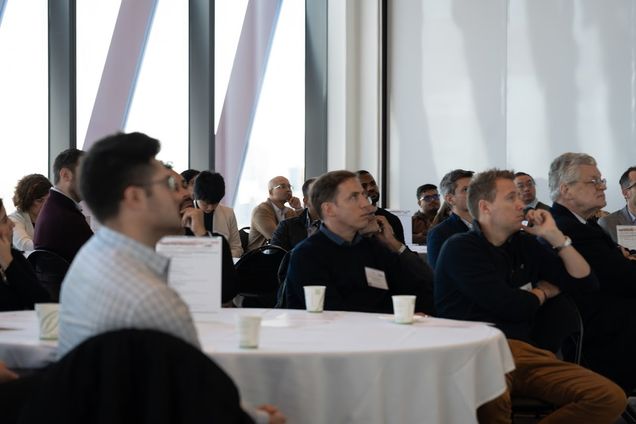 Digaunto Chatterjee, Senior VP of Engineering at Eversource, then addressed the need for electric infrastructure buildout for a sustainable future, focusing on the Greater Boston system.
He highlighted significant challenges, including aging grid infrastructure, rising costs, and the need to navigate complex policy and regulation. Achieving net-zero goals requires critical projects such as new substations, and Chatterjee stressed the need for a streamlined, inclusive process to overcome siting challenges.
Florian Dörfler, professor at the Automatic Control Laboratory at ETH Zürich, discussed the control of power-electronics-dominated power systems, essential for a distributed energy future. He noted that challenges with Inverter-Based Resources (IBRs) are now widely recognized and require bridging research between power systems, power electronics, and control theory.
A key issue is interoperability, as vendors implement different interfaces and current grid codes lag. To ensure stability, he proposed applying the principle of passivity and translating old step-response grid codes into clearer frequency-domain reference behavior.
An ensuing “Super Session on Control of Future Power Systems” followed, diving deeper into Grid-Forming (GFM) Inverters:
- Sairaj Dhople, electrical and computer engineering professor at the University of Minnesota, provided a historical context, explaining the evolution from mechanical governors to software governors that enable GFM inverters to mimic traditional inertia.
- Phillip Hart, senior engineer at GE Research, offered an industry update, detailing GE Vernova’s R&D efforts in GFM control, including solutions for overload ride-through and the deployment of battery energy storage systems.
- Federico Milano, electrical and electronic engineering professor at University College Dublin, presented a novel architecture, the Dual-Grid Forming (Dual-GFM) Converter. He noted its high robustness and stability against significant disturbances. However, he identified a current challenge— poor performance when combined with traditional synchronous machines.
- Dominic Groß, electrical and computer engineering professor at the University of Wisconsin, Madison, addressed a crucial limitation—the theory lags practice in managing the physical constraints of IBRs. He suggested a way to design the control systems for the IBRs so they always stay within their safe operating limits, such as voltage and power. This innovative design would make the new system much more reliable and less likely to fail.
Following this panel was Professor William Hogan, the Raymond Plank Professor of Global Energy Policy at Harvard University. Professor Hogan shared his research on the “Green Agenda” as a primary source of modern power system challenges. He suggested that the tension between market-based efficiency and aggressive environmental mandates creates “Third Rail” issues, or topics so politically charged that they are difficult to address objectively. He further critiqued traditional cost-benefit analyses, noting a paradox in which measures of economic benefit may increase alongside carbon emissions, forcing a difficult choice between short-term economic metrics and long-term climate-related decisions.
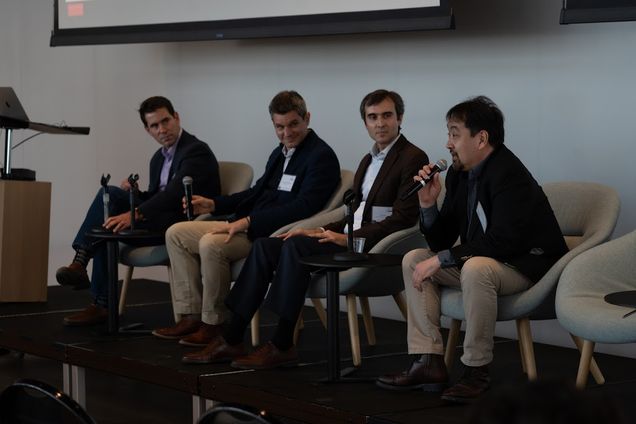 Following Hogan was a panel discussion titled “Industry, Operator, and Government Perspective on the Future of Grids.”
- Mads Almassalkhi, an electrical and biomedical engineering professor at the University of Vermont, focused on Scalable Grid Architectures to achieve a grid that is simultaneously reliable, affordable, and able to grow with demand and new technologies.
- Panagiotis Andrianesis, research associate professor in the systems engineering department at BU, spoke on reforming electricity markets by synthesizing concepts from finance, operations research, and power system engineering. His goal is to design markets that can efficiently address the massive uncertainty introduced by renewable generation and distributed resources.
- Pablo Ruiz, CEO and CTO at NewGrid, emphasized that transmission systems are the backbone of the grid. Still, current congestion management is inadequate because it incorrectly treats the transmission grid as a fixed entity.
- Bruce Tsuchida, a principal at The Brattle Group, discussed the various approaches to cost allocation and recovery for transmission projects, noting the different models available to fund necessary infrastructure upgrades.
Melissa Lavinson, Executive Director of the Mass Office of Energy Transformation, took the stage to share her focus on building a smarter Massachusetts grid to handle massive growth from EVs, heat pumps, and data centers. She stated that the traditional planning approach is too slow. Key strategies she shared include using flexible interconnections and smarter buildings to avoid costly upgrades, and implementing additional systems, such as superconducting cables, to enhance resilience and capacity.
Another final panel addressed the foundational challenges and necessary architectural shifts in energy markets to accommodate high penetration of renewables and new resources. 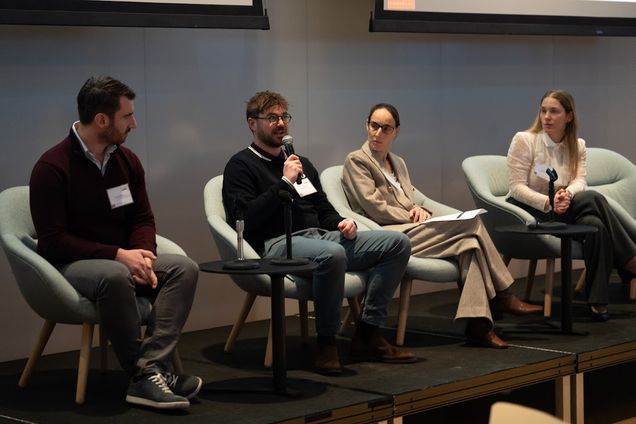
- Marianne Perben, Director of Planning Services for ISO New England, shared that in New England, shifting winter demand peaks reduces costs, but pushing decarbonization past 85% significantly raises costs and increases renewable curtailment.
- Nick Watson, Director of Flexible Resource Engineering at National Grid, detailed that National Grid’s peak demand will likely double by 2050 and shift to winter. Their “Future Grid Plan” seeks to manage this surge by rewarding customers who use Distributed Energy Resources (DERs) to support the grid.
- Elli Ntakou, System Resilience and Reliability Manager at Eversource, highlighted the use of advanced analytics and optimization tools to enhance grid reliability and resilience while saving money, demonstrating a 52% reduction in miles traveled during storm response using optimized dispatch.
- Ciaran Roberts, Technical Staff member at Emerald AI, emphasized that power demand flexibility is crucial for integrating new, high-demand enterprises like AI and cryptomining onto the grid right now.
To close out the day, three Vision Talks on the future of power grid technology and management were shared by Boston University researchers.
Fatih Acun, computer engineering graduate student fellow, introduced the concept of transforming energy-intensive data centers from mere loads into valuable grid assets by managing their demand. Recognizing that data center electricity use is rapidly climbing, his work involves developing collaborative frameworks and a simulation platform, FlexDC, to evaluate how data centers can effectively participate in demand response and contribute to a more sustainable system.
Dall’Anese highlighted his continued work on developing sophisticated tools for small-signal and stability analysis, which are essential for testing and ensuring that modern power systems remain resilient in the face of minor changes or major, sudden disruptions, such as a snowstorm.
Finally, Benjamin Sovacool, Director of the BU Institute for Global Sustainability, presented the center’s mission across various themes, including environmental health, climate governance, and the design of future energy systems. The Institute is driving projects such as the Clean Energy & Environment Legacy Transition Initiative and developing data stories for an equitable energy transition.
More information on the workshop can be found here.