BU Researchers Showcase the Future of Systems Engineering at CGSW 12.0
Center for Information and Systems Engineering (CISE) student researchers at Boston University took center stage to demonstrate how they are solving the world’s most complex problems, sharing ideas from cutting-edge soft robotics.
On Friday, January 30th, 2026, CISE hosted its 12th annual Graduate Student Workshop (CGSW 12.0). The event provided a dynamic platform for students to present their latest research in artificial intelligence, machine learning, and autonomous systems, engaging with peers, faculty, and industry leaders while fostering collaboration and innovation.
CGSW was established in 2014 to provide students with an opportunity to share their research while strengthening their communication and presentation skills and building a network for potential future collaborations.
The day began with opening remarks from CISE Director Ayse K. Coskun.
“We have a rich program spanning a wide range of areas,” Coskun said. “We’ll see presentations in AI, machine learning, security systems, robotics, formal methods, and more. These works have been published as papers at leading top-tier conferences in their respective fields.”
In addition to research presentations, the workshop featured keynote addresses from industry pioneers and a CISE alumni-faculty panel.
The first plenary speaker, Rania Khalaf, Chief AI Officer at WSO2, highlighted a shift from “passive tools” to the widespread use of autonomous AI agents in her talk titled “From Hubris to Hope When It’s Agents All the Way Down.” These agents can perform complex tasks but often struggle with simple ones.
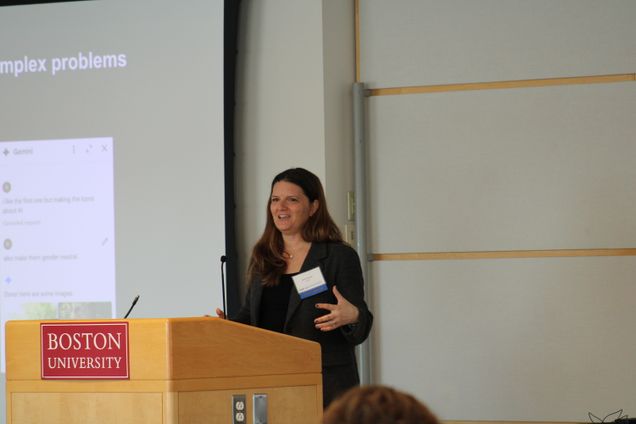
This unpredictability creates a “Moral Crumple Zone,” where humans are unfairly blamed for the errors of systems they can’t fully control. To move past the current hype and avoid costly mistakes, Khalef argued for building stronger management platforms. These platforms serve as a technical foundation, ensuring agents are treated as tools that require guardrails, rather than as experts. These platforms are necessary, as more than 33% of enterprise apps are expected to integrate AI agents by 2028, Khalef added.
Rahul Chandan, a Research Scientist at Amazon Robotics, delivered the afternoon plenary address, “Multi-Agent Coordination in Extremely Dense Environments.”He detailed how the company is optimizing its network of over one million robots by solving the “Block Rearrangement Problem” (BRaP) in high-density warehouses.
 Chandan shared that while industry-standard symbolic planning and configuration searches fail at the scale of Amazon’s 80×80 grids, his team’s “BR-LaCAM” algorithm achieves high efficiency and a theoretical completeness guarantee. By successfully coordinating assigned blocks alongside unassigned “movable obstacles,” these algorithmic advances ensure that even in highly dense environments, customer orders are fulfilled faster and more reliably.
15 student presentations were delivered throughout the day, highlighting pivotal research across disciplines.
- Session 1: Application-Oriented Machine Learning
- Session 2: Large Data Monitoring and Control
- Session 3: Safety and Control
- Session 4: Security Through LLMs and Software
- Session 5: Application Specific: A Hardware Perspective
Throughout the day, attendees voted on each student’s presentation. Three students were recognized at a reception following the program for the best presentations.
The CGSW 12.0 Best Presenter Awards:
 First place: FNU Syed Mohammad Qasim (Advisor: Ayse Coskun), LLM Limitations in Cloud Latency Diagnosis
Second place: Nicholas Sacco (Advisor: Bobak Nazer), The Power Method with Row Erasures
Third place: Akua Kodie Dickson (Advisor: Andrew Sabelhaus), Safe Autonomous Environmental Contact for Soft Robots using Control Barrier Functions
Programming wrapped up with a CISE Alumni-Faculty Panel, offering current students a glimpse into the professional trajectories of experts from academia and industry who once stood in their shoes. Representatives from Amazon Robotics, Draper, and Spiky.ai, as well as faculty startups CipherSonic Labs and Ava Robotics, discussed the dualities of trust and utility in the age of AI.
Experts Burak Aksar, Mela Coffey, Ajay Joshi, Alyssa Pierson, and Jimmy Queeney emphasize that Large Language Models (LLMs) should be treated as productivity tools that require human-in-the-loop verification rather than as sources of absolute truth. While AI can automate data analysis and boost efficiency, the panel stressed that it cannot replace the critical thinking or original research required when existing datasets are unavailable.
Ajay Joshi specifically warned students against over-relying on AI for writing, noting that ChatGPT primarily reproduces previously published content. To truly innovate or contribute something unique, individuals must leverage their own curiosity to identify knowledge gaps. Ultimately, the panel concluded that while AI will reshape valued skills, the ability to analyze complex problems and exercise human judgment remains the essential driver of professional success.
“Looking ahead, the future of technology is full of possibilities, and CISE has continually evolved over its 25-year history to help lead that progress,” Coskun said during the closing remarks. “CISE is one of the original convergent research centers at Boston University, and as BU continues to expand its convergent research initiatives, our mission aligns closely with this vision. What matters most is that this community is working together to shape what comes next—that’s exactly why CISE exists.”
She added that CISE encourages students to step beyond their comfort zones, build new connections, and pursue opportunities that prepare them to address complex challenges and contribute to the future of convergent research.
To learn more about the event, find the day’s agenda here.