Skip to Main Content
Boston University
  • Bostonia
  • BU Today
  • The Brink
  • University Publications

    • Bostonia
    • BU Today
    • The Brink
  • School & College Publications

    • The Record
Other Publications
BU Today
  • Sections
News, Research, Community

Writing a new prescription for Lesotho

BU professors try to put the "system" in the African nation's health-care system
April 12, 2006
  • Chris Berdik
Twitter Facebook

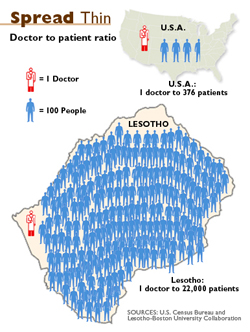
There are only about 90 doctors for the two million people living in Lesotho, a small, landlocked country in southern Africa, where the World Health Organization estimates that nearly one of every four adults, and more than 30 percent of pregnant women, are HIV-positive.

And Lesotho’s medical problem is not just about numbers. William Bicknell, a School of Public Health professor of international health, a School of Medicine professor of family medicine, and the director the Lesotho–Boston University Collaboration, says it’s also about inefficiency and lack of training. Administrators in the handful of district hospitals wait for months, or even years, for the central government’s OK for such things as repairing holes in the ceiling or replacing a much-needed doctor or nurse. Aid organizations donate expensive medical equipment, but there are no funds allocated to maintain the equipment, and foreign anesthesiologists are sent to hospitals that lack surgeons. Meanwhile, the country has no medical school and has trouble luring back native-born doctors trained in other countries, such as South Africa, because Lesotho lacks opportunities for more specialized medical training.

Earlier this year, the Collaboration, founded by Bicknell in 2003, was awarded a $195,000 grant from the W. K. Kellogg Foundation. The money, says the BU professor, will help implement a five-year plan to strengthen Lesotho’s health-care system.

“The hospitals and clinics need help in terms of managing their scarce resources,” says Bicknell. “In addition to HIV/AIDS, all the other diseases are still there. They need to give physicians the skills to handle really sick people in a hospital and skills in front-line medicine and trauma care. And because physicians in district hospitals are also usually in charge of them, they need training in things like contracts and budgets.”

Elisha Morgan (MED’06) working at
a Lesotho hospital in August, 2005

Bicknell is heading to Lesotho in June to meet with government ministers and health-care workers to draft a five-year plan to streamline how hospitals are managed and to lay the foundation for clinical training programs. Several BU colleagues will accompany him, including Mark Allan, faculty director of health sector management at the School of Management.

“It’s very challenging to run a health-care system when you have so little in terms of resources,” says Allan. “There are a lot of outside NGOs that have presences there, but our goal is to make the system work from the inside.”

On the managerial side of things, Allan says, the central government should give the district hospitals more autonomy in terms of their budgets, purchases of equipment and medicines, and decisions on hiring new doctors and nurses. “Right now, everything is too centralized. They can’t do anything without permission from the central government,” he explains, which creates “constant frustration” for hospital staff.

Plus, more autonomous and efficient hospitals will help the grant’s other main objective: getting more doctors and nurses to work in Lesotho, says Larry Culpepper, a MED professor and chairman of medicine and chairman of the department of family medicine at Boston Medical Center, who participates in the Collaboration and is the grant’s official recipient. 

While Lesotho sends students abroad for medical training, it has difficulty bringing them back to work in their home country. “There is no real physician clinical training in the country or to continue their education at a postgraduate level,” says Culpepper. “For most students [going to a foreign medical school] is just a way out of the country.”

Consequently, Bicknell and his colleagues plan to establish a family medicine residency program in Lesotho and to develop curricula for additional training in obstetrics, surgical skills, and trauma skills, among other disciplines.

“The country is small enough that there’s tremendous potential to have a positive impact on the health-care system,” says Allan. “It doesn’t need to be elaborate. It doesn’t need to be fancy. But it has to be tied to people’s concrete needs and not abstractions."

William Bicknell, standing, left, led a workshop, “Problem Solving for Better Hospitals,” in Lesotho in February. 


Explore Related Topics:

  • Global
  • Share this story

Share

Writing a new prescription for Lesotho

Share

  • Twitter
  • Facebook
  • Reddit
  • LinkedIn
  • Email

Latest from BU Today

  • University News

    150 Years Later, SPH’s Talbot Building Is Still Rooted in Health

  • In the City

    Love Thrift Shopping? Check Out Our Guide to the Best Secondhand Shops in and around Boston

  • Sports

    BU Men’s and Women’s Cross Country Set for Patriot League Championships Saturday

  • Arts & Culture

    Why We Love Being Scared by Horror Movies

  • Arts & Culture

    Hunting for the Eerie at BU’S Howard Gotlieb Archival Research Center

  • Things-to-do

    This Weekend @ BU: October 29 to November 1

  • Politics

    Massachusetts Has a Record-Tying Nine Questions on the Ballot This Year. Here’s What to Know

  • BU History

    The Ghost of Kilachand Hall

  • Arts & Culture

    New 808 Gallery Show Celebrates the Perfect Imperfection of Printmaking in the Age of AI

  • Sports

    Men’s Ice Hockey Chases a Turnaround as they Launch 2026–2027 Season

  • Entertainment

    Our Top Halloween Costume Picks for 2026

  • Mental Health

    New BU Child and Adolescent Counseling Program Seeks to Address the Pediatric Mental Health Care Crisis

  • Things-to-do

    This Weekend @ BU: October 22 to 25

  • Food

    BU Dining Services Expands Campus Offerings

  • Arts & Culture

    With a New Pride and Prejudice and Sense and Sensibility, Jane Austen Is More Relevant Than Ever

  • University News

    Committee Begins Review of BU’s Outward-Facing Sign Policies

  • Innovate@BU

    IDEA Con Returns October 24, Bringing Student Innovators and Entrepreneurs Together

  • Campus Life

    Tips for Staying Safe While Biking, Scootering, or Just Crossing the Street

  • Campus Life

    Video: Leaders Among Us—President Gilliam in Conversation with Colin Duckett

  • Health & Medicine

    BU Neurologist Says Our Bodies Tell Stories That Are Essential to Medicine

Section navigation

  • Sections
  • Must Reads
  • Videos
  • Series
  • Close ups
  • Archives
  • About + Contact
Get Our Email

Explore Our Publications

Bostonia

Boston University’s Alumni Magazine

BU Today

News, Research, Community

The Brink

Pioneering Research from Boston University

  • Twitter
  • Facebook
  • Youtube
  • LinkedIn
  • Instagram
  • Weibo
  • TikTok
© Boston University. All rights reserved. www.bu.edu
© 2026 Trustees of Boston UniversityPrivacy StatementAccessibility
Boston University
Notice of Non-Discrimination: Boston University prohibits discrimination and harassment on the basis of race, color, natural or protective hairstyle, religion, sex or gender, age, national origin, ethnicity, shared ancestry and ethnic characteristics, physical or mental disability, sexual orientation, gender identity and/or expression, genetic information, pregnancy or pregnancy-related condition, military service, marital, parental, veteran status, or any other legally protected status in any and all educational programs or activities operated by Boston University. Retaliation is also prohibited. Please refer questions or concerns about Title IX, discrimination based on any other status protected by law or BU policy, or retaliation to Boston University’s Executive Director of Equal Opportunity/Title IX Coordinator, at titleix@bu.edu or (617) 358-1796. Read Boston University’s full Notice of Nondiscrimination.
Search
Boston University Masterplate
loading Cancel
Post was not sent - check your email addresses!
Email check failed, please try again
Sorry, your blog cannot share posts by email.
Writing a new prescription for Lesotho
0
share this