Skip to Main Content
Boston University
  • Bostonia
  • BU Today
  • The Brink
  • University Publications

    • Bostonia
    • BU Today
    • The Brink
  • School & College Publications

    • The Record
Other Publications
BU Today
  • Sections
News, Research, Community

Boosting Biosurveillance

BU prof hopes to build a better system to detect disease outbreaks
September 12, 2006
  • John Thompson
Twitter Facebook
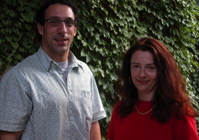
Alexander Ozonoff, SPH professor of biostatistics and Paola Sebastiani, SPH associate professor of biostatistics.

Information can be the most powerful weapon to combat a bioterrorist attack or pandemic influenza. To this end, the Centers for Disease Control and Prevention (CDC) has developed a nationwide biosurveillance system, BioSense, to provide early warnings and real-time information on disease outbreaks. Helping to improve the warning system is Alexander Ozonoff, a School of Public Health assistant professor of biostatistics, who along with co-investigator Paola Sebastiani, an SPH associate professor of biostatistics, received a $700,000 grant from the CDC. Ozonoff discussed the project with BU Today.

BU Today: What aspects of BioSense need improving?
Ozonoff: BioSense is a really ambitious project for CDC. Right now the program is working to invite more hospitals across the country to participate, which will expand coverage. The real problem that we, and other groups, are trying to address is what to do with all the data that are collected. The belief is that the signal of an important public health event, whether a bioterror attack or a massive outbreak of infectious disease, will be present in the BioSense data, but detecting that signal is a challenging statistical problem. Funding for this research project, and others like it, is meant to address that problem. 

How early can you catch an event?
It’s not clear how early we can catch an event. The goal is always to improve timeliness (how early) along with sensitivity (don’t miss any events) and specificity (low false-alarm rate). We hope that improved statistical methods can improve on all three of these operating characteristics. In general, it’s hard to say how much early warning we can provide since each outbreak is very different.  

Who decides on the standards for identifying threats, and what happens after a threat has been identified?

Determining what constitutes a threat to the public health is fundamental to BioSense, and to public health surveillance in general. There are two issues to deal with: first, if we see an increase in disease, or a geographic cluster of disease, is this increase due to chance (random variability in the number of people who are sick at any one time) or is it a signal of something important happening? This is where statistics play an important role. If we can say with some degree of confidence that the increase is not likely to be due to chance, then we must determine if it is important enough to act upon. These decisions are generally made by public health officials working together with statisticians and epidemiologists who are familiar with the surveillance system. So the decision-making process is intrinsically tied together with the collection, analysis, and interpretation of the data coming in. Each potential outbreak is generally considered on a case-by-base basis by public health officials at the local, state, or national level.

How does information get into the system, and what will it take to make this a nationwide network?
The BioSense infrastructure allows for data from multiple locations to be transmitted electronically to CDC, where the data can be analyzed centrally. Hospitals that agree to participate must meet the technical specifications determined by CDC in order to guarantee uninterrupted, consistent data flow. Right now, nationwide data from Department of Defense and the VA hospital system are part of the BioSense system, so in that sense it is already nationwide. As more hospitals from outside those two health-care systems are added, BioSense will continue to grow and expand its coverage to include more and more of the United States.

Explore Related Topics:

  • Faculty
  • Research
  • Share this story

Share

Boosting Biosurveillance

Share

  • Twitter
  • Facebook
  • Reddit
  • LinkedIn
  • Email

Latest from BU Today

  • Student Life

    Five Quick Tips from a BU Student to Ace Your Final Exams

  • Student Life

    More Than 100 Student Projects Take the Stage at Fall 2025 Experiential Learning Expo Friday

  • Student Life

    Dazzling Photographs Capture the Magic of the BU Marine Program’s Trip to Belize

  • Mental Health

    10 Tips to Help You Through Finals Season

  • Campus Life

    This School of Public Health Student Designed a Micro-Forest in Brighton

  • Watch Now

    Video: 30 Seconds of Calm to Help You Through Finals

  • University News

    BU School of Theology Receives $1 Million to Build a Support Network of New England Churches

  • Medicine

    WHO Decision Recognizing Obesity as a Disease Treatable with GLP-1 Drugs Is “Big Deal,” says BU Endocrinologist

  • Photography

    Fall 2025 at BU—Photo Essay Offers a Look Back

  • Things-to-do

    Your Guide to the Best Holiday Markets Around Boston

  • Things-to-do

    This Weekend @ BU: December 4 to 7

  • Student Life

    Meet the BU Career Ambassadors Helping Their Peers Find Internships

  • Safety

    Brrr! When It Gets This Cold, Be Smart Outside and Follow These Tips to Stay Warm, Safe, and Dry

  • Student Life

    At BU, Student-Made Gives Young Entrepreneurs a Place to Grow

  • Watch Now

    My Own Boston: Ahaan Vaknalli (COM’27)

  • Giving

    Giving Tuesday Is a Chance to Support Students Through Scholarships, Campus Resources, and Research Opportunities

  • Campus Life

    Most of MBTA Green Line to Shut Down for 15 Days in December

  • Alumni

    This Small Business Saturday, Check Out These Alumni-Owned Businesses

  • Shopping

    Black Friday on a Budget: Top Picks for Students

  • Things-to-do

    Nine Ways to Have Fun in Boston This Thanksgiving Break

Section navigation

  • Sections
  • Must Reads
  • Videos
  • Series
  • Close ups
  • Archives
  • About + Contact
Get Our Email

Explore Our Publications

Bostonia

Boston University’s Alumni Magazine

BU Today

News, Research, Community

The Brink

Pioneering Research from Boston University

  • Twitter
  • Facebook
  • Youtube
  • LinkedIn
  • Instagram
  • Weibo
  • TikTok
© Boston University. All rights reserved. www.bu.edu
© 2025 Trustees of Boston UniversityPrivacy StatementAccessibility
Boston University
Notice of Non-Discrimination: Boston University prohibits discrimination and harassment on the basis of race, color, natural or protective hairstyle, religion, sex or gender, age, national origin, ethnicity, shared ancestry and ethnic characteristics, physical or mental disability, sexual orientation, gender identity and/or expression, genetic information, pregnancy or pregnancy-related condition, military service, marital, parental, veteran status, or any other legally protected status in any and all educational programs or activities operated by Boston University. Retaliation is also prohibited. Please refer questions or concerns about Title IX, discrimination based on any other status protected by law or BU policy, or retaliation to Boston University’s Executive Director of Equal Opportunity/Title IX Coordinator, at titleix@bu.edu or (617) 358-1796. Read Boston University’s full Notice of Nondiscrimination.
Search
Boston University Masterplate
loading Cancel
Post was not sent - check your email addresses!
Email check failed, please try again
Sorry, your blog cannot share posts by email.
Boosting Biosurveillance
0
share this