Joseph
S. Lucas and Donald A. Yerxa, Editors
MILITARY
REVOLUTIONS: A FORUM
Geoffrey
Parker, "Military Revolutions, Past and Present"
Jeremy
Black, "On Diversity and Military History"
Dennis
Showalter, "Thinking about Military Revolution"
Jeffrey
Clarke, "On the Once and Future RMA"
Geoffrey
Parker, "Random Thoughts of a Hedgehog"
Michael
A. Ledeen, "Terrorism in Historical Context"
Miriam
R. Levin, "September 11 as a Transforming Event"
Timothy
M. Roberts, "1848 and American Frustrations with Europe"
Paul
Lyons, "From Vietnam to Iraq: Lessons from the City of Brotherly Love"
THE
BRITISH EMPIRE AND GLOBALIZATION: A FORUM
Niall
Ferguson, "British Imperialism Revisited: The Costs and Benefits of 'Anglobalization'"
P.J.
Marshall, "Beneficial for Whom?"
Robert
E. Lucas, Jr., "Colonialism and Growth"
Andrew
Porter, "'Anglobalization': A Conceptual Step Backward"
Andrew
J. Bacevich, "Does Empire Pay?"
Niall
Ferguson, "Globalization without Gunboats?"
Interview
with David Brooks
David
J. Staley, "Computers, Visualization, and the Representation of History"
Historically
Speaking: The Bulletin of the Historical Society
April
2003
Volume
IV, Number 4
THE BRITISH
EMPIRE AND GLOBALIZATION: A FORUM
Niall
Ferguson, P.J. Marshall, Robert E. Lucas, Jr., Andrew Porter, and Andrew
J. Bacevich
With
two books and a British television series, Niall Ferguson has placed a
spotlight on the history of the British Empire
and its relevance for making sense of the contemporary world. Here he considers
the empire’s impact on the global economy. P.J. Marshall, Robert E. Lucas,
Jr., Andrew Porter, and Andrew Bacevich
respond to his essay, followed by Ferguson’s
concluding reply.
British
Imperialism Revisited: The Costs and Benefits of “Anglobalization”
by
Niall Ferguson
It
is fair to say that recent economic history has not been kind to the British
Empire. According to one influential school of thought, late
19th-century capital exports to the country’s numerous colonies diverted
resources away from the modernization of British industry. Some scholars
have questioned whether it was even economically rational for the investors
themselves.[1]
Patrick O’Brien has argued that after around 1846 Britain
could have withdrawn from empire with impunity, and reaped a “decolonization
dividend” in the form of a 25% tax cut. The money taxpayers would have
saved as a result of a Victorian decolonization could have been spent on
electricity, cars, and consumer durables, thus encouraging industrial modernization
at home.[2]
Such
negative assessments of Britain’s
relationship to the empire sit somewhat uneasily alongside the large “nationalist”
literature on the impact of empire on Britain’s
colonies, notably India.
In the words of B. R. Tomlinson, “the suggestion remains that British rule
did not leave a substantial legacy of wealth, health, or
happiness to the majority of the subjects of the Commonwealth.”[3]
Numerous authors have insisted that the principal consequence of British
rule in the Indian subcontinent was a legacy of “underdevelopment.” Can
it really be that the empire was economically bad for both Britain
and her colonies? By drawing on the recent economic literature on globalization,
past and present, this essay argues otherwise.
* *
*
In
an influential paper published in 1995, Jeffrey Sachs and A. M. Warner
demonstrated conclusively that one of the principal reasons for widening
international inequality in the 1970s and 1980s was protectionism in less
developed economies. In their words, “open economies tend to converge [on
the developed economies], but closed economies do not. The lack of convergence
in recent decades results from the fact that the poorer countries have
been closed to the world.” When they compared per capita Gross Domestic
Product (GDP) growth among developing countries, they found that “the open
economies grew at 4.49% per year, and the closed countries grew at 0.69%
per year.” Sachs and Warner’s findings have been widely interpreted as
making the case for present-day “globalization.” However, their findings
also have important historical implications. As the authors note, in the
previous era of globalization—conventionally seen as the period from the
mid 19th century until the First World War—economic openness was imposed
by colonial powers (principally, of course, Britain) not only on Asian
and African colonies but also on South America and even Japan.[4]
A similar
point can be made with respect to flows of labor. Jeffrey Williamson and
others have emphasized the importance of international migration (or the
restrictions on it) in determining the extent of international inequality.
The more free movement there is of labor, the more international income
levels will tend to converge. One reason that modern globalization is associated
with high levels of inequality is that there are so many restrictions on
the free movement of labor from less developed to developed countries.[5]
This too has obvious implications for the history of the British
Empire, which actively promoted emigration to at least some
of its colonies, and certainly did nothing to heed the migration of British
people wherever they wished to go.
Consider
also the evidence on international capital flows, another key component
of globalization. Development economists have spent many decades trying
to work out how to raise the level of investment in backward agrarian societies.
The most obvious solution has been for them to import capital from where
it is plentiful, namely the developed world. According to the simple classical
model of the world economy, this should happen naturally: capital should
flow from developed to less developed economies, where returns are likely
to be higher. But as Robert Lucas
pointed out, with respect to the United
States and India
in the 1970s, this does not seem to happen in practice.[6]
Although some measures of international financial integration seem to suggest
that the 1990s saw bigger cross-border capital flows than the 1890s, in
reality most of today’s overseas investment goes on within the developed
world. In 1996 only 28% of foreign direct investment went to developing
countries; by 2000 their share was less than a fifth. The overwhelming
majority takes place between the United
States, the European Union, and Japan.
Investors in the developed world prefer to invest in countries which already
have high levels of per capita GDP, which is one reason why increased capital
flows in recent decades seem to have been associated with widening international
inequalities.
As
Michael Clemens and Jeffrey Williamson have shown, there was something
of a “Lucas effect” in the first era of globalization, in that “about two-thirds
of [British capital exports] went to the labor-scarce New World where only
a tenth of the world’s population lived, and only about a quarter of it
went to labor-abundant Asia and Africa where almost two-thirds of the world’s
population lived.”[7]
Nevertheless, the share of British capital going to poorer countries was
still significantly larger than it is today. According to Maurice Obstfeld
and Alan Taylor, in 1997 only around 5% of the world stock of capital was
invested in countries with per capita incomes of 20% or less of U.S.
per capita GDP. In 1913 the figure was 25%. They also estimate the share
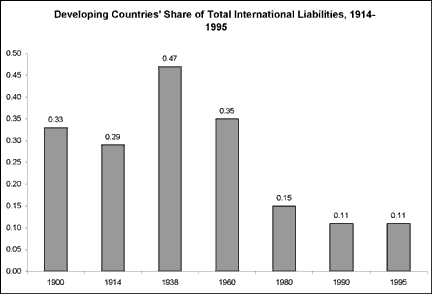
of developing countries in total international liabilities at 11% in 1995,
compared with 33% in 1900 and 47% in 1938. Those figures are at least suggestive
of the possibility that the existence of formal empire encouraged investors
to put their money in less developed economies (see Figure 1).[8]
 Figure
1
Figure
1
Finally,
we need to consider recent empirical work on the institutional and political
preconditions for growth. In a cross-country study of postwar economic
growth, Robert Barro concluded that there
were six significant variables that were likely to influence a country’s
economic performance. The first was the provision of secondary and higher
education; the second was the provision of health care, since there is
a correlation between growth and life expectancy; the third was the promotion
of birth control; the fourth was the avoidance of “non-productive government
expenditures,” since “big government is bad for growth”; the fifth was
the enforcement of the rule of law; and the sixth was the avoidance of
inflation above 10% per annum.[9]
David Landes, in his Wealth and Poverty
of Nations, has come to similar conclusions, arguing that “the ideal
growth-and-development” government would: secure rights of private property;
secure rights of personal liberty; enforce rights of contract; and provide
stability and fairness in an efficient, moderate fashion.[10]
It
requires only a passing familiarity with the nature of British colonial
administration to recognize that at least some of these were among its
defining characteristics. To be sure, British colonial rule was not democratic
(outside the “white dominions”—Canada, Australia,
and New Zealand).
But as both Barro and Landes
observe, democracy does not correlate especially closely with economic
performance.
There
is a significant discrepancy between the modern literature on economic
growth and the historical consensus that the British Empire
was economically deleterious. A striking number of the things currently
recommended by economists to developing countries were in fact imposed
by British rule. There was, as Alan Taylor has
suggested, a “London consensus” not unlike the “Washington consensus” of
our own time, with the difference that the International Monetary Fund
cannot rely on the services of the Royal Navy to enforce its recommendations.
Unless the economists have got it seriously wrong, there is at least a
prima facie case that the British Empire was economically beneficial,
not only to Britain herself, but also to her empire—and perhaps even to
the world economy as a whole.
* *
*
Let
us begin with world trade and tariffs. In an ideal world, of course, free
trade would be naturally occurring. But history and political economy tell
us that it is not. For most of the 19th century, free trade spread because
of Britain’s
power more than Britain’s
example. From the 1840s until the 1930s, the British political elite and
electorate remained wedded to the principle of laissez faire, laissez
passer—and the practice of “cheap bread.” That meant that—certainly
from the 1870s—British tariffs were significantly lower than those of her
European neighbors; it also meant that tariffs in much of the British
Empire were also kept low. Abandoning formal control over Britain
’s colonies would almost certainly have led to higher tariffs being erected
against British exports in their markets, and perhaps other forms of trade
discrimination.
The
evidence for this need not be purely hypothetical: it is manifest in the
highly protectionist policies adopted by the United
States and India
after they secured independence, as well as in the tariff regimes adopted
by Britain
’s imperial rivals France, Germany,
and Russia
after the late 1870s. Whether one looks at the duties on primary products
or manufactures, Britain
was the least protectionist of the imperial powers. In 1913 average tariff
rates on imported manufactures were 13% in Germany, over 20% in France,
44% in the United States, and 84% in Russia. In Britain
they were zero.
According
to Michael Edelstein, the economic benefit to Britain
of enforcing free trade could have been anywhere between 1.8 and 6.5%
of the Gross National Product (GNP).[11]
But what about the benefit to the rest of the world? In the words of Sir
John Graham, Britainwas
“the great Emporium of the commerce of the World.” Its domestic market
and much of its empire were more or less open to all comers to sell their
wares as best they could. The evidence that Britain
’s continued policy of free trade was beneficial, in a protectionist world,
to her colonies seems unequivocal. Between 1871-75 and 1925-29, the colonies’
share of Britain’s
imports rose from a quarter to a third. More generally, as Jeffrey Williamson
has argued, it was (mainly British) colonial authorities that resisted
protectionist backlashes to the dramatic falls in factor prices caused
by late 19th-century globalization.[12]
In
the same way, there would not have been so much international mobility
of labor—and hence so much global convergence of incomes before 1914—without
the British Empire. True, the independent United
States was always the most attractive
destination for 19th-century emigrants. But as American restrictions in
immigration increased, the significance of the white dominions—Canada, Australia,
and New Zealand—as
a destination for British emigrants grew markedly, attracting around 59%
of all British emigrants between 1900 and 1914, 75% between 1915 and 1949,
and 82% between 1949 and 1963. Nor should we lose sight of the vast numbers
of Asians who left India
and Chinain
the 19th century to work as indentured laborers, many of them on British
plantations and mines. Perhaps as many as 1.6 million Indians emigrated
under this system, which lay somewhere between free and unfree
labor. There is no question that the majority of them suffered great hardship;
many indeed might have been better off staying at home. But once again
we cannot pretend that this mobilization of cheap and probably underemployed
Asians to grow rubber or dig gold had no economic significance (see Figure
2).
 Figure
2
Figure
2
Similar
arguments may be advanced about Britain's
role as a capital exporter. As is well known, from the mid-19th until the
mid-20th century, Britain
acted as the world’s banker, channeling colossal sums of British (and other
European) savings overseas. By 1914 total British assets overseas amounted
to somewhere between £3.1 and £4.5 billion, while the British
GDP was £2.5 billion. Compared with the other major capital exporters
of the period, Britainsent
a remarkably high proportion of her savings to overseas economies. To be
sure, around 45% of British investment went to the United
States and the dominions. But 16% of British
foreign investment went to Asiaand 13% to Africa,
compared with just 6% to the rest of Europe.
Taking British investment as a whole, between 1865 and 1914, as much went
to Africa, Asia,
and Latin America (29.6%) as to the UK
itself (31.8%). This pattern was surprisingly little changed by the effects
of the First World War and the Great Depression. As late as 1938, around
18% of British overseas assets were in Asia,
and 11% in Africa. As is well known, British
investment in developing economies principally took the form of portfolio
investment in infrastructure, especially railways. But the British also
sank considerable (and not easily calculable) sums directly into plantations
to produce new cash crops like tea, cotton, indigo, and rubber.
Investing
money in faraway places is risky: what economists call “informational asymmetries”
are generally greater the further the lender is from the borrower. Less
developed economies also tend to be rather more susceptible to economic,
social, and political crises. Why then were British investors willing to
risk such an exceptionally high proportion of their savings by purchasing
securities or other assets overseas? One possible answer is that the adoption
of the gold standard by developing economies offered investors a “good
housekeeping seal of approval.” To be precise, as Michael Bordo
has shown, going onto gold reduced the yield on government gold-denominated
bonds by around 40 basis points.[13]
It is certainly the case that before 1914 adoption of the gold standard
was as good a way of obtaining cheap loans as membership in the British
Empire—though it must be remembered that many countries went onto gold
(which was, after all, a sterling standard devised in London) precisely
because they were British colonies.
Yet
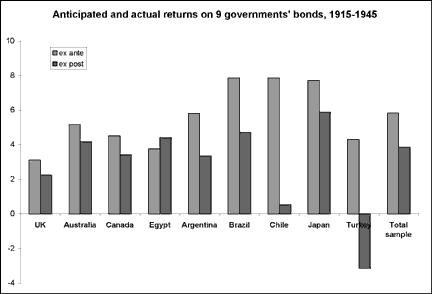
there is a need to distinguish here between anticipated and actual returns
on overseas investments. For the period 1850 to 1914, anticipated (ex
ante) returns were not significantly lower on colonial bonds than they
were on other foreign bonds. But the same cannot be said of the actual
(ex post) returns. If one takes an average of the three colonial
countries in the sample, the anticipated yield was 5.3%, compared with
4.7% for the three South American countries. But the actual returns were
significantly different: 4.7% as against 2.9%. This helps explain why,
when the same countries returned to the bond market in the interwar years,
they paid significantly different risk premia.
On average, the ex ante returns Latin American borrowers had to
offer investors were 270 basis points higher than those on new colonial
issues. Even so, actual returns on Latin American bonds were once again
worse than expected and worse than those on colonial bonds (see Figure
3).
 Figure
3
Figure
3
In
other words, experience showed that money invested in a de jure
British colony such as India,
or in a colony in all but name like Egypt,
was more secure than money invested in an independent, albeit informally
“colonized” country such as Argentina.
This was because the commitment to gold was a “contingent commitment”;
it was essentially voluntary and could be suspended in the event of an
emergency such as a war.[14]
Gold standard members who were otherwise sovereign states could not only
suspend gold convertibility of their currencies; they could also default
on their debts. To varying degrees and at various times, Argentina, Brazil, Chile, Mexico, Japan, Russia,
and Turkey
all did precisely that. Membership in the empire was quite different. British
colonies were unlikely to suspend convertibility and not much more likely
to default than Britain
herself. By the 1920s, membership in the empire was therefore confirmed
as a better “good housekeeping seal of approval” than gold (see Figure
4).
 Figure
4
Figure
4
That
imperial membership offered better security to investors than mere adoption
of the gold anchor is not surprising. There were a variety of explicit
legal guarantees offered by the Colonial Loans Act (1899) and the Colonial
Stock Act (1900), which gave colonial bonds the same “trustee status” as
the benchmark British government perpetual bond, the “consol.” Over and
above that, there was the cast-iron commitment of colonial governors and
administrators to the principles of Gladstonian
finance. It was inconceivable, declared the governor of the Gold Coast
in 1933, that the interest due on Gold Coast bonds should be compulsorily
reduced: why should British investors “accept yet another burden for the
relief of persons in another country who have enjoyed all the benefits
but will not accept their obligation”? Even colonial constitutions had
been drafted with at least one eye on creditor preferences.[15]
This
therefore explains why an increasing share of British overseas investment
ended up going to the empire after the First World War. In the period from
1856 to 1914, around two-fifths (39%) of British overseas capital went
to the empire, compared with three-fifths (61%) to the rest of the world.
But after the First World War, the tables turned. Between 1919 and 1938,
the empire got two-thirds, the rest got a third. Nor is it surprising that
more than three-quarters of all foreign capital invested in sub-Saharan Africa
was invested in British colonies (see Figure 5).[16]

Figure
5
P.
J. Cain and A. G. Hopkins lay great emphasis, in their path-breaking history
of British imperialism, on the dominant role played by the City of London,
with its ethos of “gentlemanly capitalism.” In both the formal and the
informal empire, they argue, finance came first, and British export industries
a poor second. They do not address how the policy of prioritizing overseas
investment affected the rest of the world. On the strength of the evidence
I’ve presented here, it seems reasonable to conclude that it offered at
least the opportunity of economic convergence. For in order to ensure that
loans to developing economies were repaid, British policy makers were prepared
to go to considerable lengths, ultimately allowing a system of differential
tariffs to evolve which gave colonial manufacturers easier access to the
British “home” market than British manufacturers enjoyed to colonial markets.
Intention
and outcome are two different things. The British did not see the economic
development of Asia and Africa
as their primary concern, though they sometimes paid lip service to the
idea. As we shall see, they would have acted rather differently in India,
if development had been the paramount objective. Nevertheless, the intended
policy of financial rather than industrial domination of the world economy
had secondary positive outcomes alongside the primary outcome of ensuring
that investors got their interest and principal. Under the right circumstances,
this policy was conducive to rapid economic growth on the periphery—more
so than a policy which would have put the interests of British industrial
exports first.
* *
*
The
results of “Anglobalization” were in many ways
astounding. The combination of free trade, mass migration, and unprecedented
overseas investment propelled large parts of the British
Empire to the forefront of world economic development. In terms
of the production of manufactured goods per head
of population, Canada, Australia,
and New Zealand
ranked higher than Germany
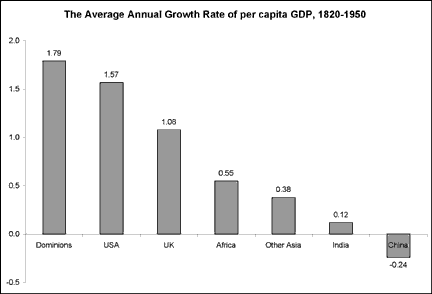
in 1913. Between 1820 and 1950, their economies were the fastest growing
in the world. Per capita GDP grew more rapidly in Canada
than the United States
between 1820 and 1913 (see Figure 6).
 Figure
6
Figure
6
But
the performance of the dominions was not matched in the rest of the Empire
and least of all in Asia. Why was Indian economic
performance so much worse than that of the dominions? India
attracted £286 million of capital raised in London
between 1865 and 1914—18% of the total placed in the empire, second only
to Canada.
Yet Indian per capita GDP grew at a miserably slow rate. Between 1857 and
1947—between the Mutiny and Independence,
in other words—Indian per capita GDP grew by just 19%, compared with an
increase in Britain
of 134%. The chart shows that between 1820 and 1950, it grew at a mere
0.12% per annum—barely at all by the standards of the “white” empire, and
slow even by comparison with Africa.
The
nationalist explanation for Indian “underdevelopment” under British rule
has four essential components. First, the British de-industrialized India
by opening it to factory-produced textiles from Lancashire,
whose manufacturers were initially protected from Indian competition until
they had established a technological lead.Second,
they imposed excessive and regressive taxation. Third, they “drained” capital
from India,
even manipulating the rupee-sterling exchange rate to their own advantage.
Finally, they did next to nothing to alleviate the famines that these policies
caused. One recent historian has gone so far as to speak of “Late Victorian
Holocausts” in the 1870s and 1890s.[17]
This negative view of the British role in India—which
can be traced back to DadabhaiNaoroji’s
Poverty and Un-British Rule in India (1901)—continues to enjoy wide
currency.[18]
No
doubt it benefited the Indian economy little to maintain one of the world’s
largest standing armies as a mercenary force. Yet recent research casts
doubt on other aspects of the nationalist critique. Tirthankar
Roy has shown that the destruction of jobs in the Indian textile industry
was probably inevitable, regardless of who ruled India,
and that an equal if not greater number of new jobs were created in new
economic sectors built up by the British. Even in the case of textiles,
by the 1920s the Government of India was clearly giving preference to Indian
manufacturers over Lancashire’s mills. Roy
also casts doubt on the idea that taxation under the British was excessive,
showing that the land tax burden fell from around 10% of net output in
the 1850s to 5% by the 1930s.[19]
The supposed “drain” of capital from Indiato Britain
turns out to have been comparatively modest: only “about 0.9-1.3% of Indian
national income from 1868 to the 1930s,” according to one estimate of the
export surplus (which was what nationalists usually had in mind).[20]
In any case, so far as the Home Charges were concerned, “a great deal of
government expenditure was in fact incurred for services that India
needed but could not supply on her own.” Finally, “the prospect of devastating
famines once every few years was inherent in India’s
ecology . . . . Famines were primarily environmental in origin” and after
1900 the problem was alleviated by the greater integration of the Indian
market for foodstuffs. The Bengal famine of
1943 arose precisely because improvements introduced under British rule
collapsed under the strain of the war.[21]
Moreover,
British rule had some distinctly positive effects. It greatly increased
the importance of trade, from between 1-2% of national income to more than
20% by 1913. The British created an integrated Indian market: they unified
weights, measures, and the currency, abolished transit duties and introduced
a “legal framework [which] promoted private property rights and contract
law more explicitly.” They invested substantially in repairing and enlarging
the country’s ancient irrigation system: between 1891 and 1938, the acreage
under irrigation more than doubled. As is well known, the British transformed
the Indian system of communications, introducing a postal and telegraph
system, deploying steamships on internal waterways and building more than
40,000 miles of railway track (roughly five times the amount constructed
in Chinain
the same period). The railway network alone employed more than a million
people by the last decade of British rule. Finally, there was a significant
increase in financial intermediation. As Roy
concludes:
The
railways, the ports, major irrigation systems, the telegraph, sanitation
and medical care, the universities, the postal system, the courts of law,
were assets India could
not believably have acquired in such extent and quality had it not developed
close political links with Britain
. . . . British rule appears to have done far more than what its predecessor
regimes and contemporary Indian regimes were able to do.[22]
By
comparison with the other major Asian empire—China,
which remained under Asian political control—Indiafared
well. The Chinese economy shrank, even if some of its troubles can doubtless
be attributed to the disruptive influence of informal European imperialism.
The
explanation for the disappointing impact of these improvements on per capita
incomes lies not in British exploitation, but rather in the insufficient
scale of British interference in the Indian economy. The British expanded
Indian education—but not enough to make a real impact on the quality of
human capital. The number of educated Indians may have increased sevenfold
between 1881 and 1941, but the proportion of the population with primary
or secondary educations was far below European rates (2% in India
in 1913, compared with 16% in Britain).
The British invested in India—but not enough to pull most Indian farmers
up off the base line of subsistence, and certainly not enough to compensate
for the pitifully low level of indigenous net capital formation, worsened
by the custom of hoarding gold. The British built hospitals and banks—but
not enough of them to make significant improvements in public health and
credit networks. These were sins of omission more than commission. Unfortunately
for Indians, the nationalists who came to power in 1947 drew almost completely
the wrong conclusions about what had gone wrong under British rule, embarking
instead on a program of sub-Soviet state-led autarky whose achievement
was to widen still further the gap between Indian and British incomes,
which reached its widest historic extent in 1973.
* *
*
Economic
historians continue to debate the causes of the “great divergence” of economic
fortunes which has characterized the last half millennium. In this debate,
the role of colonialism—and specifically the British Empire—has
a crucial role to play. If geography, climate, and disease provide a sufficient
explanation for the widening of global inequalities, then the policies
and institutions exported by British imperialism were of marginal importance;
the agricultural, commercial, and industrial technologies developed in Europe
from 1700 onward were bound to work better in temperate regions with good
access to sea routes. However, if the key to economic success lies in the
adoption of legal, financial, and political institutions favorable to technical
innovation and capital accumulation—regardless of location, mean temperature,
and longevity—then it matters a great deal that by the end of the 19th
century a quarter of the world was under British rule. According to DaronAcemoglu,
Simon Johnson, and James Robinson, “societies where colonialism led to
the establishment of good institutions prospered relative to those where
colonialism imposed extractive institutions.”[23]
Where colonizing powers encountered relatively advanced economies—as measured
by the density of population—the institutions imposed were essentially
those of plunder and exaction. These institutions were unlikely to foster
long-run growth, and indeed had the effect of impoverishing the conquered.
But in less densely populated, poorer societies, the colonizers had to
start more or less from scratch. That was why Western European style institutions
were more likely to be introduced in North America
or Australia
than in Central America.
In
all likelihood, the dichotomy between geography and institutions is a false
one. The British settled in large numbers in temperate zones, taking their
institutions with them; in the tropics, they preferred to rely on monopoly
companies and plantations run in (unequal) partnership with indigenous
elites. But by the last third of the 19th century this distinction had
faded somewhat. Even in the tropics, the British endeavored to introduce
the institutions that they regarded as essential to prosperity: free trade,
free (and indeed forced) migration, infrastructural investment, balanced
budgets, sound money, the rule of law, and incorrupt administration. If
the results were much less impressive in Africa and India than they were
in the colonies of British settlement, that was because even the best institutions
work less well in landlocked, excessively hot, or disease-ridden places.
There, the investments which were needed to overcome geography, climate,
and their attendant deleterious effects on human capital were beyond the
imaginings of colonial rulers schooled in the Gladstonian
fiscal tradition.
Perhaps
they are beyond our imaginings, too. It is far from clear that the very
different policies adopted by post-independence governments and international
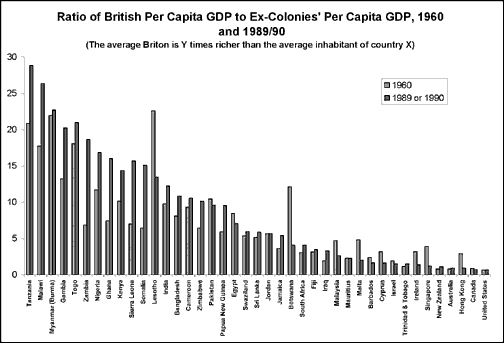
agencies have been more successful. A simple calculation of the ratio of
British per capita GDP to that of forty-one former colonies is instructive.
Between 1960 and 1990 the gap between the British and their former subjects
narrowed in just fourteen cases (see Figure 7).[24]
While it is convenient for contemporary rulers in countries like Zimbabwe
to blame their problems on the “legacy of British rule,” the reality is
that British rule was on balance conducive to economic growth. Tragically,
most post-independence governments have failed to improve on it.
 Figure
7
Figure
7
©Niall
Ferguson 2003
Niall
Ferguson is professor of financial history at New York University’s
Stern Business School and senior research fellow at Jesus College, OxfordUniversity.
His most recent books are
Empire: The Rise and Demise of the British World Order and Its Lessons
for Global Power (Basic Books, 2003) and Empire: How Britain Made
the Modern World (Allen Lane, 2003), the latter of which was published
to coincide with a television history of the British Empire broadcast in
January 2003.
[1]
Lance E. Davis and R.A.
Huttenback,
Mammon
and the Pursuit of Empire: The Political Economy of British Imperialism,
1860-1912 (Cambridge University Press, 1986), 107.
[2]
Patrick K. O’Brien, “Imperialism and the Rise and Decline of the British
Economy, 1688-1989,”
New Left Review 238 (1999): 56, 65f, 75.
[3]
B. R. Tomlinson, “Imperialism and After: The Economy of the Empire on the
Periphery,” in Judith M. Brown and
Wm.Roger
Louis, eds.,
The Oxford
History of the British Empire, vol. IV:
The Twentieth Century (Oxford University Press, 1999), 375.
[4]
Jeffrey D. Sachs and A. M. Warner, “Economic Reform and the Process of
Global Integration,”
Brookings Papers on Economic Activity 1 (1995):
6-10, 35.
[5]
Jeffrey G. Williamson, “Winners and Losers Over Two Centuries of Globalization,”
National Bureau of Economic Research (NBER)
Working Paper 9161
(2002).
[6]For
a discussion, see Michael A. Clemens and Jeffrey G. Williamson, “Where
did British Capital Go? Fundamentals, Failures, and the Lucas Paradox:
1870-1913,”
NBER Working Paper 8028 (2000).
[7]
Clemens and Williamson, “Where did British Foreign Capital Go?”
[8]
Maurice
Obstfeld and Alan M. Taylor, “Globalization
and Capital Markets,”
NBER Working Paper 8846 (2002): 60, figure
10; table 2. However,
Obstfeld and Taylor
follow Michael D.
Bordo in identifying the
spread of the gold standard as the explanation: Maurice
Obstfeld,
and Alan M. Taylor, “Sovereign Risk, Credibility and the Gold Standard:
1870-1913 versus 1925-31,”
NBER Working Paper 9345 (2002).
[9]
Robert J.
Barro, “Determinants of Economic
Growth: A Cross-Country Empirical Study,”
NBER Working Paper 5698
(1996).
[10]David
S.
Landes,
The Wealth and Poverty of
Nations (Norton, 1998), 217f.
[11]
Michael Edelstein, “Imperialism: Cost and Benefit,” in Roderick
Floud
and Donald McCloskey, eds.,
The Economic History of Britain
since 1700, vol. II:
1860-1939, 2nd ed. (Cambridge University
Press, 1994), 205.
[12]Jeffrey
G. Williamson, “Land,
Labor, and Globalization
in the Pre-Industrial Third World,”
NBER Working Paper 7784 (2000).
[13]
The definitive statement is in Michael D.
Bordo
and Hugh
Rockoff, “The Gold Standard as
a ‘Good Housekeeping Seal of Approval,’”
Journal of Economic History
56 (1996), reprinted in
Bordo,
The Gold
Standard and Related Regimes (Cambridge University Press, 1999), 149
-178.
[14]
Michael D.
Bordo and Finn E.
Kydland,
“The Gold Standard as a Commitment Mechanism,” in
TamimBayoumi,
Barry
Eichengreen, and Mark P. Taylor, eds.,
Modern Perspectives on the Gold Standard (Cambridge University Press,
1996), 55
-100.
[15]
P. J. Cain and A. G. Hopkins,
British Imperialism, 1688-2000, 2nd
ed. (Longman, 2001), 439, 570, 584f, 233.
[16]
Cain and
Hopkins,
British
Imperialism, 439, 567.
[17]Mike
Davis,
Late Victorian Holocausts: El Nino Famines and the Making of
the Third World (Verso, 2001).
[18]
See e.g.
TapanRaychaudhuri,
“British Rule in India: An Assessment,” in P. J. Marshall, ed.,
The
Cambridge Illustrated History of the British Empire (Cambridge University
Press, 1996), 361-4; Simon
Schama,
A
History of Britain, vol. III:
The Fate of Empire (Miramax, 2002),
esp. 359-64.
[19]Tirthankar
Roy,
The Economic History of India
, 1857-1947 (
OxfordUniversityPress,
2000), 42ff, 250.
[20]
Angus
Maddison,
The World Economy: A
Millennium Perspective (OECD, 2001), table 2-21b.
[21]Roy,
Economic History, 241, 22, 219f., 254, 285, 294.
[22]Roy,
Economic History, 32-6, 215, 258-263, 46f.
[23]DaronAcemoglu,
Simon Johnson, and James A. Robinson, “Reversal of Fortune: Geography and
Institutions in the Making of the Modern World Income Distribution,”
NBER
Working Paper 8460 (2001): 5.
[24]
They are:
Lesotho,
Pakistan,
Egypt,
Botswana,
Malaysia,
Malta,
Barbados,
Cyprus,
Israel,
Ireland,
Singapore,
Hong
Kong, Canada,
and the
United States:
figures from
Maddison,
World Economy.
Join
the Historical Society and subscribe to Historically Speaking
Beneficial
for Whom?
by
P. J. Marshall
As
is inevitable in any piece of historical writing, Niall Ferguson interprets
the past through the preoccupations of the present. The dominant tendency
in contemporary thinking about the wealth and poverty of nations is that
economic growth can best be assured by: maximizing the free circulation
of trade, capital, and labor; keeping inflation
under control; maintaining proper standards of law and order and financial
and governmental probity; and limiting taxation. All countries should therefore
seek to take their place in a global order dedicated to these principles.
The role of the state in the economy is of necessity a limited one. It
should provide the infrastructure for an open economy, but must avoid damaging
intervention, even if it is aimed at promoting growth. Ferguson
argues that the British Empire from the mid-19th
century generally enforced the principles of the contemporary global order
throughout much of the world. “A striking number of things currently recommended
by economists to developing countries were in fact imposed by British rule.”
Hence the British Empire was on balance a force
for good.
That
the British Empire was in some senses a global
system before “globalization” is not a proposition that will strike historians
as novel. It is, for instance, analyzed at several places in the recent
collection on Globalization in World History, edited by A. G. Hopkins.[1]There
is, however, a long tradition of writing about the economic order maintained
by later 19th-century Britain
in its empire and beyond that sees it as far from a force for good. The
case usually made is that the free trade order was a damagingly unequal
one, stunting the economic, social, and even the political development
of those countries that exchanged primary products for British manufactures.
They became societies of poorly rewarded peasant producers, whose lives
were dominated by landlords and by the great import-export merchants of
the port cities. The free movements of labor
merely meant the transportation of impoverished Indian and Chinese rural laborers
under dire conditions to become semi-slave labor
on plantations or the uprooting from their land
of Africans to be consigned
to the mining compounds of the South African Rand. Moreover, it is often
argued, the British colonial state took so negative a view of its responsibilities
that it utterly failed to mitigate the damage free trade wrought by encouraging
development in any form. What was needed were vigorous “national” governments,
as in the United States, Tsarist Russia, or Japan, capable of building
up an appropriate infrastructure and initiating positive policies to foster
a diverse economy, including industry.
Ferguson’s
case for a relatively benign imperial economic order has
much to commend it, especially if he rests his case on the period from
the mid-19th century to 1914, and thus avoids the depression years of the
1920s and the 1930s. Ferguson
is fond of posing counterfactual, what-if questions. It would certainly
strengthen his case were he to ask what if British capital, British financial
services, the demand of British markets, British technology, and British
skilled personnel had not been diffused throughout the world largely through
the mechanism of empire? Other sources of such things are hard to envisage.
Needless to say, international agencies did not exist. Japanwas,
of course, the great counter-example of a non-European state that could
deal with the world and take what it wanted from international contacts
on its own terms. How many other potential Japans were there, however,
in the later 19th-century world?
The
British imperial economic order assumed specialization of functions and
offered export-led growth in primary products to countries outside Europe.
The British market was an open one, British
shipping greatly cut the cost of transporting bulk commodities over long
distances, British investment enabled railways to be built to move such
commodities to the coast, and capital could be raised in London
for plantations to develop new crops. Export-led growth certainly occurred
in conditions in the later 19th century which were for the most part favorable
to primary producers: the prices that they got for their products generally
held up quite well, while those of the manufactured goods that they imported
tended to fall. The most conspicuous examples of growth, as Ferguson points
out, were what are called the “white dominions” (Canada, Australia, and
New Zealand), whose economies were “the fastest-growing in the world” between
1820 and 1950 and prospered greatly in the later 19th century from exports
of wheat, wool, meat, and dairy products. Farmers of export crops, such
as palm oil in parts of West Africa or wheat,
sugar cane, raw cotton, or jute in Indiaalso
did well. Tea plantations in India
and Ceylondisplaced China
as Britain’s
main supplier.
Even
in 1914, only relatively small parts of tropical Africa
were fully integrated into the British economic order, but India
certainly was, and Indiais
the great test case of the benign or malign effects of that order. Quantification
is extremely difficult, but it seems likely that there was a modest annual
overall growth in average income per head
of perhaps 0.5% throughout the later 19th century. This certainly did not
amount to any sort of transformation of the expectations of the great mass
of Indians. Indeed, large areas were devastated by periodic famines and
the death rate remained horrendously high even in “normal” years when there
were no great epidemics of plague or cholera. The conclusion that the opportunities
for improvement through increased participation in world trade brought
about by British rule were available to too few people seems inescapable.
If
the British government in India
did not actually generate poverty, could it have done more to diffuse wealth?
Should it have intervened more, even in ways that the World Bank and the
International Monetary Fund might not now approve? The government of India
was certainly much more interventionist than governments in Britainever were.
It sponsored huge programs of public works, above all the irrigation schemes
that greatly improved agricultural yields. By the end of the 19th century
the Raj was trying to grapple with the
diseases that afflicted the Indian masses and with the problems of educating
a largely illiterate population. Results were, however, disappointing,
and even Ferguson finds
the government of India’s
efforts wanting. He complains of the “insufficient scale of British interference
in the Indian economy.” “The investments which were needed [in tropical
countries] to overcome geography, climate, and their attendant deleterious
effects on human capital were beyond the imaginings of colonial rulers
schooled in the Gladstonian fiscal tradition.”
In the last resort, however, the constraints were rather more than those
of the Gladstonian fiscal tradition. For
all its undeniably high-minded concern for the well-being of its subjects,
the Raj was still a colonial regime with
such a regime’s priorities. Its own survival was the first priority. Hence
it was not prepared to be as ruthless in extracting wealth from its subjects
and applying it to investment, as, for instance, was the case with Meiji Japan. Defense
expenditure was another priority. India
not only had to provide for its own defense
but also made a substantial contribution to the defense
of the empire as a whole. India’s
role as a market for British exports could not be compromised. Not until
the First World War was India’s
government free to put duties on British imports for revenue or to protect
Indian industry.
The
case for the economic role of national governments free of such colonial
restraints still seems to have some validity, for all the fashionable despair
about the inability of any regime to manage an economy without yielding
to the sectional interests of its supporters or even the kleptomania of
its members. Even 19th-century British imperial history seems to support
the case for autonomous governments. Ferguson
points out that Canada, Australia,
and New Zealand succeeded
in diversifying their economies to the degree that “in terms of the production
of manufactured goods” per head of their
population they “ranked higher than Germany
in 1913.” There were clearly many elements in their success, but the control
over their economies, including tariff policies, which they enjoyed under
what was called “responsible government,” must surely have been one of
them. Those who assert the advantages for Britain
of maintaining a currency that is independent of the Euro are arguing the
case for the autonomy of national governments in economic matters.
Ultimately,
the debates about the beneficence or otherwise of both the British imperial
economic order and the contemporary global system under which economic
practices converge throughout the world seem to hinge on the same question:
of whom are we talking? Already “developed” countries were likely to do
well under both systems. For all its imperfections, the British order may
have been the best path on offer in the later 19th century for countries
with the economic potential of India
and perhaps of some of the Latin American republics. They have taken on
the uncertain role of “tigers” in the contemporary world. Yet poorly endowed
regions could not take advantage of the British offer of export-led growth
at the end of the 19th century and are “marginalized” now. Neither the
British empire nor modern globalization have done much for them; nor
have they for the most part been blessed with effective
national governments that might kick-start them into growth.[2]
Ferguson
also asks the question: was empire beneficent for Britain
itself? His answer is again “yes,” although, understandably in a short
piece, he does not give himself space to support that answer beyond quoting
the calculation that the benefits of “enforcing free trade could have been
anywhere between 1.8 and 6.5% of GNP.” The arguments on the other side
about the burden of defense costs or the
blunting of the competitive edge in British manufacturers who were committed
to “soft” imperial markets perforce remain unanswered. Again the appropriate
question is probably: of whom in Britain
are we talking? Conventional dichotomies between the City (presumed to
be a great beneficiary) and other sectors of the economy that are thought
to have borne the burdens of empire should probably be abandoned, but it
is still worth asking: who gained and who lost? As with the territories
incorporated within the British Empire, there
are likely to have been losers as well as winners from empire in Britain
itself.
P.
J. Marshall is emeritus professor of imperial history at the University
of London. He is editor
of both The
Oxford History of the British Empire, Vol.
II: The Eighteenth Century (Oxford University Press, 1998) and
The Cambridge Illustrated History of the British Empire (CambridgeUniversity
Press, 2001).
[1]
A.G. Hopkins, ed.,
Globalization in World History (Norton, 2002).
[2]
A.G. Hopkins, “Back to the Future: From National History to Imperial History,”
Past and Present 164 (August 1999): 239-240.
Join
the Historical Society and subscribe to Historically Speaking
Colonialism
and Growth
by
Robert E. Lucas, Jr.
During
the forty year period 1950-1990 world population grew at an annual rate
of just under 2%, and total production of goods and services grew at 4%.
This means that production per person grew at more than 2%, implying that
income per person more than doubled over these years. These figures refer
to the entire world, rich and poor alike. I have not left out the communist
countries or Africa or anyone else. Nothing
remotely like this has ever been seen before.[1]
The
remarkable economic growth in the post-colonial period has been a mix of
continued steady growth of the already-rich countries, growth at higher,
catch-up rates by some others, and continued stagnation or worse by some
of the pre-industrial societies that have been left behind. These differences
have attracted a lot of attention from economists. Detailed worldwide data
sets have been created, and patterns have been sought that might reveal
why some societies have thrived in this new economic environment while
others have continued to stagnate. Niall Ferguson’s essay provides a compact,
accurate, and useful account of what these studies of growth rate differences
have found. He concludes that the evidence from this period overwhelmingly
confirms the economic benefits of classical liberal values: free trade,
free markets, and stable, limited government. A large majority of economists
specializing in the study of economic growth would concur in this opinion.
It
would have seemed a natural development of this opening theme if the rest
of Ferguson’s essay had
focused on the British role in developing and exemplifying these liberal
values, but instead he uses it to build a case for a reassessment of British
imperialism. Thus the paper is organized as an attempt to relate
the evidence on comparative economic performance in the post-colonial period
to contributions of the British Empire during
the colonial period itself. I find this an odd way to think of the British
contribution: In common with many British thinkers from Adam Smith onward,
I think of imperialism as almost an opposite of liberalism—a system
based on paternalism and coercion rather than on autonomy and free exchange.
In any event, I do not find the economics of Ferguson’s
defense of imperialism convincing.
The
conclusion of the essay, “that British rule was on balance conducive to
economic growth,” suggests a direct argument that the economic growth of
the successful societies in the post-colonial years can be viewed as a
continuation of their economic performance under the British
Empire. There are also two indirect arguments. One is that
the free trade environment that has been so conducive to economic growth
in the postwar years can be viewed as a resumption,
still only partial, of the British-influenced commercial environment of
the late 19th century, which lasted until 1914. This is the “Anglobalization”
of the title. The second is that British institutions transferred to the
colonies under the Empire have fostered economic success after independence.
These two arguments are complicated and harder to judge; I will discuss
them below as well.
I like
the graphics in Ferguson’s
essay, and offer in return one of my own.[2]
The figure below plots the course of per capita incomes in five parts of
the world since 1750. There are only so many curves that can be put on
one graph, and since I wanted to include everyone in the world, I tried
to group similar societies together. Groups I, III, and IV are countries
largely populated and ruled by Europeans, wherever located, ordered from
most to least successful economically. Group II is Japan—not a group at
all, I know, but Japan's role in the history of the Industrial Revolution
is so singular that I could not bring myself to average it in with anyone
else. These four curves summarize the history of most of the successful
societies of the modern world, and some of the failures.

|

|
The
final curve includes all of Africa and Asia
(except for Japan):
today, more than two-thirds of the world’s population. British
India and Africa are here, along
with the subjects of French, Dutch, German, Portuguese, Spanish, and American
imperialism. So is China,
with its ambiguous role in the colonial age, and those few others that
somehow remained outside the empires of Europe
and Japan.
The striking fact is that these colonial subjects had the same living standards
at the end of the colonial period as they had had two centuries earlier.
The British
Empire shows up in this figure in two places. British-ruled
and largely British-occupied Canada, Australia,
and New Zealand
are included in the top curve, along with the U.S.and
the UK.
The British-ruled and largely non-British occupied colonies of Africa
and Asia are included in the bottom curve.
When Ferguson writes that
“on balance” British rule was conducive to economic growth, he means that
an average of these two per capita income paths (think of Spain)
would be a pretty successful economic history by world standards. Of course,
Ferguson recognizes the distinction between the two types of colonies—he
uses the term “dominions” for colonies settled by British people—but he
does not use it consistently to break the question of evaluating the empire
into its component parts. This leads him to comparisons that seem to me
as irrelevant as calling Algeria
a department of France
and then telling the Algerians they should be happy to be living in such
a prosperous country. I just do not see what historical questions can usefully
be addressed without treating the economics of the dominions and the economics
of the colonies in Africa and Asia
as completely separate and largely unrelated topics.
My
figure does not show the British colonies in Africa
and Asia separately, but doing so would have
added no information: the pre-1950 histories of the economies in these
parts of the world all show living standards that are roughly constant
at perhaps $100 or $200 above subsistence levels. There are no differences
in this regard between colonies and independent nations in this group (Japan,
of course, excepted) or between the subjects
of any one of the European empires or another. Fergusonis
surely right that there is no reason to think that British or other imperialism
caused the economic stagnation shown on the figure: Stagnation at
income levels slightly above subsistence is the state of traditional agricultural
societies anywhere and any time. But neither did the modern imperialisms—the
British included—alter or improve incomes for more than small elites and
some European settlers and administrators.
The
income curve for Africa and Asiain
my figure turns up a bit after 1950. This may not look like much in the
picture—these parts of the world are still very poor by European or American
standards—but it amounted to more than a tripling of incomes. The fact
that living standards for masses of people in these populous, poor societies
finally began to grow after independence is what made possible the high
worldwide growth rates that I quoted at the beginning of this piece. The
main economic event of the late 20th century was this diffusion of the
Industrial Revolution to non-European societies (begun in Japan half a
century earlier), a diffusion that will surely continue throughout the
21st century. A central question is why it did not begin much earlier,
during the colonial period, at the same time that the Industrial Revolution
was spreading throughout Europe.
That
it did not do so is especially surprising and puzzling in view of the developments
that Ferguson calls
“Anglobalization.” There were large scale increases
in the volume of world trade in the 19th century—even by the impressive
standards of the late 20th century—and considerable investment by the British
in the Americas, India, and elsewhere. Ferguson reviews
some of the evidence from this period, and points out that the security
of foreign investment is an advantage of imperialism: British military
power made Indian railroad bonds as safe for British savers as home investments
were. This is important, and India
was surely better off with the British-built railroads than without them,
but somehow investments like these did not lead to anything like the kind
of economic development we have seen in the post-colonial period.
Ferguson
rightly emphasizes the potential importance of the empire in facilitating
trade and capital flows, but does not go on to ask why it was that this
potential was largely unrealized. Why weren’t the factories that are now
changing people’s lives all over Asia(for the
better!) operating in British India or the Dutch
East Indies 100 years earlier? Ferguson and Jeffrey Williamson
may be right that parallels between the world economy now and prior to
1914 justify the use of the common label “globalization” for both periods,
but this terminology should not be allowed to obscure the fact that the
second, post-colonial phase of globalization was associated with unprecedented
growth in the living standards of hundreds of millions of people while
the first, colonial phase was not.
There
remains the possibility that the institutions set up under the British
Empire played a role in fostering the economic growth that
occurred in the successful post-colonial societies. Ferguson cites
a stimulating recent paper by Acemoglu,
Johnson, and Robinson that advances the idea that “societies where colonialism
led to the establishment of good institutions prospered relative to those
where colonialism imposed extractive institutions.” There must be something
to this, but if this idea is to have useful content, we need some way of
identifying “good institutions” other than looking at economic performance. Ferguson
criticizes the Indian “nationalists
who came to power in 1947” for “embarking . . . on a program of sub-Soviet
state-led autarky,” as though the Indian socialists were isolated deviants
from the British liberal, capitalist tradition. But liberalism was dead
in Britain
in 1947, too! Many of the leaders of newly independent India
got their ideas about centralized socialist planning at Cambridge
and the London School of Economics.[3]
There are so many things one can learn from the British, but we shouldn’t
permit them to take credit for the good ones and blame the colonials for
all the bad ones.
The
Industrial Revolution began in Britain,
and British people took it to America
and other parts of the world, appropriating land and other resources as
they came. Vast wealth was created in the process, and if this is what
is meant by British imperialism, then surely no one has ever questioned
its success, from the viewpoint of British people. During the 19th and
early 20th centuries, industrialization spread to
much of Europe and to Japan, under British
influence certainly, but not under British rule. I think the pre-1914 international
trade environment that Ferguson
describes played an important role in this diffusion, and the protectionist
policies of the interwar period retarded it. But in any case the diffusion
that did occur before 1950 was between independent nations, not within
the empires of Europe or, later, Japan. The
economic progress that has come to Asia and Africa
came after the colonial empires were dismantled. This progress has been
mixed, with many mistakes and failed hopes, but it has been real and it
will continue.
The
one glorious exception to these generalizations is the postwar miracle
of the Crown Colony of Hong Kong. This was the product of laissez faire
economic policies introduced by a maverick administration that was
completely out of step with the socialists back home. I would like to call
this the exception that proves the rule. Most remarkably of all, most Hong
Kong residents welcomed the transfer of authority from the
British to the communist Chinese government. Nostalgia for the empire seems
to be a very one-sided emotion.
Nobel
laureate Robert E. Lucas, Jr. is the John Dewey Distinguished Service Professor
of Economics at the University
of Chicago. He is the author
of Lectures
on Economic Growth (HarvardUniversity
Press, 2002).
[1]For
comparison, during the 18th century world population and production both
grew at about 0.33% per year, and average living standards grew not at
all. From 1800 to 1950, when the industrial revolution began to transform
the lives of large numbers of people, population grew at 0.7% and production
at 1.4%, implying per capita income growth of 0.7%. All of these figures
are taken from Tables 5.1 and 5.2 in my Lectures on Economic Growth
(Harvard University Press, 2002).
[2]This
is Figure 5.3 in my Lectures.
“Anglobalization”:
A Conceptual Step Backward
by Andrew Porter
Britain’s
empire these days is high on the list of places for scholarly tourists
to visit. The style of visitation, however, is rarely that of the wandering
scholar. Academic entrepreneurs career around in the manner of the modern
jetsetter, equipped with a concept for all time zones, a laptop for the
storage of nuggets, and a 48-hour stopover permit. Niall Ferguson does
not entirely escape the hazards of such a position. His concept is “globalization,”
than which it is of course difficult to find one wider or more all-embracing.
His laptop is dedicated to the task of generating graphs and bar charts,
dispensing comforting continuities from imperfect or ambiguous contemporary
statistics. And a little more time for reflection might have enabled him
to address some of the further questions provoked by his interesting paper.
Let
us take “globalization” as a starter. How is it to be understood, either
in chronological terms or functionally? His terminology refers to “modern
globalization,” but also to “the previous era of globalization” conventionally
dated we are told to the years 1850-1914. This period may also have been
“the first era of globalization.” His argument, however, also knits the
two together in a single period and process. At different points in the
paper, globalization may be taken to mean either little more than the far-flung
existence of even limited economic activity involving a major power’s (e.g. Britain’s)
nationals, or an active process of territorial integration into a worldwide
market economy. In both cases, “globalization” is apparently a continuing
feature, albeit one, Ferguson
argues, in which the phase 1850-1945 was characterized by the equalization
of incomes. The second half of the 20th century, on the other
hand, witnessed mounting economic divergence and inequality.
There is a fuzziness here in the handling of globalization—whether as concept,
descriptive category, or economic process—that needs to be cleared away.
This
need for clarity is further indicated by Ferguson’s
lack of attention to the possibility that globalization, however it is
defined, may have had a history stretching back well before 1850. There
is much in the history of the 17th and 18th centuries to support the view
that a process of globalization was then underway. Doubtless the balance
of power and wealth among (and so the contribution made by) participating
states was different then from that which developed later on; and “globalization”
had perhaps not yet become global in its reach. It may be debated whether
there was a distinctly “early modern globalization,” or merely an earlier
phase of a single process. It is more important, however, to recognize
that the prominence of war and economic protection or monopolization meant
that the characteristics of that earlier age were very different from those
that Ferguson suggests
operated during the British-dominated phase of globalization after 1850.
If
it is accepted that there was an early modern globalization underway well
before the French Revolutionary and Napoleonic wars; that its momentum
owed much to war both internationally and on local colonial frontiers;
and that the prominent role of Britain in the Caribbean, North America,
and parts of Asia means that it too deserves the ghastly appellation of
“Anglobalization,” then this has implications for Ferguson’s portrayal
of the post-1850 period. From then on Ferguson
seems to allow that the global accumulation of wealth was promoted only
by an increasing absence of restraint on the movement of people (labor
migration), the flow of capital (external investment), and produce from
land (overseas commerce). This argument is unpersuasive because it ignores
the role of war, economic protection, and strategic calculation—persisting
from that earlier period—in the continuing growth of a global economy. Britain’s
many colonial wars in the 19th century and beyond were an essential aid
to the incorporation of new territories into her own empire, and to the
expansion of free trade both within her colonies and into areas beyond
the reach of her direct rule. Furthermore, in Ferguson’s
contemporary age of “modern globalization,” echoes of the early modern
period are to be found in the way in which world economic patterns are
being decisively shaped by the protectionist agenda of the United
States and many other European countries,
notably in respect of their domestic agriculture.
This
last observation directs us not only to the compatibility of continuing
globalization with partially-closed economies, but also to the limitations
of free trade arrangements historically associated with the pursuit of
an open global economy. Contrary to much current thinking, Ferguson
wishes us to accept that the priority attached by Britain
to free trade, free labor migration, and unfettered capital movements was
beneficial to Britain
itself, to her empire, and to the world at large. The extension of her
empire not least contributed to the global growth of GDP, because Britain
was the “least protectionist” of all the great powers. By this yardstick,
the British Empire was “a good thing,” British
rule “on balance conducive to economic growth.” I would argue that this
simple standard requires a more critical consideration than it receives
in Ferguson’s essay.
Two
points are fundamental. First, it is surely necessary to bear in mind that
the pattern of free trade, particularly in the form of unlimited exchange
of foodstuffs and raw materials for manufactured capital and consumer goods,
generally operates over any significant period of time to the decided disadvantage
of commodity producers. Free trade might have been one of the pillars of
“Anglobalization,” but at the same time it was likely to restrict and impoverish
the less economically “modernized” party. The second follows from that:
free trade cannot necessarily be equated with freedom of choice and opportunity.
The time at which any territory is drawn through the opening up of its
trade into the globalizing economy can have a critical impact on its future
development. The great variety of combinations of climate, geographical
position, and natural endowment of resources inevitably means that each
territory may be more or less well placed to find its own niche in the
range of economic openings prevailing at any one time. Hence, as Donald
Denoon demonstrated in his Settler Capitalism (1983), temperate
lands of white settlement, faced with exclusion from industrial and manufacturing
options, not only evolved their own forms of capitalism but did so largely
irrespective of their colonial or independent status. Moreover, their contribution
to the globalization process was evidently compatible with a distribution
of any gains within individual states that was often very far from equalizing
incomes. Fergusonis to
be applauded for his realism in calling
on historians to consider not ideal worlds but inescapably imperfect worlds
in which the option of “Anglobalization” was if not the best then perhaps
the least bad course available. However, the reality of the imperialism
of free trade which underlay that option was far more constraining and
less benign than Ferguson,
at least here, seems to acknowledge. It was, of course, greatly to Britain’s
own advantage as the world’s major industrial power for much of the 19th
century that she should insist on the expansion of free trade while at
the same time facing little serious competition in the new markets she
was exploiting.
My
last comment relates still more directly to the issue of costs and benefits.
As befits any public performer, Ferguson
is fond of catching his audience’s attention with striking juxtapositions
of images and arguments. Stark intellectual polarities, however, can be
snares and delusions, especially in the history of empire, so riddled as
it is with complexities and ambiguity. In seeking to argue that the empire
was not “economically bad for both Britain
and her colonies,” Ferguson
sets up an Aunt Sally no less grand and vulnerable than that constructed
by some of the historians he criticizes.
Consider
his reference to Robert Huttenback and Lance Davis’s Mammon
and the Pursuit of Empire, a book extensively debated when it appeared
in 1986. Whatever the problems presented by that work (and they were numerous),
Davis and Huttenback did not make quite the bald claim for Britain’s
losses and colonial benefits from empire that Ferguson’s
compressed opening paragraph suggests. They confirmed above all the need
to ask of imperial commitments and colonial possessions who benefited,
from what, and when. In demonstrating that fortunately placed individuals,
particular social classes, and identifiable types of business in both metropole
and colonies gained or lost in varying degrees and at different times,
they argued convincingly for a more discriminating and nuanced scrutiny
of the empire’s political economy than was currently available. They also
proved beyond doubt the centrality of the incidence of taxation and the
costs of defense to any assessment of costs and benefits. Ferguson seems
in effect to argue that the association of global economic growth with
both the element of redistribution inherent in the workings of a free market
system and the existence of Britain’s free trade empire was sufficient—as
Lewis Carroll would put it—for all to have prizes. That surely represents
a significant retreat from the ground so usefully opened up to debate some
fifteen years ago.
Andrew
Porter is Rhodes Professor of Imperial History at King’s
College, London . He is
editor of The
Oxford History of the British Empire: The Nineteenth
Century (Oxford University Press, 1999; 2001).
Join
the Historical Society and subscribe to Historically Speaking
Does
Empire Pay?
by Andrew
J. Bacevich
Niall
Ferguson advances “at least a prima facie case that the British
Empire was economically beneficial, not only to Britain
herself, but also to her empire—perhaps even to the world economy as a
whole.” For the most part, that is, “Anglobalization” paid, producing results
that “were in many ways astounding.” Where results fell short of that standard,
the culprit was insufficient exertion. Britain’s
imperial sins were those of “omission rather than commission.” Indeed,
when, the sun finally set on Britain
’s empire, independence in all too many cases left the Crown’s former subjects
worse off.
In
offering this argument at this particular moment, Ferguson
adds his voice—knowingly, one assumes—to a swelling chorus heard throughout
much of the Anglo-American world. Already discernible before the terrorist
attack of September 11, these voices have become altogether insistent since.
Empire, they argue, has gotten something of a bum rap. Indeed, if a planet
awash with religious fanatics and rogue regimes is to have any hope of
enjoying order and predictability—and by extension, prosperity and civility—a
little dose of empire might be just what the doctor ordered.
Among
those former colonials who were the very first to throw off British rule,
this idea has met with growing favor. In public discourse, a preference
for rhetorical evasions persists—“global leadership” being the euphemism
of choice—but the truth is that especially since September 11 more and
more Americans have warmed to the notion that as the sole remaining superpower
the United States ought to call the shots.
In
words and actions, the present Bush administration has with alacrity seized
upon this imperial moment. The administration’s National Security Strategy,
published precisely one year into the so-called war on terror, offered
a breathtaking assertion of American primacy. More telling still, the battle
dress-clad legionnaires sweeping into such formerly British imperial precincts
as Central Asia and the Persian Gulf—and settling in for what promises
to be a protracted stay—testify in ways both symbolic and real to this
administration’s willingness to don the mantle of empire. Although
not quite willing to say so out loud, Washington and Wall Street have laid
claim to the prerogatives once reserved for London
and its City.
A new
variant of globalization, informed by American values and American aspirations,
has emerged, a successor of sorts to the Anglobalization that made life
in the late 19th and early 20th centuries comparatively tolerable. Noting
the resemblance between today’s Washington
consensus and the Londonconsensus
of that earlier age, Ferguson
finds hopeful similarities between the two projects. When it comes to economic
and political ground rules, the United
Statesarguably stands today as the true
successor of Great Britain
in its imperial heyday.
Implied
but not stated is the suggestion that by following the wise example of
their cousins across the pond, the architects of today’s American Empire
just might manage to create a global imperium approaching Britain’s in
durability and (by Ferguson’s measure) decency, to the benefit of all.
A nice
thought but don’t count on it—at least not without Americans having to
pay a helluva price.
Ferguson’s
empire is a business proposition, its success measured in terms of capital
flows, advances in per capita GDP, and the anticipated vs. actual return
on government bonds. In that empire, the practitioner of “gentlemanly capitalism”
occupies center stage. (Rudyard Kipling, T. E. Lawrence, and Winston Churchill,
meanwhile, are nowhere to be seen). It is an empire devoid of grandeur
and, seemingly, of moral purpose.
To
be sure, the American Empire is also a business proposition. But
it is not only just that. When any modern president describes America’s
purpose—and here George W. Bush differs little from his immediate (and
now all but forgotten) predecessor—he speaks the language not of the corporate
CEO or accountant but of the prophet and revolutionary. It is not gentlemanly
capitalism that informs the American Empire but a conviction that providence
has charged America
with the salvation of the world. The patron saint of the American Empire
is not J. P. Morgan; it is Woodrow Wilson.
Do
sophisticated, worldly American statesmen—people like Cheney, Powell, and
Rumsfeld—really believe all of the Wilsonian blather about democracy, freedom,
and world peace that routinely washes across the top of the bully pulpit?
Maybe, maybe not. But in either case they can’t stop pretending that they
do, and that’s what counts. The continuing legitimacy of the empire prohibits
them (and us) from admitting any doubts about America
’s responsibility (and capacity) to steer history
to its intended destination.
As
a consequence, in the Age of Bush empire demands of its subjects much more
than it did in the Age of Victoria. It is not simply a matter of trade
balances and gold reserves. It is about ideology and culture. Come, be
like us: this is America
’s message to the world—sometimes an invitation, at other times a command.
In this empire, the ultimate proof of loyalty is not obedience but conformity,
a willing embrace of that package of values and taste and lifestyle known
as the American Way
of Life.
That
in some quarters—most notably at present across much of the Islamic world—this
expectation evokes antagonism and resistance is to put things mildly. Thus,
the future of the American Empire promises to be a bloody one—indeed, the
leaders of the Bush administration promise that we face many years of apparently
unavoidable armed struggle.
Few
subjects demand more careful thought today than the prospects and problems
awaiting America
s experiment in global empire. History may well hold some useful lesson
for how best to guide the great enterprise
to which the United States
has committed itself. But the British Empire—at
least as depicted by Ferguson
in this essay—seems unlikely to provide a useful model.
In
the meantime (at least if the present administration has its way), we will
not shirk our duty. If we fail, it will not be due to sins of omission.
Rather, adhering to the tradition of Woodrow Wilson, we will get on with
teaching others—Arabs, this time—to elect good men, at the point of a bayonet
if need be.
Andrew
J. Bacevich is professor of international relations at BostonUniversity
and director of that institution’s Center for International Relations.
His most recent book is American
Empire: The Realities and Consequences of U. S. Diplomacy (HarvardUniversity
Press, 2002).
Join
the Historical Society and subscribe to Historically Speaking
Globalization
without Gunboats?
by
Niall Ferguson
In
November 2002 British foreign secretary Jack Straw made some remarks to
the New Statesman magazine which seem
apposite here:
I’m
not a liberal imperialist. There’s a lot wrong with liberalism, with a
capital L, although I am a liberal with a small L. And there’s a lot wrong
with imperialism. A lot of the problems we are having
to deal with now are a consequence of our colonial past.
Reading
the comments on my essay by Andrew J. Bacevich,
Robert E. Lucas, Jr., P.J. Marshall, and Andrew
Porter, I was sometimes reminded of Straw’s words. His
misunderstanding of Britain’s
imperial legacy is, of course, absurdly crude. Yet at least two of the
commentators’ criticisms seem to be based on the same underlying assumption
that there was, from a liberal standpoint, a “lot wrong” with the British
Empire.
Central
to my argument is that there was such a thing as liberal imperialism and
that on balance it was a good thing. From the 1850s until the 1930s the
British approach to governing their sprawling global imperium
was fundamentally liberal both in theory and in practice. Free trade, free
capital movements, and free migration were fostered. The rule of law was
institutionalized. Colonial government practiced the strict rules of Gladstonian
fiscal and monetary policy: balanced budgets and a stable currency. This
policy “mix” encouraged British investors to put a substantial portion
of their capital in what we would now call emerging markets. New technologies
like railways and steam power were therefore spread across the world, reaching
countries they would not have reached had those countries been self-governing
or under some other less liberal form of imperial rule. The results of
liberal imperialism were mixed, to be sure. Not everywhere grew as rapidly
as the colonies of white settlement. But even those countries (like India)
that achieved only very slow increases in per capita income fared better
than they would have fared under alternative regimes.
In
short, Peter Marshall is right to
infer from the essay a counterfactual question: “What if British capital,
British financial services, the demand of British markets, British technology,
and British skilled personnel had not been diffused throughout the
world largely through the mechanism of empire?” I have little doubt that
the global economy would have grown less rapidly in such an alternative
19th century. I certainly do not think it plausible that these things would
have happened on the same scale without the “mechanism” of empire. And
yes, as Porter says, that mechanism did indeed rely on “war” and “strategic
calculation” to promote the growth of a “global economy.” This was, as
I have written elsewhere, “globalization with gunboats.”[1]
Political Independence
and Economic Growth
Robert
E. Lucas, Jr. admits that “in common with
many British thinkers from Adam Smith onward” he “think[s] of imperialism
as almost an opposite of liberalism.” This was certainly true in Adam Smith’s
day, when the empire was thoroughly mercantilist in its policies.[2]
Less than a century later, however, Smith’s Wealth of Nations had
been enshrined as one of the sacred texts of Victorian liberalism. Policy
makers took it for granted that laissez faire was superior to state
intervention and monopoly. This was not true in other European empires,
which from the late 1870s onward steadily increased the level of both agricultural
and industrial protectionism. In failing to make this distinction, Lucas
errs.
He
further errs when he imputes to me the argument that “the economic growth
of the successful societies in the post-colonial years can be viewed as
a continuation of their economic performance under the British
Empire.” This is the very reverse of what I say. By comparing
the economic performance of Britain’s former colonies before and after
British rule, I show that a majority—27 out of 41—fared worse under independence
than they had fared under British rule, in that the economic gap between
Britain and them widened after the 1960s. Because he uses highly aggregated
data in assessing the economic performance of Africa
and Asia, Lucas fails to distinguish between
the economic performance of British colonies and those of other empires,
to say nothing of China
. To say that “these colonial subjects had the same living standards at
the end of the colonial period as they had had two centuries later” is
therefore to miss the point that (for example) in South Africa they rose
while in the Congo they collapsed, or that in India they held steady while
in China they declined.
Lucas
insists that the real distinction to be made is between “the economics
of the dominions and the economics of the colonies of Africa
and Asia.” But the real distinction we need
to consider is that between British colonies and comparable economies in Asia
and Africa that had different forms of government.
My question remains unanswered: given that the British imposed superior
economic institutions wherever they ruled, did it make a discernible
difference? Such questions are not easy to answer when the data for 19th-century Africa
and Asia are so patchy. But Lucas’s ballpark
figures certainly do not help us.
For
that reason, his claim that the diffusion of the industrial revolution
“was between independent nations, not within the empires of Europe”
is a generalization too far. India
acquired an immense railway network, coal mines, and a modern textile industry
under British rule. South Africa
did the same. Where the prerequisites for industrialization were present
in the territories under British rule, it was encouraged not hindered (with
one caveat, which follows). The implication—that India would have performed
as well as Japan had it remained independent—is not plausible, because
it does not compare like with like. When P.J. Marshall talks enthusiastically
of “vigorous ‘national’ governments, as in the United
States, Tsarist Russia, or Japan,”
he is not offering credible role models for the great majority of British
colonies. Indeed, when many former colonies self-consciously sought to
follow the Russian example in the 1960s, the results were dire.
Lucas
claims that “living standards for masses of people in these populous, poor
societies finally began to grow after independence.” As a global generalization
this seems uncontroversial, but once again it does not make any distinction
between British colonies and other economies. It is also somewhat cavalier
with chronology. To repeat: most British colonies—especially those in Africa—lagged
further behind Britain
after independence. Among the minority that closed the gap, India
began to do so only in 1979 (see chart below). The “economic development”
of the “post-colonial period” largely refers to the very recent past, when
governments like India’s
abandoned the unsuccessful protectionism and socialism of the post-independence
period. As Lucas rightly says, the Indians and others got the ideas for
some of these policies from Britain,
but not (he omits to mention) from the British imperialists. The ritish
Empire can be blamed for many things, but surely not the London
School of Economics.
The
Imperialism of Free Trade versus Tariffs
The
most important criticism advanced—not surprisingly by the two experts in
the field—relates to the role of tariffs. Here there is an important distinction
to be drawn and it is one that I discuss more fully in my book than was
possible in the allotted space here. This is the distinction between those
colonies which secured, through the granting of “responsible government,”
the right to set their own tariffs. Canada
did so in 1879, an example soon followed by Australia
and New Zealand.
Recent work on the late 19th and early 20th century by Jeff Williamson
and Michael Clement has shown that there was a positive correlation—an
apparently awkward one for the proponents of unconditional economic “openness”—between
the imposition of tariffs and growth.[3]
This has important implications for any economic history of the British
Empire. If Canada
and the other dominions benefited from protection, then the question becomes:
would India
have done better with tariffs? That is certainly the implication of P.J.
Marshall’s assertion that “the free trade order was a damagingly unequal
one, stunting the economic, social, and even the political development
of those countries that exchanged primary products for British manufactures”;
and Andrew Porter’s even more sweeping
claim that “free trade . . . generally operates over any significant period
of time to the decided disadvantage of commodity producers.”
Yet
there is a difficulty with this line of argument. First, as Douglas Irwin
has pointed out, the tariffs imposed by Canada
and others were revenue tariffs, not protectionist tariffs. Canadian growth
came from exports of agricultural products, not import substitution by
domestic manufacturers.[4]
Second, the argument ignores the far more damaging effects of unfree
trade on primary producers during the 1930s. The Depression was hard on
everyone, but harder on primary producers outside the system of imperial
preference than inside it. Porter’s generalized argument against free trade—
which is explicitly repudiated by Clemens and Williamson—also ignores the
continuing harm inflicted on primary producers today by European Union
tariffs and subsidies. Finally, it is to lapse into the economically inexact
rhetoric of an earlier anti-imperialist era to claim that Britain “insisted
on the expansion of free trade while at the same time facing little serious
competition in the new markets she was exploiting.” The evidence that imperial
markets were open to and were successfully penetrated by German firms in
the late 19th century is well known and often adduced as proof of British
entrepreneurial decline.
The
Distribution of Costs and Benefits
Three
out of four commentators argue that the benefits of British imperialism
were unevenly distributed. Only “small elites and some European settlers
and administrators” gained, while much more numerous peasant cultivators
did not (Lucas). I am, of course, well aware of the arguments advanced
by Davis and Huttenback, particularly their
point that the lion’s share of the financial returns on empire flowed to
a tiny group of politically influential investors. As the author of the
history of perhaps the greatest of all the financial houses interested
in the empire—the Rothschild bank[5]—I
think I can claim to have contributed important evidence in support of
that point. However, Lucas’s own data relate to per capita income growth
and tell us nothing about the relative gains made by the rich and the poor,
then or now. If the world economy grows, then at least all may have
prizes. But if it does not, then there are no prizes for anyone.
In
fact, there is good reason to question his assumption that the empire as
a whole increased inequality. To speak of “some European settlers” is to
underestimate the many millions of such beneficiaries. The effect of mass
migration to land rich, labor poor colonies
like Canada
, Australia,
and New Zealand
was, as Jeffrey Williamson has argued, to reduce global inequality.[6]
It is also possible (and the British certainly believed) that their rule
in India
tended to reduce social inequality.[7]
Lessons
of History?
A
final point worth making is that my essay has very different implications
for the United States
in our own time than the two American authors seem to recognize. Strikingly,
Lucas leaves out of his account of post-1945 economic growth any acknowledgement
that this was due in some measure to America
’s “imperialism of free trade.” Like many economists, he assumes that the
rapid growth of trade after the Second World War was naturally occurring,
whereas historians would tend to emphasize the “hegemonic” role of successive U.S.
administrations, who had learned the lesson
of the 1930s and committed themselves to trade liberalization as a policy
goal.
Even
more puzzling is Andrew Bacevich’s allegation
that the empire I portray was “an empire devoid of grandeur and, seemingly,
of moral purpose.” If he wishes to be reminded of the share scale of the
undertaking and the crucial role of evangelical Christianity in providing
its rationale, he need look no further than
my book. Kipling, Lawrence, and Churchill are all there.
Andrew
Bacevich thinks that the American Empire is informed not by “gentlemanly
capitalism” but by “a conviction that providence has charged American with
the salvation of the world,” and that therefore “in the Age of Bush empire
demands of its subjects much more than it did in the Age of Victoria.”
For this reason, he concludes, “the British Empire
. . . seems unlikely to provide a useful model.” This is quite wrong. Britain
in the early 1820s was in the grip of one of the greatest religious revivals
in her history. The evangelical
movement played a crucial role in legitimizing and inspiring British expansion
in mid-19th century. To any student of the Victorian empire, the mood of
pious bellicosity which hangs over the White House at the time of writing
is all too familiar.
The
true difference between then and now lies in the very short time horizon
of nearly all America
’s quasi-imperial undertakings. The American view, paraphrased by Bacevich,
is that “others” can be “taught to elect good men, at the point of a bayonet
if need be,” allowing American troops to return home swiftly from the scenes
of their interventions. President Bush insists that it is not his intention
to “determin[e] the precise form of Iraq
’s new government”:
We
will remain in Iraq
as long as necessary and not a day more. America
has made and kept this kind of commitment before in the peace that followed
a world war. After defeating enemies, we did not leave behind occupying
armies, we left constitutions and parliaments.
The United
States, in short, forswears the traditional
techniques of imperial rule and instead anticipates swift transitions to
democracy in the wake of its military interventions.
To
American voters, this is no doubt reassuring. To the historian, however,
it seems unrealistic. The problem of our time, I venture to conclude, may
prove to be not the liberal imperialism feared by Jack Straw but the conservative
“non-imperialism” propagated by George W. Bush.
[1]Niall
Ferguson,
Empire: The Rise and Demise of the British World Order and
the Lessons for Global Power (Basic Books, 2003).
[2]Andrew
Porter makes the claim that “a process of globalization”
was already underway in the 17th and 18th centuries. This is not borne
out by empirical studies of price and wage convergence. See Kevin H. O’Rourke
and Jeffrey G. Williamson, “When did Globalization Begin?”
NBER
Working Paper 7632 (2000). The “fuzziness” about globalization
is in Porter’s definition, not mine.
[3]
Michael A. Clemens and Jeffrey G. Williamson, “A Tariff-Growth Paradox?
Protection's Impact the World Around 1875-1997,”
NBER Working Paper
8459 (2001).
[4]
Douglas A. Irwin, “Interpreting the Tariff-Growth Correlation of the Late
Nineteenth Century.”
NBER Working Paper 8739
(2002).
[5]
Niall Ferguson,
The World’s Banker: The
History of the House of Rothschild (
Weidenfeld
and Nicholson, 1998).
[6]
Jeffrey G. Williamson, “Winners and Losers
Over
Two Centuries of Globalization,”
NBER Working Paper 9161 (2002);
idem, “Land, Labor and Globalization in the Pre-Industrial Third World,”
NBER Working Paper 7784 (2000).
[7]
Angus
Maddison,
The World Economy: A
Millennium Perspective (OECD, 2001), 110f.
END
OF FORUM
Join
the Historical Society and subscribe to Historically Speaking
Historically
Speaking: The Bulletin of the Historical Society
April
2003
Interview
with David Brooks
conducted
by Joseph S. Lucas
David
Brooks, author of Bobos
in Paradise: The New Upper Class and How They
Got There (Simon and Schuster, 2000) and editor of the anthology
Backward and Upward: The New Conservative Writing (Vintage Books, 1996),
is working on a book called How to Be American (forthcoming from
Simon and Schuster). His essays on American culture and politics
have appeared in a wide variety of publications, including the Weekly
Standard, the New Yorker, the New York Times Magazine,
the Atlantic Monthly, Forbes, the Washington
Post, the TLS, Commentary, and the Public Interest.
Joseph
Lucas: When you were in college, at the University
of Chicago, you planned
to become an academic historian. What got you interested in history? Did
you have an idea back then of what you would write about once you became
a history professor?
David
Brooks: I
grew up in an academic household. My father was an English professor who
worked at New YorkUniversity
and then WestchesterUniversity
teaching mostly 19th-century English literature. And my mother wrote her
history dissertation at ColumbiaUniversity—on
Wimbledon Common—and then went on to teach Western Civ.
as a traveling, starving professor. So history was basically something
I grew up with. It was normal for me to want to become a history professor.
It was the family business.
I
became interested in American history, particularly late 19th- and early
20th-century technological history, and social and cultural history. One
of my professors at the University of Chicago
was Neil Harris. He was my senior paper advisor, and I took a number of
courses from him on the effects of technology and other things on culture.
Even
at an early age I fixated on the books of the late 1950s and early 1960s—Leo
Marx’s The Machine in the Garden (1964), William Taylor’s Cavalier
and Yankee (1961), Cesar Graña’s
Bohemian versus Bourgeois (1964), and the books that came from that
American historical tradition of Richard Hofstadter and Henry Steele Commager.
Those were the books I liked the most.
Lucas:
Do you still like those books?
Brooks:
Absolutely. I go back to those books all the time. I’m writing a book
now that’s sort of an updated version of David Potter’s People of Plenty
(1954). In the 1950s historical writing was more for the general public—sometimes
a little too broad, maybe, but usually more interesting than the stuff
that came before and after.
Lucas: At
that time, historians were in the habit of taking on big themes. They didn’t
hesitate to conceive of and then tackle subjects like “the history of the
American mind.”
Brooks:
My favorite example is Reinhold Neibuhr’s
The Nature and Destiny of Man, which I always say covers a lot of
ground. I admire the serious scholarship of that era—on Neibuhr’s
part or Commager’s (his book The American
Mind). But there was also a willingness to generalize and the understanding
that you were writing for the educated lay reader.
Lucas:
What do you think has changed since then?
Brooks:
I would say professionalization and
scientism are the two main culprits. I didn’t become an academic in part
because I didn’t want to write for journals whose readers numbered only
in the single digits.
When
I was a senior in college I went to a conference which was put on by the Chicago
literary magazine Triquarterly.
Lots of academic all-stars were there, mainly from literary studies, but
not exclusively: Wayne Booth, Edward Said, RonaldDworkin.
There were about fifteen or twenty superstars, very impressive people.
I sat there for twenty-two hours, and I barely understood a word they said.
I wrote in the school paper that maybe this language is useful, and I could
go to graduate school and learn it. But suppose it turns out to be a racket?
Then I’ll have wasted ten years, and then I’ll have to unlearn what I’ve
learned. So I ended up not going to graduate school, and went into journalism
instead.
Lucas:
Yet it’s clear from your writing that you keep tabs on what academics are
up to.
Brooks:
I look at the catalogues of academic presses, and I spend a lot of
time cruising the better bookstores. When
Lingua Franca was around, they would have people in the field describing
what they thought were the best books in the field, and you could pick
up a few of those if you were interested.
I
need to keep in touch with the world of scholarship for the sort of reporting
I do. Every reporter needs to bring something to the table. Some people
bring the fact that they’ve just gotten off the phone with somebody who
was at a meeting with the president. I don’t do that sort of reporting,
so I try to bring the world of ideas to bear on modern politics and modern
events. I just went down to Nashville
to look into Bill Frist’s background, and
I needed to find books about either Nashville
or the South, or the “southern mind.”
Lucas:
What did you read to prepare for the Nashville
trip?
Brooks:
I read John Egerton’s The
Americanization of Dixie. I went back and read a book I mentioned already,
Cavalier and Yankee, which is a favorite of mine. It’s about the
cavalier mentality of the Confederacy and its anti-commercial feeling.
I have a reasonable knowledge of the Southern Agrarians—I’ll Take My
Stand was assigned to me in college.
I
just wrote a piece about why Americans lack class consciousness. There
you can go back to Seymour Martin Lipset
and his writings on American exceptionalism.
Or you can go further back to Puritanism. One of the writers I often turn
to is SacvanBercovitch
(named after Sacco and Vanzetti).
His description of the eschatological framework of the Puritan mind is
something I find very applicable to a lot of current public policy debates.
Lucas:
So you believe that ideas from the colonial period still inform American
culture?
Brooks:
Why does George Bush—who, as he said during the campaign, has no interest
in nation-building, who doesn’t have a great interest in history and probably
hasn’t read too many books—react to September
11 in such an overtly moralistic way? I’d say it’s because he subconsciously
has inherited certain ideas about what America
should be and certain religious impulses. And those ideas and impulses
are deep and longstanding, as many historians have described them.
Lucas:
Are these the kind of ideas you write about in your forthcoming book, How
to Be American?
Brooks:
Essentially the question of the book is: if you drive around your basic
fast-growing suburb in America
, are these people as shallow as they look? I hope to show that while there
are many excesses of materialism and shallowness and complacency, the ideas
that, say, Bercovitch talks about, and
some of the nobler impulses that Lincoln and Teddy Roosevelt talked about,
are still alive, if submerged, in these people.
Lucas:
You started your first book, Bobos in
Paradise: The New Upper Class and How They Got There, by writing about
the changes you noticed in America when you got back from Europe after
working there for several years for the Wall Street Journal. You’ve
written elsewhere about the differences between Europeans and Americans.
These are differences you’ve experienced first-hand.
Brooks:
I
left America
a big Europhile, and came back still admiring Europebut
feeling much more estranged from it than before I lived there. My two turtles
when I was a boy were named Disraeli and Gladstone. My family was Anglophilic,
very much in the “think Yiddish act British” style of New York Jewry. When
I lived in Brussels for
four and a half years I came to see that the mentality really is very different.
I felt more like a stranger there than I expected to.
Lucas:
In “Among the Bourgeoisophobes: Why the
Europeans and Arabs, Each in Their Own Way, HateAmerica
and Israel
,” Weekly Standard (April
15, 2002), you argue that an anti-bourgeois ethos shapes elite
Europeans’ ideas about America
. Is this a vestige of the aristocratic disdain for ordinary people?
Brooks:
There is definitely a different attitude toward democracy. I would
get invited to these conferences at a place called Ditchley
Park, which is in Oxfordshire
where Churchill spent part of World War II. In attendance were elite diplomats
from across Europe, academics and foreign policy
people from the States, and a few journalists. You would hear from the
European diplomats—and there were also former prime ministers and cabinet
ministers—anti-democratic attitudes that you just wouldn’t hear in America
, uttered publicly at least. The idea that we can never let the people
know about this, we can’t let them vote on this because they’ll get it
all wrong. Those are attitudes that I think are prevalent in Europe
and just not found in the United States.
Europeans
have more sophisticated public discussions. And frankly a lot of Europeans,
particularly the French, write the sort of books I like. Scholars there
are less professionalized and what they write is read by the general public.
But
I came away thinking—and maybe this was just Belgium—that Francis
Fukuyama’s “last man” really was to be found in northern Europe; complacent,
flat, comfort-oriented lives—not enough work.
Lucas:
Since Bobos in Paradise [which argues
that the American elite of the 1990s successfully merged two sets of values
that have historically been at odds: bourgeois and bohemian—hence, “bobo”]
you’ve continued to write about the American bourgeoisie, and also its
enemies. I’m thinking of “Among the Bourgeoisophobes,”
and also “Patio Man and the Sprawl People:America’s
Newest Suburbs,” Weekly Standard (August
12-19, 2002) and “One Nation, Slightly
Divisible,”Atlantic Monthly (December 2001). Why is it that Bobos
don’t figure very largely in these essays?
Brooks:
I’m sick of them. While promoting the book, actually, I found myself
in places like Scottsdale, Arizona,
where golf is far more important as a cultural influence than universities.
I remember being in Piffin, Ohio,
a rural town where a lot of the things I was writing about didn’t touch
these people at all. I sort of knew this already, but I came to see more
vividly that the slice of America
I wrote about in Bobos, the coastal,
upper-middle class suburb, is an influential but small part of America. And
so since then I’ve tried to do more reporting from rural America,
exurban America,
and in Nashville,
where I just came back from, pretty well-preserved Protestant establishment America,
with white-tie balls and country clubs, and rich people who’ve been rich
for four generations.
I’ve
become incredibly impatient with people who don’t know about these parts
of America (which was me only five years ago)—people who don’t know what
Pentecostalism is, or don’t know who Tim LaHaye
is (whose books have sold 42 million copies). It seems to me you have a
responsibility to know your own country.
Lucas:
Do you think that these neglected parts of America
have closer ties to the country’s cultural roots?
Brooks:
All the country’s regions have ties to America
’s many different traditions. But if you use the phrase “middle
America,” you’re talking about the people who live in rural
areas and exurbs. And exurban America
is interesting because it’s growing. One of the things that intrigues
me is that in the 1990s 90% of the offices that were built in this country
were built in exurbs. Whereas in 1979 the vast majority—I think 80%—of
the office space in America
was in cities. Now it’s almost 50/50. So you have a whole new crowd of
people who don’t commute to cities, don’t go to dinner in cities, don’t
have any contact with urban life. They live in these fast-growing exurbs,
and it’s interesting to know what they’re all about.
Lucas:
Do you think these people are more capable than Bobos
of articulating and defending American values?
Brooks:
No, they’re much less capable. They don’t read as much; they don’t
listen to NPR; they don’t even watch PBS. The paradox of their lives is
that they seek out the pleasures of private life, but because they work
so hard and create so many companies and jobs and products, they
account for the U.S. economy being so dominant in the world, and therefore
arousing hatred, envy, resentment—all sorts of feelings—from people around
the world. So while they seek out just private satisfaction, America
’s position in the world means that they’re inescapably drawn to foreign
conflicts, as we learned on September
11, 2001. So they get woken up and dragged into politics, which
they desperately want to avoid. They’re not inclined or trained or interested
in—I’m speaking generally, of course—the wars of ideas and debates about
the future of the country.
Lucas:
You mentioned Francis Fukuyama. Since September 11, 2001, intellectuals
have waged a modern battle of the books, pitting Fukuyama’s The End
of History and the Last Man against Samuel Huntington’s The Clash
of Civilizations and the Remaking of the World Order. What do you make
of this?
Brooks:
I used to be a firm Fukuyaman. I was
the only person in America,
aside from him maybe, who would go around
saying his book was absolutely right. The second part of the book is about
“the last man,” which as I said is who I found in Brussels. Fukuyama’s
intellectual guru, AlexandreKojève,
moved to Brusselswhen
he decided history was over, which was an act of integrity, if boringness.
Now
I’m a little less convinced that Fukuyama
is right. One of things you see across the United
States and especially across the world
is religious revival being so strong. Philip Jenkins, a historian at PennState,
notes in his book The Next Christendom: The
Rise of Global Christianity that the most successful social idea of
the 20th century was Pentecostalism, which started at nothing and now has
400-500 million adherents. According to projections there will be about
one billion Pentecostals in the world in 2050.
Jenkins
writes about the rise of Christianity in Latin America
and Africa, especially the rise of Protestantism,
which is displacing Catholicism in many places. What this shows is that,
as Peter Berger argues, the secularization thesis is not true. You have
to be a lot more religiously minded when you think about grand politics.
You have to be aware of religion when you think about this Fukuyama/Huntington
debate. To me it’s not so much a clash of religions but a clash of eschatologies.
Saddam Hussein has one vision of how history ends, Osama
bin Laden has another, and many Americans share a vision of how history
ends—with the United States as the last, best hope on earth leading the
whole world to democracy.
Lucas:
In much of your work you suggest that big changes have recently happened
or are happening right now. How do you think future historians will describe
our era?
Brooks:
One of the things I think future scholars will emphasize is the tremendous
wave of democratization throughout the world. I think there were 10 multi-party
democracies in the world at the turn of the 20th century, and now there
are 120 real democracies and 170 multi-party nations, 33 new democracies
in the last 20 years.
I think
that our look at the world does not take into account our victory in the
Cold War. When historians look back on this era that will be a tremendous
victory, and I think we’re either too close to it or don’t really understand
what it means. We’re shaped more by World War II and Vietnam
than our victory in the Cold War.
Historians
will also focus on the unprecedented mass affluence of the country. When
you go to places like DouglasCounty
or LoudounCounty
or Henderson, Nevada,
they’re carving golf courses out of the desert, and these places are huge. Mesa, Arizona,
has more people living in it than live in St.
Louis, Minneapolis,
or Cincinnati. That’s
the emergence of a new sort of person. And we really haven’t caught up
with that. END
Join
the Historical Society and subscribe to Historically Speaking
Computers,
Visualization, and the Representation of History
by David J. Staley
For academic
historians, serious history is written history. But why can’t the past
be depicted visually? Many visual representational forms exist already:
film, museums, Chautauqua presentations, dramatic recreations. Academic
historians, if they consider these other representations of the past at
all, tend to confine them to the background of our discipline. These might
be fine for schoolchildren or museum patrons or history
buffs, but a professional historian would never design one of these visual
displays as a substitute for a conference presentation, a journal article,
or a monograph. Of course there are many historians who are interested
in the representation of the past on film. Hayden White even coined a term
for such a visual history: historiophoty. Indeed, some historians
have appeared in documentaries and have written elegant critical and theoretical
essays about historical films. However, academic historians tend not to
direct their own films. And even White was forced to concede that historians
tend to use images only to supplement their words.[1]
I have
yet to discover any philosopher of history who directly explains why serious
history must be written history. Instead, many philosophers of history—if
they discuss the issue at all—equate serious history with written history
as an axiom, a first principle upon which the rest of the edifice of our
discipline is built. The philosopher and historian Michael Stanford has
been perhaps the most eloquent about this assumption. In The Nature
of Historical Knowledge Stanford writes that “history, like poetry
and song, is a way of using language.” In an otherwise insightful analysis
of historical methods, Stanford provides no other explanation for why this
is so. “Whether spoken or written,” he argues, a historical work “is a
construction in words.”[2]
Stanford does not explain why history is a construction in words;
he just asserts that it is.
Our
reasons for preferring writing over visual representation are rooted in
the same cultural assumptions that have undergirded much of modern Western
thought, assumptions that historians have had little occasion to question:
We believe that words and writing represent the highest form of thought.
The arrival of the printing press hastened the creation of the “Gutenberg
Galaxy,” a cultural environment wherein the ability to write and read the
printed word became the hallmark of scholarship and the educated person.
The modern discipline of history was forged during this “Gutenberg” period.
Long before Ranke established our current practices, history was viewed
as a branch of literature. As Francis Haskell has chronicled, while visual
images such as paintings, sculpture, and monuments were at one time a common
method for representing the past, modern historians after the Renaissance
dismissed these, confining them to the ranks of antiquarians.[3]
In establishing the professional discipline of history, Ranke emphasized
immersion in the sources, meaning the written documents found in the state
archives. That writing was associated with science, scholarship, and the
highest level of thought would probably have been self-evident to any 19th-century
historian.
This
attitude persists among historians at the beginning of the 21st century.
While ours is a culture awash in images—from television, magazines, cinema,
billboards, newspapers, video games, and now the Internet—historians continue
to remain committed to the written word. Our educational institutions enshrine
these beliefs. One need only note that reading and writing are considered
core cognitive competencies, whereas facility with images is deemed an
enrichment experience, something that can be easily cut when budgets get
too tight. If “Johnny can’t read,” politicians, business leaders, and concerned
parents lament the state of our schools and fret about Johnny’s competitiveness
in the marketplace. If “Johnny can’t draw,” no one bats an eye. Perhaps
it is the very ubiquity of images that explains this attitude: that images
are associated with mass culture and a “dumbed down” society. Images are
something little kids look at before they learn to read the words. Wayward
teenagers avoid reading the novel by seeking out “the movie version.” In
emphasizing graphics over prose, newspapers such as USA Today appeal
to the lowest common denominator. These largely unexamined cultural assumptions
might explain why historians insist history must be written. While it is
true that some historians study images—such as art historians and historians
of popular culture—and while it is true that visual primary sources are
becoming increasingly common in historical scholarship, we write about
images. Historians do not choose to communicate through images.
Historians
uncritically adhere to the written word despite the limitations of that
medium of communication. Where I have found no definitive statement from
a philosopher of history concerning the necessity of writing, I have found
more direct evidence for the problems of writing as a medium for representing
the past. In an early 19th-century essay, Thomas Carlyle wrote about how
difficult it was to write about causation in history:
The
most gifted man can observe, still more can record, only the series of
his own impressions; his observation, therefore . . . must be successive,
while the things done were often simultaneous; the things
done were not in a series, but in a group. It is not in acted, as it is
in written History: actual events are nowise so simply related to each
other as parent and offspring are; every single event is the offspring
not of one, but of all other events, prior or contemporaneous, and will
in its turn combine with all others to give birth to new: it is an ever-living,
ever-working Chaos of Being, wherein shape after shape bodies itself forth
from innumerable elements. And this Chaos . . . is what the historian will
depict, and scientifically gauge, we may say, by threading it with single
lines of a few els in length! For as all Action is, by nature, to be figured
as extended in breadth and in depth, as well as in length . . . so all
Narrative is, by its very nature, of only one dimension; only travels forward
towards one, or towards successive points; Narrative is linear,
Action is solid.[4]
More
recently, John D. Hicks expressed his frustration with writing as a medium
for conveying historical narrative. “All historical writing,” he observes,
is
a kind of compromise between topical and chronological treatment; how far
should he go with one subject before he takes up another? And what sequence
can he follow that will least confuse the students who so regularly
assume that whatever comes earlier in the book happened before whatever
comes later? And how can he guard against introducing a subject, following
it halfway through, then dropping it for chronological reasons and forgetting
to return to it? Many times I have pointed out to my students how much
simpler it would be if historical synthesis could follow the example of
a symphony orchestra, with the various instruments, each representing some
significant developments, all blended together to produce a harmonious
whole. Instead, the historian has to do the best he can to convey his enormously
complicated message on a single instrument that can produce only one tone
at a time.[5]
Although
both Carlyle and Hicks expressed frustration with the written word as a
medium for representing the past, neither sought an alternative medium.
As Hicks says, historians must “do the best we can” with the written word.
When
we write, we line up words in sequential order, even when the reality we
are representing does not line up so sequentially. The effect is something
like trying to translate all the information contained in a map into written
prose. Even as they tend to dismiss other forms of visual information,
most historians would agree that maps are useful to our work, and would
probably admit a map as a “serious” form of history. Maps are useful because
they efficiently arrange information in a two-dimensional space. Now, imagine
trying to write out all that information as a sequence of words: “Paris
is west of Berlinand
north of Madrid and
south of London, located
on the Seine which winds from . . . .” There
are any number of cases where a map-like display of the past would convey
historical knowledge better than a written account, because the historical
reality historians wish to represent is often made up of events occurring
at once simultaneously, chronologically, and topically. Instead of “doing
the best we can” with writing, perhaps historians might seek out a more
appropriate medium of communication.
Many
of the events of the past, as Carlyle observed, might be better understood
as a three-dimensional structure extending in breadth and depth as well
as length. Think of complex historical phenomena like the genesis of revolutions,
the causes of the First World War, or the rise of consumer culture. The
events that made up these historical phenomena did not occur one at a time,
like a line of words, but more like the acoustic space of a symphony, with
events occurring simultaneously, located in a variety of places, moving
at different rhythms of time. The medium of writing forces us to reduce
this three-dimensional (or even four-dimensional) structure into a one-dimensional
sequential line of words.
Instead,
why not employ a medium of representation that retains more of this multidimensionality?
Maps would seem a natural medium for historians,
but there are many other visual forms that would retain multi-dimensional
structure. In his Outline of World History, H.G. Wells commissioned
the artist J.F. Horrabin to design illustrations and charts. One chart
in particular highlights the elegance
and efficiency of a visualization to convey historical information:

Source:
H.G. Wells, Outline of History (New York: Macmillan, 1921), 1123.
In
this diagram, time is represented along the x-axis, and geographic space
is placed along the y-axis. Within the resulting space, Horrabin has placed
notable events. Note how we can watch the rise and fall of the Roman
Empire in this image, which is represented as a steadily increasing
area. Note how this area expands in size as the empire grows both westward
and eastward. Now, look to the upper right portion of the image and notice
the advance of the Huns who, in the year 220 A.D. are “deflected” by the Great
Wall of China. The movement of the Huns is depicted as a line,
which moves inexorably westward, eventually “piercing” the Roman
Empire and taking a “chunk” out of it. Horrabin, reflecting
the historiography of the early 20th century, did not choose to represent
the Han Empire in a similar fashion, but he easily could have done so.
Moreover, he might have depicted interactions between Rome
and China
through, say, a depiction of the Silk Road.
Questions of interpretation aside, this relational graph conveys multiple
dimensions of historical information, in a manner similar to a geographic
map. Note how your eye moves around the image, at once grasping the whole
while zooming in on specific parts. This visualization retains more of
the simultaneity and whole/part structures that are linearized in a written
account.
Imagine
this image updated in a digital environment. We could add a third dimension
along a z-axis, representing some other thematic dimension, as Hicks would
have wanted. The resulting three-dimensional space would feature a “volume”
that represents the rise and fall of Rome,
with another volume reflecting its spatial/temporal/thematic relationship
with Han China. In such a three-dimensional digital space, we could rotate
the image, viewing in from many angles and perspectives. A viewer could
also “fly around” inside the space, “zooming in” on some portion of the
space, alighting somewhere within the volume, thereby revealing new levels
of information. The volume itself could be filled with representations
of events, people, and other historical
phenomenon, such as a Hadrian’s Wall to mirror
the Great Wall. After zooming into the details, we could then zoom back
out to reveal the macro-level structure of the whole once again. Instead
of a linear, one-dimensional written narrative, this visual image would
be an efficient way to visualize the multidimensionality of the past.
Like
geographic information systems (GIS) maps, the digital information space
I have described above could be easily produced right now; it is not the
stuff of science fiction. In fact, there are historians and social scientists
who are currently experimenting with such representations. The China
Historical GIS Project at Harvard (http://www.people.fas.harvard.edu/~chgis/)
is an extensive collection of databases for much of Chinese history, which
are then geo-referenced. The resulting GIS maps reveal patterns in the
data that would not have been apparent had the data remained in database
form. The historian John Bonnett has recreated 19th-century Ottawa
using digital modeling techniques. Most of the buildings have long
since been razed, but by using fire insurance records, contemporary photographs,
written documents, and other primary sources, Bonnett has been able to
“rebuild” many of the buildings in silico. It may be possible in
the near future to allow a viewer to “walk through” the city using virtual
reality, providing a multidimensional experience that would be difficult
to capture in a written account.[6]
Digital visualizations need not make reference to physical spaces. The
sociologist Lothar Krempel “maps” social networks and relationships as
abstract structural patterns (http://www.mpi-fg-koeln.mpg.de/~lk/netvis.html).
Spheres of differing size and color represent social actors, whose relationships
to and influence upon each other are depicted as lines of varying width
and color. The resulting digital “tinker toys” depict complex social relations;
Krempel has so far depicted gift exchange patterns among the !Khung, the
patterns of influence flowing among German research institutes, universities,
and corporations, and the structure of world trade. These visualizations
capture more of the Chaos of Being than what can be represented in writing.
A
historical work is a representation, not the thing represented. Why, then,
do historians choose one form of representation (the written word) over
the many other forms of representation? Digital visualizations provide
historians useful and evocative possibilities for representing the simultaneity,
multidimensionality, and holistic structures of the past. I envision a
day when dissertation committees—and journal editors and academic publishers—accept
a visualization in lieu of a written document.
David
J. Staley is an assistant professor of history and the director of grants
at Heidelberg College in Tiffin,Ohio.
He is the author of Computers,
Visualization, and History: How New Technologies Will Transform Our Understanding
of the Past (M.E. Sharpe, 2003) and is the executive director (elect)
of the American Association for History and Computing (AAHC). He is a series
editor for the AAHC/M.E. Sharpe book series “History, the Humanities, and
New Technology,” and is currently at work designing a visualization comparing
imperialism and globalization and is preparing a manuscript analyzing the
visualizations in William McNeill’s The Rise of the West.
[1]
Hayden White, “Historiography and Historiophoty,”
American Historical
Review 93 (1988): 1193-99.
[2]
Michael Stanford,
The Nature of Historical Knowledge (Blackwell,
1986), 130.
[3]
Francis Haskell,
History and its Images: Art and the Interpretation
of the Past (Yale University Press, 1993), 1-2.
[4]Thomas
Carlyle, “On History,” in Fritz Stern, ed.,
The Varieties of History:
From Voltaire to the Present (Vintage Books, 1972), 95.
[5]John
D. Hicks,
My Life with History: An Autobiography (University of
Nebraska Press, 1968), 166.
MILITARY
REVOLUTIONS: A FORUM
Geoffrey
Parker, Jeremy Black, Dennis Showalter, Jeffrey Clarke
In
January 1955 Michael Roberts delivered his inaugural lecture, “The Military
Revolution, 1560-1660,” at the University
of Belfast. Roberts argued
that the changes wrought by firearms and the tactical reforms of Maurice
of Nassau and GustavusAdolphus
led to larger, more disciplined, and more expensive standing armies. Supporting
these armies necessitated bureaucratic mechanisms that led to more centralized
and complex governments. Put simply, late 16th-century tactical reforms
helped to bring about the modern nation-state. Almost as soon as it was
published in 1956, Roberts’s thesis was incorporated into accounts of early
modern military and political history. In 1976, however, Geoffrey
Parker modified the original formulation of the Military
Revolution by calling attention to the importance of siege warfare in the
16th century. The fortifications developed to resist artillery assault
first in Italy
and then all over Europe were the real keys
to the Military Revolution and were ultimately responsible for the increased
size of European armies. In 1988 Parker expanded the concept of the Military
Revolution to include naval warfare and the experience of European militaries
in colonial settings with the publication of The
Military Revolution: Military Innovation and the Rise of the West, 1500
– 1800, 3rd ed. (CambridgeUniversity
Press, 2000). The overseas expansion of Europe,
Parker argued, was primarily a function of its superior armies and fleets.
The Military Revolution debate continued through the 1990s with Jeremy
Black and Clifford J. Rogers, among others, contributing major critiques.
While
historians debated the nature and extent of the Military Revolution in
early modern Europe, advances in weapons systems
such as those showcased in the 1991 Gulf War were prompting military experts
to proclaim the emergence of a “revolution in military affairs” (RMA).
In the following forum, several prominent military historians weigh in
on both the historiographical and policy
debates involved with these military revolutions of yesteryear and today. Geoffrey
Parker brings the Military Revolution debate up to date
by addressing Jeremy Black’s more recent concerns as well as discussing
the relevance of historical understanding to contemporary policy matters.
Black, along with Dennis Showalter and Jeffrey Clarke, respond, followed
by Parker’s concluding reply.
Military
Revolutions, Past and Present[1]
by Geoffrey
Parker
A
couple of years ago, a friend and I were cruising the shelves of London
University’s magnificent bookstore, Dillons
(now merged into Waterstones), in which
“History” occupied an entire floor. After passing “World History,” “European
History,” and “Women’s History,” we lingered over “Military History” (reassuringly
large), and then found ourselves in front of some shelves labeled “Black
History.” “Oh no!” my friend exclaimed. “Not an entire section filled with
Jeremy’s books!”
Jeremy
Black has certainly been prolific. He has 213 entries to his credit in
the current bibliography of the Royal Historical Society. Last summer
one of his students hosted a party for him,
entitled “Convergence,” to mark the fact that the number of books he has
written equals his age. Several of them deal with military history in general
and a few with military revolutions in particular. Most recently, in War:
Past, Present & Future, Black argues that military revolutions
are not driven by research and technology, as some of us had supposed,
but rather stem primarily from “military organization”:
“Organization”
can be understood in a double sense: first, the explicit organization of
the military—unit and command structures—and second, organization as an
aspect of, and intersection and interaction with, wider social patterns
and practices, leading to the social systematization of organized force.[2]
Black
criticizes historians like me who have argued that an important
military revolution, based on technology and research, occurred in early
modern Europe. On the one hand, he claims,
we fail to offer empirical research, instead “employing individual cases
as illustrations more than evidence”;on
the other, he dismisses early modern Europe’s
Military Revolution as a chimera. While acknowledging that “Europeans created
the first global empires” in the 16th and 17th centuries, Black denies
that these empires were the fruits of a “technologically driven Military
Revolution.” Furthermore, he even denies that these empires exercised
military dominance over the rest of the world’s peoples.[3]
These
denials overlook three important developments that took place between 1500
and 1650. First, superior military technology and combat effectiveness
enabled relatively small groups of Spaniards to dominate thousands of square
miles of Central and South America; second, those same assets enabled equally
small groups of Russians to create the largest state on earth; finally,
several groups of Western Europeans achieved mastery over the world’s
oceans thanks to a lethal combination of “guns and sails” devised by shipwrights
along Europe’s Atlantic coast.[4]
I contend
that a military revolution did occur in early modern Europe;
that it reflected advances in research and technology, not “military organization”;
and that it played a crucial role in the rise of the West . . . .
Geoffrey
Parker is Andreas Dorpalen Professor of History at Ohio State University.
He is author or editor of thirty-one books, including the award-winning
The Military Revolution: Military Innovation and the Rise of the West,
1500-1800 (Cambridge University Press, 1988; rev. ed., 1996), which
has been tranlsated into Chinese, French, German, Indian, Japanese, and
Spanish.
[1]
This essay is adapted from a paper presented in August 2002 at the
XXVIIIth
International Congress on Military History sponsored by the U.S. Commission
on Military History. A longer version with full documentation will appear
in the
ACTA of the Congress.
[2]
Jeremy M. Black,
War: Past, Present & Future (Sutton, 2000),
28-29. Admittedly Black includes in his definition of military organization
“the systematization of knowledge, such that it is possible better to understand,
and thus seek to control, the military, its activities and its interaction
with the wider world.” But the examples he offers are statistics
and mapping, not the acquisition of knowledge through research.
[3]
Black,
War, 95: “Historians who argue for a technologically driven
Military Revolution as the key causative factor behind the European rise
to dominance in the early-modern period are mistaken, because, first, although
the Europeans created the first global empires, this was only partly due
to the military developments of the Military Revolution and, second, there
was no European dominance.”
[4]
Black specifically discounts two of these important anomalies. Black,
War,
110: “It is possible to consider the Spanish
conquistadores as unique,
and in addition, to regard the trajectory and causation of naval success,
both in the
Indian Ocean and elsewhere, as
separate.” Possible, perhaps, but it seriously undermines the argument
that no Military Revolution occurred in early modern
Europe.
Join
the Historical Society and subscribe to Historically Speaking
On
Diversity and Military History
by
Jeremy Black
Geoffrey
Parker correctly draws attention to our different views
on early-modern warfare, ones I have discussed in European Warfare,
1494-1660 (2002), but I suspect there are more fundamental differences
that repay consideration. I am wary about meta-narratives and cautious
about paradigms, mono-causal explanations, and much of the explanatory
culture of long-term military history. My emphasis is on diversity and
on being cautious in adducing characteristics and explanations. Thus, in
the series of books that accompany War: Past, Present and Future—European
Warfare, 1494-1660 (2002), European Warfare, 1660-1815 (1994),
Western Warfare, 1775-1882 (2001), Warfare in the Western World,
1882-1975 (2002), and War in the New Century (2001)—there is
a stress on diversity within both the West and the Rest . . . .
Jeremy
Black is professor of history at the University of Exeter. He is the author
of America as a Military Power, 1775-1865 (Praeger, 2002).
Join
the Historical Society and subscribe to Historically Speaking
Thinking
about Military Revolution
by
Dennis Showalter
From
the relatively humble beginnings of a lecture delivered in what was a secondary
British university, and a pamphlet published in a city then hardly noted
as an intellectual center, the concept of “military revolution” has metastasized.
It has metastasized semantically, subdividing into the “military technological
revolution,” which focuses on weapons systems; the “revolution in military
affairs,” involving related but not comprehensive bodies of innovation
in warmaking; and the “military revolution” pur,
a comprehensive upheaval, “uncontrollable, unpredictable, and unforeseeable,”
that brings systemic changes mot merely to armed forces but to states and
societies. “Military revolution” has metastasized historically. From its
original location in the late 16th and early 17th centuries it has been
extended backwards into the Middle Ages, and forwards to the contemporary
era with stopovers in the mid-19th and early 20th centuries. “Military
revolution” has metastasized geographically. Its initial location in northern
Europe, specifically the Netherlands and Sweden, has expanded first to
most of the continent including the British Isles, then to Asia, Africa,
and the Ottoman Empire. And finally, “military revolution” has metastasized
conceptually. Its original paradigm of an episodic process with relatively
clear beginnings and ends is being challenged by an alternate concept of
development over centuries, with particular actions and reactions less
significant than the underlying pattern of steady modernization. In the
more extreme version of this thesis, military revolution becomes
for practical purposes military evolution, and invites incorporation
into the Whig/Marxist approach of history as progress.
The disputatio
between Jeremy Black and Geoffrey Parker
presented here involves intellectual adversaries who invite preliminary
categorizing in the context of Isaiah Berlin’s
famous dichotomy. Black is a fox: a wide-ranging investigator who in the
context of war studies takes the world for his
province and challenges traditional wisdoms regarding “the West and the
Rest.” Parker is a hedgehog. No less wide-ranging intellectually, his scholarship
and his reasoning alike remain solidly based in the Western experience
of the 16th and 17th centuries. Black’s argument is that military revolution,
however it is defined and wherever it appears, depends ultimately on military
organization. Organization is institutional, by its nature favoring the
long term and the slow hand. Its totemic gas is nitrogen. Parker, on the
other hand, makes his case for the centrality
to military revolution of technology-based innovations and the research
bases and mentalities underpinning them. These innovations energize. They
inspire “aha” moments. By their nature they are episodic, involving the
kind of paradigm shifts discussed by Thomas Kuhn. They have the impact
of oxygen . . . .
Dennis
Showalter is professor of history at Colorado College and past president
of the Society for Military History. His Tannenberg: Clash of Empires
(Archon, 1991) won the Paul Birdsall Prize.
Join
the Historical Society and subscribe to Historically Speaking
On
the Once and Future RMA[1]
by
Jeffrey Clarke
Given Geoffrey
Parker’s specialization, it is not surprising that his
presentation begins to lose a certain fidelity as it transitions into the
20th century and especially into the contemporary decade. But to his credit,
Parker has discovered that the term “revolution
in military affairs”—widely acronymed RMA—has
great resonance with current defense decision-makers and thinkers, including
many of the world’s principal heads of state and their closest advisers.
The literature on the subject is extremely rich and, although generally
not written by historians, makes extensive use of historical analogies
for both scholarly and partisan purposes. Although few of today’s RMA exponents
would admit to any similarities with Parker’s early modern European models,
useful parallels certainly exist . . . .
Jeffrey
Clarke is Chief Historian of the U.S. Army Center of Military History and
a long-time adjunct professor at the University of Maryland, Baltimore
County. Among his recent works is Riviera to the Rhine, one of the
Army's World War II "Green series" operational histories.
[1]
The views expressed in this essay are those of the author and do not necessarily
reflect the official policy of the Department of the Army, the Department
of Defense, or the
U.S.
government.
Join
the Historical Society and subscribe to Historically Speaking
Random
Thoughts of a Hedgehog
by Geoffrey
Parker
So
Dennis Showalter has finally discovered
my secret: “Parker is a hedgehog!” I first came across Michael Roberts’s
Inaugural Lecture “The Military Revolution, 1560-1660” as an undergraduate
in 1964, and the last chapter of my doctoral dissertation in 1968
(with Roberts as an examiner) sought to explain why his “model” did not
seem to fit the Spanish Army of Flanders. That chapter eventually appeared
as an article in 1976. I began work on The Military Revolution in
1982 and published it six years later.
[1] This is indeed a hedgehog's page compared with Jeremy Black, who
first published on the subject in 1991 but refers the persevering reader
to no less than twelve of his books—covering several thousand pages—since
then. Small wonder that, looking back, Black finds that his “ideas have
developed over the years” and he “can spot differences in
emphasis in [his] work.” Nevertheless, as he says, his oeuvre has
“remained consistent in emphasizing diversity within both the West and
the Rest,” and every book bristles with examples and counterexamples from
around the world.
This
does not always aid historical clarity. Sir Isaiah Berlin’s
celebrated essay on “The Hedgehog and the Fox,” cited by Showalter, discussed
the lapidary views about history in Leo Tolstoy’s “Epilogue” to War
and Peace. Having portrayed as the backdrop to his novel the enormous
upheavals that engulfed Europe in the early
19th century, which his contemporaries ascribed to the “genius” (sometimes
“evil genius”) of Napoleon Bonaparte, Tolstoy (who did not himself use
the “fox” or “hedgehog” metaphors) questioned whether Napoleon had in fact
shaped those upheavals and concluded that he did not:
A
contemporary event seems to us indubitably the doing of all the men we
know of concerned in it; but in the case of a more remote event we have
had time to observe its inevitable consequences, which prevent our conceiving
of anything else as possible. And the farther back we go in our investigation
of events the less arbitrary do they appear.
So
Tolstoy tried to portray Napoleon as one man among many wrestling with
a variety of forces and influences over which he had little control and
whose outcome he could not predict.[2]
History,
as Tolstoy recognized, often works in a non-linear fashion. The simplest
and most compelling illustration of the logic of the process is the “Polya
urn” thought experiment. Imagine a large vessel containing two small balls,
one red and one blue. Players are supposed to remove one ball, at random,
and return it to the urn, accompanied by an additional ball of the same
color. And they are supposed to repeat this procedure until the urn has
been filled. If the Polya urn starts out
with one red ball and one blue one, then the odds of picking either one
start out as even; but once the first move is made and a player picks a
ball (say red), and returns it with a like ball, the odds shift. There
are now two red balls and only one blue. On the next move, the odds of
picking red are now 2-1, and if a red ball is indeed picked and returned
with a mate, there will then be three red balls to one blue. The chances
of picking a red ball have thus risen from 50% to 75% in just two moves;
and if one keeps picking in accord with the prevailing chances, which increasingly
favor red, the odds climb so swiftly that red balls will soon be dominant.
It is then very easy to forget that at one time the odds of the urn becoming
virtually completely red or virtually completely blue were even.[3]
The
rise of the West was just such a non-linear process. Jeremy Black’s desire
to “recreate the uncertainty and confusion within which choices and changes
occur” is therefore commendable, but it can only take us so far in explaining
how the West managed to acquire domination over 85% of the world’s land
and most of its oceans by 1914. After a certain point, the potential of
“uncertainty and confusion” to halt or derail Western expansion dwindles.
Thus although between 1775 and 1842 Britain “intervened unsuccessfully
in Argentina, Egypt, and Afghanistan,” these failures pale in significance
beside the simultaneous acquisition of direct control over a numerous population
and prodigious resources in India. Likewise, although there is indeed “a
need to encourage research in a number of fields that have been relatively
under-studied, for example the military history of South-East Asia and
the ‘Horn’ of Africa,” and although it would doubtless illuminate why those
areas managed to resist Western conquest for so long, nevertheless the
survival of a few such blue balls in the Polya
urn neither alters nor explains the fact that by 1914 almost all the rest
were red . . . .
[1]Readers
interested in the “humble begins” of Roberts’s “lecture delivered in what
was a secondary British university” will find material in
Geoffrey
Parker, “Michael Roberts 1908-1996,”
Proceedings of
the British Academy 115 (Biographical Memoirs of Fellows, I): 333-354.
[2]
L. N. Tolstoy,
War and Peace, English translated by Rosemary Edmonds,
2 vols. (Penguin, 1957), 2:1433; Isaiah
Berlin,
The Hedgehog and the Fox: An Essay on Tolstoy’s View of History
(Simon and Schuster, 1953).
[3]
See Philip
Tetlock and
Geoffrey
Parker, “Conclusion: Counterfactual History: Its Advocates,
Its Critics And Its Uses,” in Philip
Tetlock,
Ned
Lebow, and
Geoffrey
Parker, eds.,
Unmaking the West: Exploring Alternative
Histories of Counterfactual Worlds (forthcoming).
END
OF FORUM
Join
the Historical Society and subscribe to Historically Speaking
Terorrism
in Historical Context
by
Michael A. Ledeen
The
best book on terrorism is Walter Laqueur’s
A History of Terrorism, written some twenty-odd years ago, because
it puts terrorism in its proper historical
context, and thus avoids an intellectual blunder very common nowadays:
the assumption that we are dealing with something quite new and unique.
The word “terror” itself goes back to the French Revolution, and was then
taken on by various killers, anarchists, assassins, intellectuals, and
leaders of large and small political and religious movements. All of them—from
Robespierre to the 19th-century Russian anarchists, from Sorel
to Yasser Arafat—believed that it was possible
to frighten and intimidate their enemies in order to achieve political
objectives that were impossible by normal political means. So terrorism
isn’t new and isn’t all that rare.
Laqueur
also took pains to point out that terrorism was not, as it is often described,
a desperate act fueled by misery and poverty. Most terrorist leaders have
been well educated (with a surprisingly high percentage of medical doctors),
and the September 11 killers fit the model. They came from good families
with plenty of money, and they had excellent opportunities to become successful:
they were well educated, traveled abroad, spoke foreign languages, and
had no trouble finding work. As Thomas Friedman has pointed out, there
is obviously an important connection between this generation of Islamic
terrorists and significant strains in European culture. Students of fin
de siècle France and Germany should recognize some of these
strains—which run from Nietzsche to Hermann Hesse—and
it’s a bit disappointing that very few scholars have noticed the connection. David
Brooks had a great essay on “bourgeoisophobes”
in the Weekly Standard (April 15, 2002) that delved into this fascinating
and important theme, and some of George Mosse’s
writings on the origins of national socialism describe the transformation
of bourgeois self-hatred into a kind of spiritual revolution in the late
19th and early 20th centuries. My own book on D’Annunzio’s
occupation of Fiume
at the end of the First World War, D’Annunzio: The
First Duce, dealt in large part with the phenomenon . . . .
Michael
A. Ledeen, resident scholar in the Freedom Chair at the American Enterprise
Institute, is the author of, most recently, The War Against ther Terror
Masters (St. Martin's Press, 2002).
Join
the Historical Society and subscribe to Historically Speaking
Progress,
Holes, Ruses, and Countercultures: September 11 as a Transforming Event[*]
by
Miriam R. Levin
For
a brief moment, the terrorist attacks on the WorldTrade
Center and the Pentagon made all Americans—indeed
the entire world—aware of technology by casting a most horrific light on
the web of structures and socio-technical systems in which we are embedded.
And then, somehow, this fragile web drifted back below the public’s consciousness
as the media and politicians turned to human suffering, human heroes, and
human failures. But what we see, hear, and read in the media does not mean
that technology is far from people’s minds these days or that public attitudes
toward it have remained the same. Historian John Lukacsrecently
observed that a profound new division has begun to form “between people
who are still unthinking believers in technology and in economic determinism
and people who are not.”[1]
In
March 2002 the National Science Foundation funded a workshop at the Massachusetts
Institute of Technology entitled “Rethinking Technology in the Aftermath
of September 11.” Several issues and questions about the impact of September
11 on the history of technology were raised at this workshop. Here I offer
my own thoughts . . . .
Miriam
Levin is professor of history at Case Western Reserve University. She is
the editor of Cultures of Control (Taylor & Francis, 2000).
This
essay is adapted from Miriam Levin, “Progress, Holes, Ruses, and Countercultures:
September 11 as a Transforming Event,”
History and Technology 19
(2003). Reprinted with permission from Taylor & Francis,
www.tandf.co.uk.
[1]
John
Lukacs, “It’s the End of the Modern
Age,”
Chronicle of Higher Education, April 26, 2002, B7.
Join
the Historical Society and subscribe to Historically Speaking
1848
and American Frustrations with Europe
by
Timothy M. Roberts
The United
States and Europe
are at it again. On January 22 of this year U.S.
defense secretary Donald Rumsfeld was asked
why, concerning U.S.
claims of Iraq’s
dangerous weapons, “a lot of Europeans would rather give the benefit of
the doubt to Saddam Hussein than to President George Bush.” Rumsfeld’s
reply was that much of Europe supported the United
States; only two countries, France
and Germany,
were “a problem,” and these weren’t that important, since “that’s old Europe.”
German and French officials snapped back, protesting that Europe’s
age actually was a good thing. The German foreign minister said, “Europeans
[are] old,” but only “as far as the creation of a state or culture is concerned.”
A French spokesman said that since Europe was
“an old continent . . . ancient in its traditions,” it could offer wisdom
to the less seasoned republic across the Atlantic.
Meanwhile, Rumsfeld’s remarks also suggested
that the United States
expected more return from less traditional potential allies like Italy, Poland,
the Czech Republic,
and Hungary,
the latter three recent entrants to the NATO alliance. Said Rumsfeld,
“the center of gravity is shifting” toward such members of the “new Europe.”
Pundits wondered what this exchange hinted at: either U.S.
plans to act unilaterally, without consultation of “old Europe,”
or U.S.
anticipation that “new Europe” would march lock step to
the American drumbeat.
While
wrangling over how to oppose terrorism
is a new chapter in transatlantic history, the ambivalence with which Americans
regard European politics goes back to the early history of the United
States. An episode often overlooked, but
worth remembering today, happened during the mid-19th century. The United
States gazed at a Europe
aflame in the revolutions of 1848. Several aspects of the relationship
between the United States
and Europe then resemble conditions today.
Americans assumed that Atlantic nations’ adoption of democratic institutions
would depend on their “age.” Americans alternately cheered and groaned
at Europeans’ efforts to act according to American democratic prescriptions.
And European leaders expressed exasperation at Americans’ meddling and
simplistic understanding of continental affairs. The 1848 revolutions provided
an early test of transatlantic solidarity, and the test failed. But the
story of Americans’ responses to 1848 reveals aspects of American politics
and society at that time. And it illustrates a pattern of American perceptions
of Europe that the United
States today might well try to avoid .
. . .
Timothy
M. Roberts teaches history at Bilkent University in Ankara, Turkey. He
is the author of "The United States and the European Revolutions of 1848,"
in Robert Evans, ed., The Revolutions in Europe, 1848-1849: From Reform
to Reaction (Oxford University Press, 2001).
Join
the Historical Society and subscribe to Historically Speaking
From Vietnam
to Iraq
: Lessons from the City of Brotherly Love
by
Paul Lyons
The
current anti-war movement draws fuel from groups who for several years
have been protesting against globalization. At their best, these respective
movements stand against militarism and imperial adventures and in solidarity
with those locked out of affluence and, characteristically, liberty. At
worst, these various Lefts romanticize Third World revolution, apologize
for dictatorship, and simply flip the conventional view of American exceptionalism
on its head—instead of being the last, best hope for mankind, the
United States becomes the cause of all of the world’s woes, from poverty
to AIDS.
These
groups could stand to learn some lessons from the Philadelphia Resistance,
one of America’s
most successful Vietnam
era anti-war movements . . . .
Paul
Lyons teaches history, social welfare policy, and Holocaust studies at
Richard Stockton College and is the author of The People of This Generation:
The Rise and Fall of the New Left in Philadelphia (University of Pennsylvania
Press, forthcoming).
Join
the Historical Society and subscribe to Historically Speaking


