Mentors


Project Description
Recently, the Albro Lab has developed a novel arthroscopic Raman needle probe for performing the first-ever in vivo diagnostics of the composition of musculoskeletal connective tissues. Recent work has established the capability of the platform to: 1) generate Raman-derived ECM specific biomarkers, which can predict 80% of the variation of proteoglycan content and 70% of the variation of elastic modulus of articular cartilage ex vivo over a range of degenerative states, and 2) acquire Raman ECM biomarkers in vivo of the articular cartilage of a live sheep during knee arthroscopy. Together, these characterizations serve as strong support with the capability of our Raman probe platform to serve as a clinical tool for monitoring connective tissue degeneration and restoration.
In the current project, we aim to examine the capability of advancing this novel technology towards diagnosing IVD degeneration and monitoring its response to emerging treatments. To the end, the ability of our Raman probe to monitor IVD composition will be assessed in ex vivo degenerative model systems, including bovine IVDs of varying age and IVDs subjected to enzymatic degeneration.
Research Participants
Program: INM
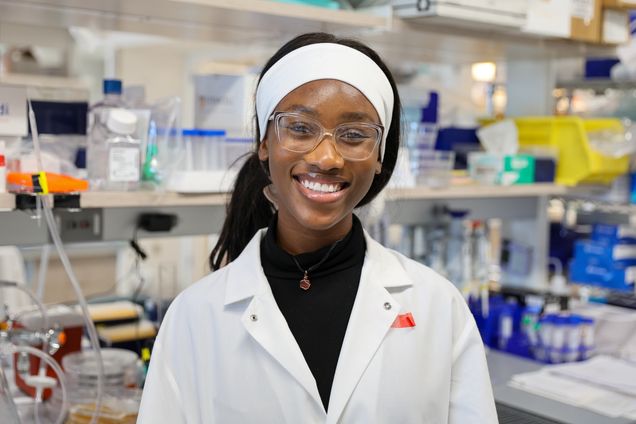
Mark Lucas, Research Experiences for Undergraduates.
Hear what Mark’s taking with him from his time at BU.
Learn More
Juliet Parry, Research Experiences for Teachers.
Hear how Juliet took what she learned back to her classroom.
Learn More
Research Goals
- Evaluate the capability of our Raman spectroscopic platform, as a nondestructive, label-free measurement.
- To quantify the relative contribution of key biochemical constituents of IVDs for determining tissue composition and predicting functional material properties.
- Prior work on using our Raman platform on articular cartilage explants demonstrated the ability of Raman spectroscopy to “optically biopsy” cartilage to assess its biochemical composition (proteoglycan, collagen, water) and monitor cartilage degeneration. The platform will be applied to bovine IVDs subjected to varying degrees of enzymatic (trypsin) degeneration and bovine IVDs from a range of animal ages (2 month, 1 year, 3 year, 10 year), where degeneration is more prominent for older age animals.
- IVDs will be analyzed for Raman-derived biomarkers, mechanical properties (aggregate modulus, fluid permeability), and biochemical composition.
- The project will test the hypothesis that Raman-derived biomarkers can predict the variability of IVD composition and material properties with an R2 >0.7.
Learning Goals
- The student will get trained in an extensive array of interdisciplinary skills required to perform various components of the project.
- This includes harvesting tissue, Raman spectroscopic measurements and data analysis, mechanical testing, biochemical analysis of GAG assay and histology preparation.
- These techniques are crucial in evaluating the mechanical and biochemical properties of tissue and large data set processing which in turns can help student to improve his/her critical thinking and problem-solving skills.
- Further, the student will perform monthly research presentation in the Albro Lab’s project meeting, thus providing a unique opportunity to enhance presentation and science communication skills.
Timeline
Weeks 1-4: Student training in project techniques, including: IVD tissue specimen harvest and preparation, Raman probe measurements of IVD tissue specimen and data analysis, mechanical characterization of IVD specimen composition, and biochemical assay characterization.
Weeks 5-7: Raman analysis of IVD tissue specimens. Bovine IVDs subjected to varying regimens of enzymatic GAG depletion but variation of trypsin dose and exposure duration. Bovine IVDs of varying age range (2 month, 1 year, 3 year, 10 year) n=10 per group.
Weeks 8-10: Mechanical testing of biochemical assays of IVD tissue specimens.