Research for a clean energy future through the University Partnerships Program
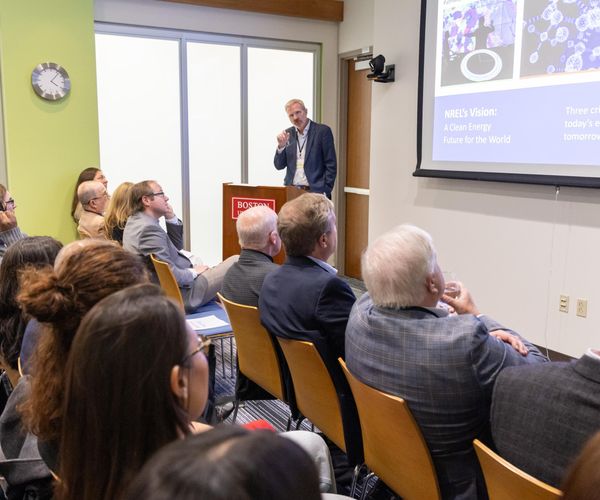
Boston University’s partnership with the National Laboratory of the Rockies (NLR), formerly the National Renewable Energy Laboratory (NREL), through the University Partnerships Program, generated important new research. Spearheaded by IGS, this collaboration explored equity, justice, and racism in the electric mobility transition, as well as justice in supply chains for advancing clean energy technologies.
Read Article

Analyzing the Racial Disparities of EV Adoption and Infrastructure
Does access to electric vehicles vary by race or income? This is a pressing concern for just transitions as electric vehicle (EV) adoption has grown exponentially in the United States over the past decade. Our joint electric mobility study in Applied Energy offered new insights into this question through sophisticated geospatial modeling of EVs. For the first time, the study quantified both income and race inequality in the distribution of EV adoption and charging infrastructure across the US based on current and historical trends. In the process, a novel way of quantifying the evolution of inequality emerged, with potential broad applicability.
BU Researchers


Exploring the Impact of Socioeconomic and Demographic Factors on EV Adoption
When it comes to purchasing and using electric vehicles (EVs), income, age, and gender significantly shape perceptions about EVs. Our collaborative study in Energy and Climate Change was one of the first to examine EV adoption and charging infrastructure through an equity lens using state-of-the-art original survey data. Survey results of more than 7,000 adults in the US revealed that individual factors such as housing type and region can strongly shape EV purchase preferences — leading to disparities in who pursues electric mobility.
BU Researchers
Advancing Justice in Critical Mineral Supply Chains
Additionally, IGS researchers assisted the Accelerated Deployment and Decision Support (ADDS) center within the Energy Systems Integration directorate at NREL to evaluate multiple social and environmental justice dimensions related to the supply chains of select critical minerals, including extraction, processing, recycling, and disposal.