Enhancing the Student Experience Through Teaching and Learning Internal Quality Assurance: Development and Pilot of the SIITE Method Faculty Survey at Boston University’s STEM Department
MaKenzie Elliott
Instructor’s Introduction
MaKenzie designed, conducted and reported on this research project while taking my WR 151: The World of Higher Education. In this class, students explore the purpose of college from historical, philosophical, and sociological perspectives, examining thinkers from various times and places to understand — and to question — the very educational model we find ourselves in today. For her project, MaKenzie researched and elaborated upon an analytical framework that can help universities improve their teaching faculty’s effectiveness.
What is truly impressive about her project is something that few first-year writers attempt: she developed and piloted her own survey instrument to test her framework against faculty perceptions in STEM departments here at BU. In the course of her paper, she comes up with specific and highly practicable ideas for improving university teaching, such as student feedback panels and frequent peer visits to classrooms. In addition, after analyzing her results, MaKenzie formulated a series of elegant revisions to her own survey, bringing the process of question-research-read-reflect-refine full circle. It was very rewarding to see MaKenzie’s thoughtfulness and dedication result in something both actionable and theoretically quite sophisticated.
Some questions that our course asked were: Is higher education today an engine of social mobility or a way to reinforce existing hierarchies? Can it be a means of liberation, or is it merely a credential? The either/or is a provocation, of course; the answer is most likely both/and. In this tricky landscape, MaKenzie’s paper seeks to peer through to what actually happens in the classroom and how faculty can be incentivized to help students get the most out of their educations.
Maria Gapotchenko
From the Writer
Growing up with a neurodivergent and hard-of-hearing younger brother sparked my early awareness of the importance of accessible, high-quality education. Observing the ways in which learning environments can either support or hinder student success shaped my understanding of education as a deeply impactful and often inequitable system.
After arriving at Boston University, I came to recognize that the pursuit and assurance of educational quality is essential even within highly regarded institutions. This project was inspired by that realization and by a desire to better understand how universities evaluate and improve teaching and learning practices, particularly within STEM disciplines.
Through this research, I developed the SIITE Method, a framework built on five core practices: establishing clear quality standards, promoting faculty training and peer review, encouraging stakeholder feedback, implementing comprehensive evaluation, and fostering continuous improvement. Together, these practices aim to address common challenges in quality assurance, including limited transparency, low faculty engagement, insufficient stakeholder participation, gaps in monitoring, and structural barriers to sustained improvement.
Through this work, I hope to encourage more collaborative and adaptive systems of educational quality assurance that not only support faculty, but ultimately enrich the student learning experience
Enhancing the Student Experience Through Teaching and Learning Internal Quality Assurance: Development and Pilot of the SIITE Method Faculty Survey at Boston University’s STEM Department
Abstract
Quality assurance (QA) is a concept that has become increasingly important in undergraduate higher education in the past few decades. As it stands, educational quality is something many students, particularly in the STEM fields, tend to express dissatisfaction with as studied by Munirul Abidin in his paper about teaching quality perception disparities. This paper will identify five internal quality assurance (IQA) measures that are essential to enhancing the student educational experience and develop a teaching faculty survey to assess the state of these practices at any given university. In order to achieve this goal, I will analyze the “3P Conceptual Model” of QA—a conclusion of Matthijs Krooi et al.’s meta-analysis—as a framework for developing survey questions that will provide a comprehensive understanding of a university’s IQA methodology. From this model I have identified the following SIITE practices as vital to enhancing the student experience: setting clear quality Standards, stakeholder Involvement and feedback, continuous Improvement, faculty Training/development and peer-review, and wide-ranging Evaluation/assessment. Preliminary survey responses from a few STEM departments at Boston University indicate the effectiveness of the proposed survey in assessing the state of BU’s SIITE Method IQA practices and highlight a few areas for improvement.
Introduction
The concept of quality assurance (QA) in higher education has its roots in 1950’s Western business practices, which focused on strengthening organizational systems and fostering continuous improvement. In the public sector, QA historically relied on government oversight, professional credentials, and internal audits, as described in The European Student Handbook on Quality Assurance in Higher Education (Friend-Pereira et al. 10). The widespread adoption of QA in European higher education was propelled by initiatives like the 1999 Bologna Process, which aimed to standardize and enhance educational standards across the continent (“Bologna”). UNESCO’s World Declaration on Higher Education in 1998 broadened the concept of educational quality to an international scale (“World”).
The quality of teaching and learning is fundamental to the university experience, directly shaping student satisfaction and overall institutional success. However, a significant gap often exists between student and faculty perceptions of educational quality. A 2015 study by Munirul Abidin highlights this disparity, revealing that students rate their satisfaction with teaching and learning 1.37 points lower than faculty on a 1-5 scale. The study identifies key areas of concern, including lecturers’ ability to promote skills, literacy in teaching practices, and communication effectiveness (188). These findings emphasize the need for more effective strategies to ensure educational quality and enhance the student experience.
Over the past few decades, numerous internal quality assurance (IQA) models have emerged, prioritizing different practices to meet the evolving needs of United States institutions and students. This paper focuses on IQA measures for improving teaching and learning, drawing on Matthijs Krooi et al’s “3P Conceptual Model” as a theoretical foundation for the identification of five practices (the SIITE method) that I argue are essential to providing a quality education and supporting an effective IQA process. By addressing the critical intersection of teaching quality and the student experience, I developed a survey to investigate the presence and impact of these practices. The survey was piloted in select STEM departments at Boston University and the preliminary results were provided and analyzed to assess the survey’s effectiveness and identify areas for structural improvement.
Defining Quality in Higher Education
The most common way to define quality in the world of higher education is the “traditional concept of quality” described by Noha Elassy in his paper “The concepts of quality, quality assurance and quality enhancement” (253). This approach is characterized by a comparative analysis that lacks a truly substantive measure of the HEI’s (Higher Education Institution) quality. By relying on a linear ranking of universities we naturally favor the “old and rich” institutions and encourage imitation over innovation (Elassy 253). Thus, this paper establishes a new definition of educational quality that is independent of ranking and emphasizes clear, individualized expectations and continuous improvement.
Accreditation standards seem to be the next natural way to define the quality of education at an institution; by following a “conformance to standards” approach we can focus on educational outcomes but fail to specialize the process to each university, leaving them unlikely to evolve beyond baseline expectations. A more promising approach to defining quality is “fitness for purpose” which focuses specifically on an institution’s success in fulfilling its intended purpose (Elassy 252). Specifically, this paper prioritizes the ability of a university to achieve its mission or goal through practices unique to the institution. Furthermore, these practices must be flexible and ever-changing to effectively accommodate the “multidimensionality” of educational quality (Schindler et al. 4).
In addition to this broad definition of university quality, investigating the idea of teaching and learning quality requires its own specifications. To do this, one of Laura Schindler and others’ proposed classifications of HEI quality, from “Definitions of Quality in Higher Education: A Synthesis of the Literature,” will be used. Schindler et al.’s paper identifies “Purposeful,” “Exceptional,” “Transformative,” and “Accountable” as four conceptualizations of education quality, each of which is most effective in a unique context (5). When it comes to teaching and learning quality, the Transformative approach is fitting as it “effect[s] positive change in student learning and personal and professional potential” (Schindler et al. 7).
A final consideration when contemplating the meaning of quality, is the distinction between “quality assurance” and “quality enhancement.” Where QA is about evaluating and assessing the educational process, quality enhancement is often defined as the act of treating and improving the process (Elassy 256). Throughout this paper, the term quality assurance will be used as an umbrella term intended to encompass both diagnostic and developmental practices related to teaching and learning quality.
The Importance of Quality Assurance for the Stakeholders
As defined by Joanne Burrows in her paper “Going Beyond Labels: A Framework for Profiling Institutional Stakeholders,” stakeholders in higher education are “individuals or groups who believe that a college is accountable to them and behave as if it were” (5). Not only do stakeholders gain something from the success of an institution, but they are also the very context for which universities exist and continue to operate in pursuance of education. Burrows identifies the following four relevant categories of stakeholder groups: clientele, employees, donors, and regulators (10).
For the purposes of exploring teaching and learning educational quality, we will focus on the internal stakeholder groups which include students as clientele and faculty and administration as employees. In pursuit of enhancing the student educational experience, administrators are essential in supporting the faculty who are responsible for teaching students (Avci et al. 49). To understand the motivations of these stakeholder groups, we must determine what factors of an institution indicate quality for each one. When it comes to faculty and administrators, the focus is primarily on the intensity of workload and its associated benefits. These employee groups have been surveyed by Robert Ulewicz to care most about “regular income,” the number and flexibility of working hours, “clear promotion rules,” and the opportunity to attend and participate in conferences. These incentives were prioritized over educational quality focused indicators such as “subjects in a teaching contract” and the chance for professional improvement, demonstrating how they generally perceive institutional quality as relative to employment benefits. Conversely, students stress the impact of an “approachable” presentation of information, “devoted lecturers” and “well-prepared educational materials,” and having easy access to academic faculty (Ulewicz 102). Thus, students are essential to assessing the quality of a university’s education, but faculty are the people whose practices must be adjusted to improve the educational experience.
Internal vs External Quality Assurance
Diagnosing and ensuring educational quality can be done from two directions, internal and external. External quality is characterized by the accreditation and ranking processes described above, it is “the capacit[y] of higher education institutions to respond to the changing needs of the society with whom they interact” (Friend-Pereira et al. 14). The purpose of external quality assurance (EQA) is to appease the external stakeholders by focusing on “compliance and accountability,” but it is not specialized to a certain university and thus is limited in its ability to develop an institution beyond surface level standards (Paintsil 20). As universities move towards being self-funded, stakeholder involvement in EQA has increased which gives it the potential to become more effective; however, for the time being it is largely unable to address teaching and learning quality (Paintsil 21).
On the other hand, internal quality assurance (IQA) already has the potential to make effective changes to enhance the student educational experience. For HEI’s, internal quality is the ability of the institution to achieve its goal; it is about creating an environment that facilitates “the unfettered search for truth and the disinterested pursuit of knowledge” (Friend-Pereira et al. 14). IQA is spearheaded by the faculty and university administrators and allows for the implementation of practices specialized to the context of the institution. Not only does a lack of strict external standards allow flexibility for the university, but it also opens up the opportunity for timely adjustments and improvements to the process (Paintsil 19). These changes are more likely to be effective as they will be implemented by evaluators who have an intimate understanding of the institution and how it functions. According to Ransford Paintsil in his book “Balancing Internal and External Quality Assurance Dynamics in Higher Education Institutions,” the primary downfall to IQA is that it is not a legal requirement for universities to execute and is thus viewed as less impactful and monetarily worth-while than EQA which provides tangible qualifications to a university. While IQA is not a particularly strong “social authority,” it is an essential way to improve the student experience by “focus[ing] on curriculum development, teaching, learning and research” (Paintsil 19).
The Challenges of Implementing Quality Assurance
Over the course of the last three decades as IQA has become a more common practice at HEI’s, many challenges have arisen that stunt its effectiveness. In their paper “Issues and Challenges of Quality Assurance in Higher Education Institutes: A Systematic Literature Review,” Pushpakumara et al. explains three categories of issues universities often face when implementing internal quality assurance measures.
The first of these categories is “Institute-Related” and involves problems with management and structure (Pushpakumara et al. 52). University administrators must be willing and able to motivate and facilitate achievement amongst the academic staff. This requires a “dedicated workforce” of people whose primary responsibility is overseeing the implementation of a well structured and organized IQA process (53). Teaching and learning QA practices cannot be overly vague, they must be thorough while remaining flexible enough to promote constant improvement. Pushpakumara et al.’s second category of challenges is “QA Process Related” and is all about supporting the process that was established by the institution (52). The university must constantly monitor the IQA practices by observing the teaching and learning process to identify areas for improvement (54). There must also be maintenance of information systems and most importantly for the purpose of enhancing the student experience, management should be transparent about the QA procedure as uncommunicated expectations are fatal to success. Finally, there are “QA Stakeholder Related” issues which are characterized by a reluctance of academic staff to participate and a low stakeholder involvement in the process (55). When professors are hesitant to adapt to changes because they view IQA practices as an additional workload it removes any possibility for teaching and learning improvement. Curriculum development and experience sharing are also essential steps of the IQA process that cannot occur if the internal stakeholders voices are not heard (56).
While this is a fairly wide-ranging set of challenges, Pushpakumara et al. argues that there are three primary ways of addressing them. In order to promote IQA success, HEI’s can improve stakeholder awareness/motivate attitude changes, implement policy improvements, and utilize information systems (57). Here we will focus on the first two which are essential to the teaching and learning process. Quality assurance should be a common idea for the academic staff and must be depicted as a professional exercise rather than additional workload. The policies should be published and understood by all people involved and they have to be adaptable and frequently revised. An IQA procedure is ever-evolving as management and university administrators find new ways to improve and identify new challenges the institution is facing in the pursuit of a quality learning experience for students. These challenges, as well as the proposed methods for overcoming them, will be an essential part of identifying essential IQA practices for enhancing the student experience.
The 3P Conceptual Model: IQA for Teaching and Learning
There are dozens of tried and tested IQA models and frameworks for the higher education sector including the PDCA model which stands for Plan-Do-Check-Act and the 5S Kaizen model which follows the steps of Sort, Set in order, Shine, Standardize, and Sustain (Mullaicharam et al.; Nurcahyo et al.). Many vital methods and aspects of these and other models are common throughout the literature on IQA framework and must be unified into one “model” on which to base the evaluation of an institution’s practices. This is where Krooi and others’ IQA literature synthesis “Introducing the 3P conceptual model of internal quality assurance in higher education: A systematic literature review” comes in. The paper proposes a relatively simple and all-encompassing model for quality assurance implementation and assessment based on an analysis of 51 papers describing other models for teaching and learning focused IQA (3). This “3P conceptual” framework establishes Purpose, People, and Process as essential elements and describes specific aspects of each.
Krooi et al. define Purpose as the goals that the institution wishes to achieve with its implementation of IQA practices (4). This first step of the model has three primary components that allow the HEI to establish its own unique purpose: first the university must define what improvement means for them, then they have to hold professional development training for the teaching staff, and finally they must form some system of accountability. Commonly, improvement under the context of teaching and learning is an iterative process that involves many “cycles of feedback and improvement” that can ultimately be described as continuous improvement, something that will become an integral part of teaching and learning IQA (Krooi et al. 4). Unlike primary school teachers, many professors at HEI’s have little to no formal education on teaching practices and pedagogy, especially in the STEM departments, as will be discussed in the survey results section of this study. Professorial staff are often expected to effectively educate students with nothing more than a degree in a specific field; if you’ve ever tried to help an older family member use their mobile phone, you can see how knowledge and experience do not always translate to an ability to teach others. Thus, mandatory teaching development training and a standard method of assessment and accountability are important ways for a university to ensure that their students are receiving the best education the academic staff can provide.
These beginning steps naturally lead an HEI to question what actors or People with roles are necessary to achieve their desired goals. There are many stakeholders involved in quality assurance but through his analysis of the teaching and learning IQA literature, Krooi et al. identify Teachers and Students as the most impactful groups. The academic staff are “change agents” who should be involved in both peer and self evaluation, so they can reflect on and implement the necessary changes to achieve continuous improvement of the “learning community” (5). Professors should not simply be evaluated by administrators or management but they should also be giving and receiving feedback to/from other educators in their departments and contemplating the effectiveness of their own teaching. As students are the ultimate beneficiaries of educational improvement, many researchers in the field of higher education IQA believe they are essential for providing feedback through “student evaluation survey” or “feedback panels/committees” (Krooi et al. 6). While a professional perspective on the quality of teaching at a university is important, it can never truly assess how well students, who have little to no background understanding of university material, are understanding a subject. The student account is by no means a “direct measure of educational quality,” but it is essential when evaluating the effectiveness of teaching and learning as their comprehension and educational competence are the goal (Krooi et al. 6).
Finally, having determined a goal and the necessary participants, the university now needs to implement a Process. A general format for the teaching and learning IQA process as proposed by Krooi et al. involves: setting quality standards, collecting information on quality indicators, monitoring, reflecting, and subsequent action (6). A specific and measurable set of quality standards is vital as it allows the university to “track and compare teaching and learning performance” throughout the process of implementing new IQA measures (Krooi et al. 7). Determining if the educators are meeting these standards requires the university to collect feedback from many sources including students, professors, and department administrators that evaluate the quality of aspects such as teaching methods and curriculum design. However, assessing these standards once a year is not enough; professors should be consistently monitored to get a better feel for how educational quality changes on a daily basis and identify specific areas for improvement. This is an extremely complicated process to modify, so all of the information collected through monitoring must be carefully reflected on, so relevant and impactful teaching advancements can be made.
While the three P’s may not provide a strict set of steps for a university to follow, they allow flexibility and establish an overview method for universities to build upon in a way that works best for their specific context. Krooi et al’s framework is a guideline for determining specific practices that target the enhancement of the higher education student learning experience and address common issues with the implementation of IQA.
Necessary Practices for Enhancing the Student Experience: Introducing the SIITE Method
By combining the previous two sections of this paper, five student experience focused IQA practices that tackle previously encountered hurdles are formulated below. This list, summarized in Table 1, acted as a baseline for developing questions for the faculty survey.
The first essential IQA practice for improving the teaching and learning landscape is developing clear quality standards. Krooi et al. list this as the first step of the Process section of their 3P model. Without communicated expectations, teaching faculty have no way of knowing what they must do to fulfill the university definition of quality, and IQA evaluators are left without a baseline for evaluation. This practice addresses the common issue discussed by Pushpakumara et al. of a lack of transparency about IQA causing misunderstandings and weakening the system. Additionally, tangible and achievable standards are the foundation of a less intimidating quality assurance process that fosters academic faculty contribution which is necessary for improving the state of educational quality and by extension the student experience. I would even argue that using the proper terminology, including “quality assurance” is important as it forces focus on the end goal of improving teaching quality to benefit students.
Secondly, faculty training/development and peer-review are vital to improving the student experience as they ensure consistent pedagogical abilities amongst teaching staff and help make QA less of an additional workload for individual professors. Krooi et al. state that these developmental exercises are an important part of the Purpose part of the 3P model as they “enable teachers to learn and act in a manner that fits the needs of a particular context” (5). This practice further develops a learning community for the academic staff and encourages active contribution to the IQA process by bringing about the attitude changes Pushpakumara et al. suggest as a solution to many of the issues they identified. As described by Ulewicz, prepared and devoted professors are a major indicator of quality for students, so ensuring staff teaching quality is an essential part of enhancing the student learning experience.
Stakeholder involvement and feedback practices fulfil the 3P conceptual models requirement of information collection. This often comes in the form of student course evaluation and staff work-place experience surveys such as the one developed below. Pushpakumara et al. identify a lack of stakeholder involvement as a central challenge of implementing IQA and thus must be directly combatted by teaching and learning practices. Student feedback is also the only direct way to measure student satisfaction, so it is a vital step to identifying changes that must be made to enhance the student experience.
The next crucial practice is a wide-ranging teaching evaluation and assessment process. Monitoring the university is mentioned by both Krooi et al. and Pushpakumara et al. as necessary for identifying ways to improve teaching and learning IQA policies. This practice can include syllabi review, curriculum evaluation, and student outcomes analysis. While student outcomes, such as final grades and job placement, are not directly indicative of their educational experience, they are a good starting point for identifying major issues with teaching quality that can be further investigated.
Finally, HEI’s must emphasize the importance of continuous improvement. This is the central component of both the very definition of “Transformative” educational quality as explained by Schindler et al. and the purpose of Krooi et al.’s teaching and learning IQA model. A university must not simply implement practices and never investigate their effectiveness and modify them accordingly. Flexibility and timely improvements to the process are the freedoms IQA offers universities that EQA cannot. Not only should administrators be striving to constantly improve, but there should be an expectation for academic staff to do so as well. Without constant attention and support, IQA is sure to fail as Pushpakumara et al. explain, leaving the student experience stagnant.
| Practice | Purpose/Enhancement | Primary Problem Addressed |
| Setting Clear Quality Standards | Makes expectations tangible, achievable, and less intimidating for staff | Lack of Procedure Transparency |
| Faculty Training/Development and Peer-Review | Fosters a learning community that perceives QA as a group effort rather than additional individual workload | Reluctance of academic staff for active contribution |
| Stakeholder Involvement and Feedback | Gives students and staff a chance to speak up and share experiences to improve the system as a whole | Lack of Stakeholder Participation |
| Wide-Ranging Evaluation and Assessment | Ensures issues are not falling through the cracks/going unnoticed | Failure to Monitor Process |
| Fostering Continuous
Improvement |
Allows for constant
modification of QA process and encourages growth mindset |
Unsupported Organizational Structure |
Table 1
I will refer to these practices together as “the SIITE Method,” standing for Standards, Involvement, Improvement, Training, and Evaluation.
Development and Piloting of the SIITE Method Faculty Survey
The first step to improving the student experience is evaluating the current state of teaching and learning Internal Quality Assurance at the institution. While this can be done by determining what IQA management practices are supposed to be taking place, a more impactful way is to determine what practices the academic staff perceive to exist. HEI administrators may have a detailed concept and plan for quality assurance, but if the measures are not reaching the professorial level then the process is not truly making an impact. Thus, directly surveying the teaching staff is essential to improving the IQA process of an HEI. Using the combined work of Krooi et al.’s 3P conceptual model and the categories of challenges identified by Pushpakumara et al., this paper has developed and tested an anonymous faculty survey that diagnoses the state of teaching and learning IQA at Boston University.
The survey begins by collecting some preliminary background information about the respondents department, professorial level, pedagogical education, and research/teaching commitments. This information is important for evaluating the experience and time priorities of academic staff at the university. When this survey was piloted in a few of Boston University’s STEM departments (Physics, Astronomy, and Mathematics), the following results were found from a respondent pool of 11, 91% of whom are professor level staff.
- Do you have any formal education in teaching/pedagogy?
- How many classes do you typically teach per semester?
- What is your level of involvement in research?

Figure 1
The remainder of the survey evaluates the IQA practices at the university using the practices identified in Table 1. The questions do not necessarily appear in the following order in the survey and are all multiple choice but have varying response types.
Setting Clear Quality Standards
- Have you ever heard the term “quality assurance” used at BU under a teaching and learning context?
- Is there a clearly communicated and defined standard/expectation/goal for your teaching set by the university/department administration?
Faculty Training/Development and Peer-Review
- Has Boston University required you to engage in teaching development or training? 7. Are you involved in a faculty peer-review group?
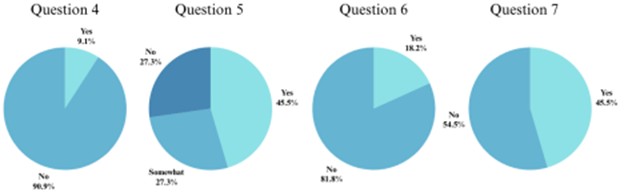
Figure 2
Stakeholder Involvement and Feedback
- How much does BU’s student class review system impact your teaching methods? Wide-Ranging Evaluation and Assessment
- Is your teaching evaluated by the administration?
- Are you required to submit your syllabi to the administration?
- Are learning outcomes assessments or similar benchmarking measures of your classes
conducted by the administration?

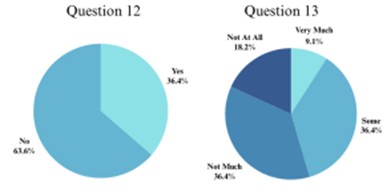
Figure 3
Fostering Continuous Improvement
- Is there incentive or expectation for you to modify/improve your teaching from semester to semester?
- How much emphasis is placed on continuous improvement of your teaching by the administration?
Figure 4
While I acknowledge that the respondent pool of these preliminary results is small, the survey indicates some key problems with Boston University’s teaching and learning IQA practices. Since 82% of the respondents report having no formal education in pedagogy (Figure 1), internally ensuring teaching quality is necessary for BU. Figure 1 also shows that a combined 64% of respondents spend more than 15 hours a week working on research, which suggests a considerable time priority placed on researching over teaching, further cementing the importance of IQA. Based on the rest of the survey, the practices most in need of attention at Boston University appear to be: 1. Setting Clear Quality Standards, 2. Faculty Training/Development and Peer-Review, and 3. Fostering Continuous Improvement. 91% of respondents had never heard the term “quality assurance” at BU, which indicates that any existing IQA practices are likely not intertwined with a common and clear goal. You can also see that 82% of these educators have never been required by Boston University to attend any sort of teaching training or development programs (Figure 2). Finally, these results suggest that BU is failing to highlight the importance of continuously improving teaching practices as 64% of respondents feel no incentive to do so and 55% experienced little to no emphasis on the practice. Ultimately, I do not wish to make any definitive claims about the state of BU’s adherence to the SIITE method; these results may suggest a need for a wider scale investigation using an improved version of this survey.
There is a final question at the end of the survey that gives respondents an opportunity to leave questions, comments, or concerns. This section allows professors to anonymously share their thoughts on IQA practices at their institution which can indicate in what ways the process needs to be more transparent or the goals more emphasized. For example, a response to this question from the piloting of the survey reads, “Teaching evaluations by undergraduates are useless. Worst aspect of them is that they are made before students see their final course grades.” This response could suggest that there need to be changes made to the student course evaluation process at Boston University or might mean the administration needs to address faculty attitudes towards evaluations by reestablishing their purpose in the professional development process.
Additionally, this comment section allows our survey to grow and change with faculty feedback in the same way the survey hopes to inspire improvement for the teaching and learning IQA processes at the universities at which it is distributed. Another response from the pilot suggested that the use of the term “administrator” could be misleading as it does not differentiate between department and university wide management. A future version of this survey should better define this term to be inclusive of both top administrators and department chairs. A few survey comments suggested more response options be included as the questions are primarily yes/no multiple choice. The survey could be modified to follow a Likert scale to allow respondents more freedom with their responses. Finally, a few comments mentioned that their responses were a result of past or personal experience rather than university required activities. The next version of the survey should specify “university required” in all questions to get data about the effectiveness of the university’s IQA system rather than voluntary faculty engagement in teaching development. These are just a few modifications that could be made to the survey to improve its assessment of the SIITE method teaching and learning IQA practices.
Conclusion
This study highlights the role of Internal Quality Assurance (IQA) practices in improving the teaching and learning environment at Higher Education Institutions (HEIs). By synthesizing Krooi et al.’s 3P conceptual model and Pushpakumara et al.’s categorization of challenges, I have identified five student experience-focused IQA practices: setting clear quality standards, faculty training/development and peer-review, encouraging stakeholder involvement and feedback, comprehensive teaching evaluations, and fostering a culture of continuous improvement. These practices form a strong foundation (the SIITE Method) for addressing challenges commonly faced in IQA implementation and enhancing the overall student experience.
The SIITE Faculty Survey pilot results from Boston University’s STEM departments emphasizes the need for more deliberate and transparent IQA practices. Findings revealed gaps in pedagogical training, a lack of emphasis on teaching quality improvement, and low awareness of quality assurance practices among faculty. Although these conclusions are preliminary, they emphasize the need to reinforce IQA practices at BU and suggest a fundamental effectiveness of the survey in identifying such needs. Modifications including more inclusive terminology, expanded response options, and clearer question framing can further improve the survey’s ability to reliably diagnose institutional practices.
Ultimately, this paper advocates for a dynamic and collaborative approach to IQA that evolves with faculty input and institutional needs. By prioritizing these practices and empirical evaluation, HEIs can build a more effective quality assurance system that not only supports academic staff, but also enriches the student learning experience.
Appendix
Works Cited
Abidin, Munirul. “Higher Education Quality: Perception Differences among Internal and External Stakeholders.” International Education Studies, vol. 8, no. 12, 26 Nov. 2015, pp. 185–192, https://doi.org/10.5539/ies.v8n12p185.
Avci, Ömer, et al. Stakeholders in U.S. Higher Education: An Analysis through Two Theories of Stakeholders. Bilgi Ekonomisi ve Yönetimi Dergisi, 2015.
“Bologna Process – University of Bologna.” Www.unibo.it, Alma Mater Studiorum Universita Di Bologna, www.unibo.it/en/university/international-outreach/bologna-process.
Burrows, Joanne. “Going beyond Labels: A Framework for Profiling Institutional Stakeholders.” Contemporary Education, vol. 70, no. 4, 1999, pp. 5–11. Proquest, www.proquest.com/docview/1291788816?pq-origsite=gscholar&fromopenview=true&sourcetype=Scholarly%20Journals&imgSeq=1.
Elassy, Noha. “The Concepts of Quality, Quality Assurance and Quality Enhancement.” Quality Assurance in Education, vol. 23, no. 3, 6 July 2015, pp. 250–261, ProQuest, https://bu.primo.exlibrisgroup.com/permalink/01BOSU_INST/11pmtsf/cdi_emerald_primary_10_1108_QAE-11-2012-0046.
Friend-Pereira, John C., et al. European Student Handbook on Quality Assurance in Higher Education. The National Unions of Students of Europe, 2002.
Krooi, Matthijs, et al. “Introducing the 3P Conceptual Model of Internal Quality Assurance in Higher Education: A Systematic Literature Review.” Studies in Educational Evaluation, vol. 82, 1 Sept. 2024, www.sciencedirect.com/science/article/pii/S0191491X24000397.
Mullaicharam, A.R., et al. “Basic Concepts of Quality Assurance in Higher Education Institution-A Review.” Journal of Pharmaceutical and Biological Sciences, vol. 3, no. 1, 29 June 2015, pp. 14–20, jpabs.org/admin/uploads/HQ1BNK.pdf.
Nurcahyo, Rahmat, et al. “The Analysis of the Implementation of 5-S Principles Integrated with ISO 9001 Requirements at Higher Education Level.” SAGE Open, vol. 9, no. 3, July 2019, p. 215824401987077, https://doi.org/10.1177/2158244019870773.
Paintsil, Ransford. Balancing Internal and External Quality Assurance Dynamics in Higher Education Institutions. Universitetet I Oslo, May 2016, pp. 18–21, www.duo.uio.no/bitstream/handle/10852/52448/FINALTHESIS27.pdf?sequence=1.
Pushpakumara, HMC, et al. “Issues and Challenges of Quality Assurance in Higher Education Institutes: A Systematic Literature Review.” Management Matters, vol. 10, no. 1, 30 Sept. 2023, pp. 49–65.
Schindler, Laura, et al. “Definitions of Quality in Higher Education: A Synthesis of the Literature.” Higher Learning Research Communications, vol. 5, no. 3, 30 Sept. 2015, pp. 3–13.
Ulewicz, Robert. “The Role of Stakeholders in Quality Assurance in Higher Education.” Human Resources Management & Ergonomics , vol. 6, June 2017.
“World Declaration on Higher Education for the Twenty-First Century: Vision and Action and Framework for Priority Action for Change and Development in Higher Education.” United Nations Educational, Scientific and Cultural Organisation, 9 Oct. 1998.
MaKenzie Elliott is a junior studying Astronomy and Physics in the College of Arts and Sciences at Boston University. She intends to pursue a PhD in her field and continue in academia as a cosmology researcher and professor. Driven by a deep fascination with the universe, she is especially passionate about making astronomy more accessible to the public. She hopes to bridge the gap between complex scientific research and broader audiences by promoting inclusive, engaging science communication and expanding opportunities for people of all backgrounds to connect with and learn about space. Outside of academics, she enjoys reading, crocheting, and volunteering at the local Gifford Cat shelter.