 |
 |
|
|
|
|||
|
|||
 |
|||








Fronting the Freep
Terror alerts, the Super Bowl, and Wiffle ball — all in a day’s work for Free Press editor Gillooly
By Kristen Hoffman (COM’05)
|
|
Daily Free Press editor in chief Patrick Gillooly directs an editorial meeting early this semester. Photo by Phoebe Sexton |
|
|
|
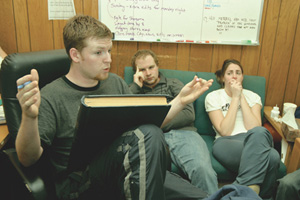
It’s six o’clock on a Wednesday evening and eight students are gathered in a tiny, disheveled office. Notepads in hand, they aren’t memorizing formulas or discussing Shakespeare — they are deciding the news stories 12,000 people will read in the next day’s issue of the Daily Free Press, Boston University’s daily independent student newspaper.
“If it affects students’ lives, it will be in our paper,” says editor in chief Patrick Gillooly (COM’06). Alongside an editorial staff of seven students, Gillooly says, he volunteers an average of 70 hours a week at the paper, while trying to have the normal academic and social life of a college student.
“I never get sick of it,” Gillooly says, despite practically living in the paper’s ramshackle office on Commonwealth Avenue. He even stores a pillow beside his desk for those rare occasions when he can catch a few moments’ sleep. “Every night is a different night,” he says, “every night there’s different news.”
Production begins at 4 p.m. and generally wraps up between 3 and 4 a.m. Editors keep a daily log of official finishing times on a dry erase board, which staff members also use to record their triumphs and vent their frustrations: “3:10 a.m. record [earliest finish] for spring 2005,” and “6:11 a.m. — please kill us,” are examples of the students’ tongue-in-cheek comments.
Aside from the tough hours, a lot of hard work goes into the Freep, as it’s affectionately called on campus. Gillooly, chosen by the group of former editors and staff members that makes up the publication’s board of trustees, took over as editor in January 2005. (There is a new editor each semester.) His responsibilities include supervising daily news budget meetings, picking lead stories, designing the layout of every issue, and of course, editing stories. But his most important role, according to his colleagues, is as leader in a high-stress environment.
“He’s the most innovative editor I’ve had the pleasure of working with,” says Phoebe Sexton (COM’06), the paper’s photo editor for the second consecutive semester. “He’s able to combine the most fun with the most work.”
Although the staff has its share of fun, the product attests to the fact that the Daily Free Press is a serious student newspaper. Approximately 4,000 copies are delivered to 50 locations on the Charles River Campus each weekday. Circulation jumps to 12,000 on Thursdays because of an arts and entertainment section and a special college insert from Sports Illustrated. Subscriptions are available as well, and an online version gets 28,000 hits a week. With articles from approximately 100 regular writers and pictures from 70 photographers over the course of a semester, the Daily Free Press boasts the fourth-largest print run of Boston’s daily newspapers, just behind the Boston Globe, the Boston Herald, and the Metro.
The paper reports campus news as well as city, state, and national news that affects students. During nightly 6 p.m. editorial meetings, staff members discuss which articles to include in the 12-page paper. One February evening, they chose a terror alert announcement from Boston Mayor Thomas Menino as the lead story. President Bush’s State of the Union address and a package of stories about potential Super Bowl riots also went on the front page. Sirens wailing outside the building interrupted the meeting. Gillooly gestured to his colleagues, saying, “Hey, someone go check the [police] scanner.”
The Freep staff alleviates some of the daily pressure by playing in-office Wiffle ball and posting funny photos on the wall. Humorous grammar violations are recorded on a large white board in Gillooly’s office.
“We’re such a family,” Sexton says. “And Patrick helps it to be not so dysfunctional. He exhibits all the qualities of a good editor. Even when you are freaking out about a problem with somebody, he’ll say, ‘OK, let’s go out on the stoop and talk.’”
A native of Westborough, Mass., Gillooly chose BU because of the Daily Free Press. The print journalism major became interested in writing during a journalism class as a high school freshman. Although he struggled at first, his teacher “really gave me a shot at it,” he says, instilling in him a passion for news writing. Not long after, he became the editor of his high school paper.
Gillooly remembers walking into the Daily Free Press office on his second day at BU and asking how he could get involved. Former editor Bill Yelenak put him straight to work. “I told Bill that I would be the editor of this place someday, and I’d do whatever it took to get there. Now here I am, and I have no regrets,” Gillooly says. “It’s all worth it in the end.”
Gillooly wrote more than 160 stories during his first two years at the paper. “The biggest story I’ve worked on was when the Goldin presidency was pulled,” he recalls, referring to the October 2003 decision to withdraw the offer of the University presidency to Daniel Goldin the week before he was to start. “The way that this paper reacted to it was awesome,” he says. “Every section was in here working on every story.”
In the future, Gillooly says, he aims to become involved in the business and managerial aspects of running a newspaper. He also hopes to leave his mark on the Daily Free Press by establishing an alumni fund to provide future editors of the 35-year-old paper with new computers and other equipment. With a year left before graduation and two years of full-time editing under his belt, Gillooly will retire from the staff of the Freep in May. He’ll take five classes each semester of his senior year — a task many seniors would dread — but he is looking forward to it. “Taking five classes of schoolwork is going to be a breeze,” he says, “compared to this.”

29
April 2005
Boston University
Office of University Relations