 |
 |
|
|
|
|||
|
|||
 |
|||




Student speaker finds her generation
By Tim Stoddard
|
|
|
Julie Macé Photo by Albert L’Étoile |
|
|
|
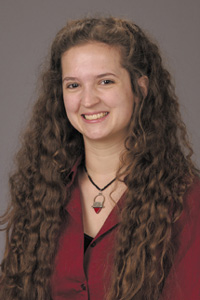
Julie Macé doesn’t consider herself part of a “lost generation,” a designation many baby boomers have slapped on young Americans for their supposed apathy and self-absorption. In her speech to this year’s graduating class, Macé (CAS’04) will urge her classmates to shake that stereotype by becoming active members of their communities. “It’s a call to action,” she says. “I wanted to admit our weaknesses as a generation, but also see what we can do to overcome the reputation we have.”
Reflecting on her experiences at Boston University, Macé will discuss how finding one’s niche on a large urban campus is good training for life after college. “Because we’ve had to overcome the fear of being lost in the crowd,” she says, “and because we’ve forged our communities here, we can use that sense of community in the larger world to participate more in civic life.”
Macé will encourage her classmates to be active leaders in their new communities, particularly when it comes to participating in local and national politics. “Only a third of our age group voted in the last election,” she says. “No matter where you stand in the political spectrum, it’s vital that you have a voice in electing your civic leaders.”
Earlier this semester, President ad interim Aram Chobanian invited the University’s most academically accomplished seniors to submit a speech draft. A committee of faculty members and administrators received 41 submissions and listened to 5 finalists deliver their speeches before selecting Macé to address the class of 2004.
Although she has never stood before a crowd of more than 20,000, Macé has few qualms about public speaking. Since freshman year, she’s been an active member of Stage Troupe, the oldest and largest student theater group on campus, performing in The Importance of Being Earnest, Get Smart, and The Seagull.
An international relations major graduating summa cum laude, Macé has been invited to join Phi Beta Kappa. She has traveled widely, and says that the theme of her speech was inspired in part from seeing politically and socially active young people abroad. While working on a farm and planting trees in western Australia a few summers ago, she says, she “found that everyone my age had a cause. I don’t know if it was a trend, but it felt very genuine. Everyone had something they felt very strongly about, whether it was indigenous Aboriginal issues or the environment. It was inspiring.”
Macé was born outside of Paris, moving to the United States when she was seven years old. She returned to Paris while studying abroad last year, and was struck by how politically active French youth were, particularly about the war in Iraq. “There were quite a few protests against the war,” she says, “and it was incredible, the involvement of young people.”
Macé hopes to explore South America after graduation, possibly joining the Peace Corps or working with a nongovernmental organization involved in sustainable development. This past year, she completed a work for distinction — a two-semester independent project culminating in a thesis and oral defense — examining sustainable agriculture in the United States and France, and how small farms in both locations are disappearing as a result of government subsidies. She sees herself eventually returning to graduate school, preferably in Europe, to further explore some aspect of sustainability. And from there? “I think Antarctica is my next continent to check out,” she says.

13 May 2004
Boston University
Office of University Relations