News & Media
Newsletter
Stay connected with the latest breakthroughs in biological design with The Biodesign Bulletin. This recurring digest highlights new research, major publications, center updates, and upcoming opportunities.

Current Edition
The Biodesign Bulletin – Feb. 05, 2026
Previous Edition
Engineering RNA to be Programmable. Green lab’s new RNA design method combines novel neural networks
A team of researchers from Boston University’s Biological Design Center and the Department of Biomedical Engineering recently made significant steps forward in the development of the next generation of computational RNA tools. They published a study in Nature Communications that describes a novel, AI-assisted technique for designing different types of RNA molecules with improved... More

Dean’s Catalyst Awards Announced for 2025
ENG program injects seed funding into ambitious, collaborative research projects: Boston University College of Engineering Dean ad interim Elise Morgan has announced the five winners—out of a record 30 applicants—of the 2025 Dean’s Catalyst Awards. The research teams will each receive funds over two years to pursue promising, ambitious projects that... More

Wilson Wong is College’s Newest AIMBE Fellow. Honor for a pioneer in mammalian synthetic biology and immune cell therapy
Wong was nominated, reviewed, and elected by his peers “for pioneering contributions to mammalian synthetic biology, immune cell therapy, and leadership in service and outreach for synthetic biology,” according to his citation. He is perhaps best known for his advances in chimeric antigen receptor (CAR) T-cell treatments for cancer.
Yazicigil to Colead $6 Million Project to Advance Wireless Capabilities
The Northeast Microelectronics Coalition (NEMC) Hub has awarded a $6 million grant to a new project coled by a BU engineer that aims to spur the domestic development and manufacturing of cutting-edge semiconductor chips. Assistant Professor Rabia Yazicigil (ECE) will work with colleagues from academia and industry to pioneer what... More

Three BU Researchers Win National Honor for Early-Career Scientists and Engineers
White House’s presidential award recognizes BU researchers studying special education, lasers, and genes and DNA It’s one of the highest honors the United States government can bestow on scientists and engineers—and now it’s been conferred on three Boston University researchers: Elizabeth Bettini, Michelle Sander, and Zeba Wunderlich. They’ve each received a... More

Scaling Up Synthetic Biology. $1.5 million for Khalil and colleagues to realize dream of human artificial chromosomes
The Chan Zuckerberg Initiative (CZI) today announced that a joint BU-NYU team will receive nearly $1.5 million over two years to develop a technology that would streamline the engineering of mammalian cells, potentially leading to improvements in cell therapies and functional genomics studies.

Dean Announces First Faculty to Earn New Awards for Lab Equipment
Boston University College of Engineering Dean ad interim Elise Morgan has announced the inaugural recipients of the Dean’s Research Infrastructure Awards (DRIA). Six faculty members, along with collaborators they identified, will receive funds under a program that aims to support innovative, high-impact research by enabling the upgrade, repair, or acquisition... More
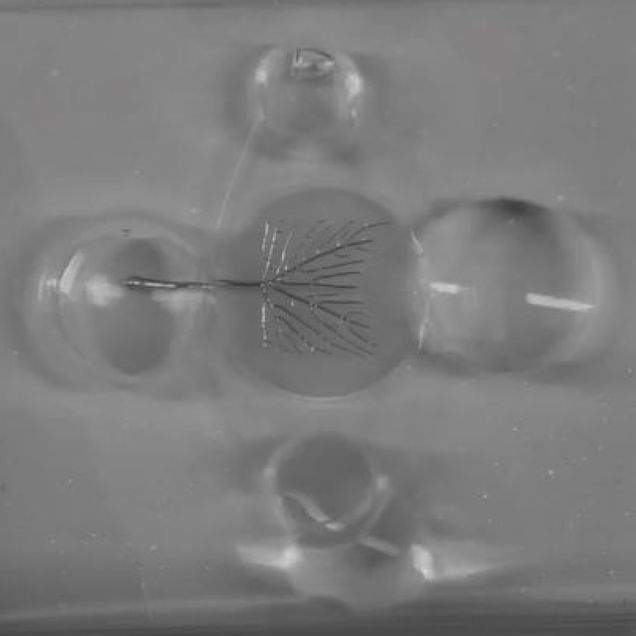
Innovative Tissue Engineering: A Pioneering New Method Explained
Now, Professor Christopher Chen (BME, MSE) and his team at the Boston University College of Engineering and the Harvard University Wyss Institute have invented a new approach to solve this complex problem. It’s called engineered sacrificial capillary pumps for evacuation, or ESCAPE for short. In new research published in Nature, More

BU Students Head to Paris to Compete in International Synthetic Biology Competition
Aiming to keep heavy metals out of the food we eat, a team of Boston University undergrads has traveled to Paris this week to pitch a soil monitor they invented, as part of the annual International Genetically Engineered Machine (iGEM) Grand Jamboree.

2024 Kilachand Fund Awards Boost Projects Building Antivirus Platform, Improving Brain Imaging, and Fighting Antibiotic Resistance
Messenger RNA (or mRNA) vaccines showed their potential as critical virus response tools during the COVID-19 pandemic. But mRNA vaccines come with limitations, including a lack of immediate antiviral immunity and high dosage requirements. Another antivirus tool, antibodies, can provide immediate protection against viral infection (from Ebola, for example), but... More