Rethinking Antibiotic Resistance Through Engineered Biology
Inside the Dunlop Lab at BU’s Biological Design Center
At Boston University’s Biological Design Center, researchers are rethinking how engineering biology can illuminate—and ultimately help solve—some of today’s most pressing challenges. Among them is Biomedical Engineering Professor Mary Dunlop , whose work is uncovering the subtle but powerful differences in how microbes behave—differences that could reshape how we think about the emergence of antibiotic resistance.
Dr. Dunlop did not begin her career in biology. “When I started out, I was really interested in classical engineering topics, like fluid dynamics and feedback control,” she says. As an undergraduate at Princeton University, she studied mechanical and aerospace engineering, with a minor in computer science. It was only later, during her graduate studies at the California Institute of Technology, that her path shifted. “I was working on a collaborative project where we were applying feedback control to biological systems,” she explains. “I thought it was really fun.” That experience introduced her to a new way of thinking—one where living systems could be understood through the same principles that govern engineered ones: sensing, feedback, and response.

Today, the Dunlop Lab applies that engineering mindset to biology, focusing on how microbes sense and respond to their environments. Her team studies how bacteria sense changes around them and adapt, using those insights both to understand biological systems and to engineer new ways of interacting with cells.
One of the most striking insights from her research is that genetically identical bacteria can behave very differently. “I think about it like identical twins,” she explains. “They have the same genetic makeup, but aren’t the same person.”Similarly, cells with identical genomes can show different behaviors—so that, when exposed to the same antibiotic, some survive while others don’t. This hidden variability can influence treatment outcomes.
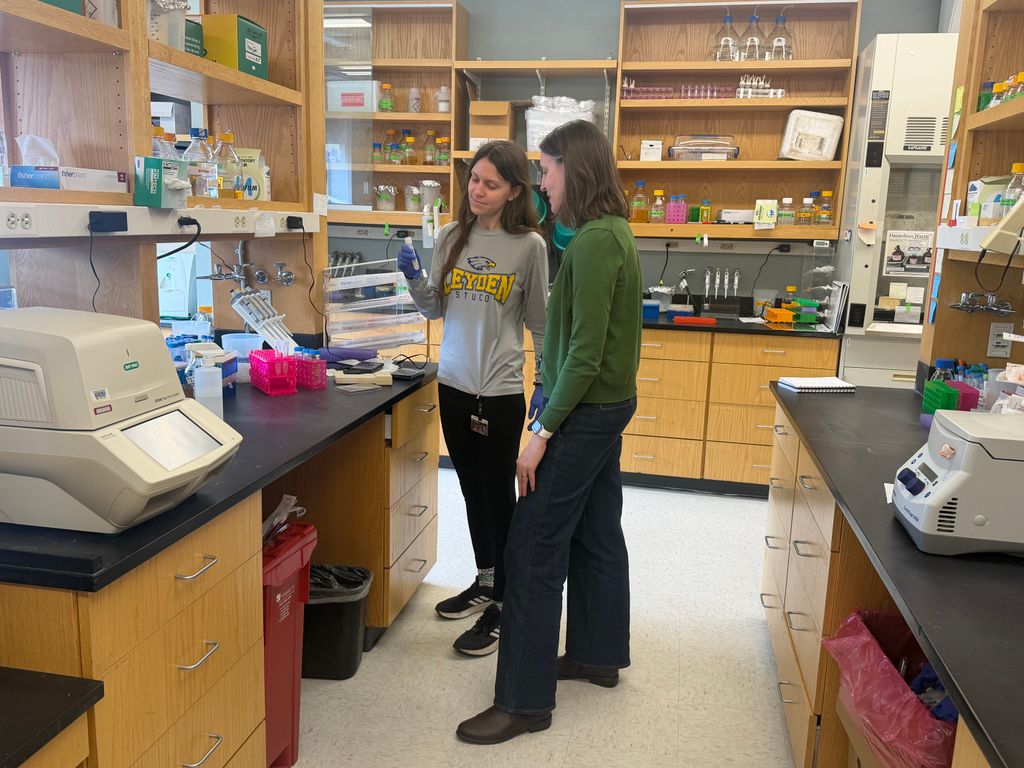
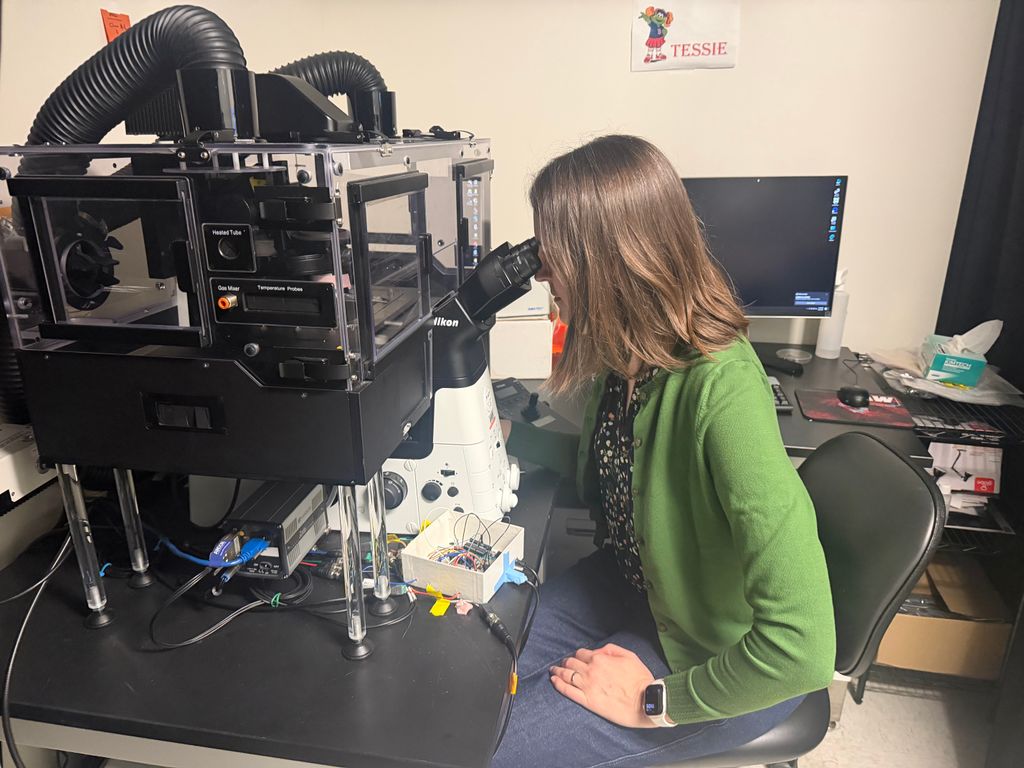
To better understand and control these behaviors, Dunlop’s lab has developed novel tools that allow researchers to directly interact with cells. One of the most powerful approaches that her team has pioneered is the use of light to interact with bacteria. By introducing light-responsive components from other organisms into bacteria—a method known as optogenetics—her team can precisely control cellular activity in real time, effectively creating a programmable interface to interact with these living systems and allowing her group to mimic processes that happen in the initial stages of the evolution of drug resistance, mirroring how variation across cells can allow them to evade drug treatment.
At the core of this work is a deeper effort to rethink antibiotic resistance. Rather than focusing only on whether bacteria carry resistance genes, Dunlop’s research highlights how differences in behavior between otherwise identical cells can allow some to survive treatment. These differences may act as early “stepping stones,” enabling bacteria to persist long enough to eventually develop stronger, more permanent resistance.
Looking ahead, this understanding could open the door to new treatment strategies. “If we could identify why cells behave differently, those mechanisms could become drug targets,” she says. Instead of relying on antibiotics alone, future therapies might combine drugs with approaches that reduce variability between cells, making bacterial populations more uniform and easier to treat. “You could use a combination therapy that reduces the ability of the cells to mount some of these responses,” she explains.
While the long-term applications are promising, Dunlop emphasizes that her lab’s work is rooted in basic science. “We’re very interested in fundamental understanding, which is critical to identifying missing pathways in the evolution of drug resistance. We are also developing the engineering tools to interface with cells in real time as they are needed to enable this research,” she says. These tools serve as enabling technologies, allowing other researchers to build on her lab’s work and expand its impact.

Like many areas of research, synthetic biology is full of unexpected discoveries. “We get unexpected results all the time,”she says. “That’s where you discover interesting things.” She also notes how surprising the field can be to those outside it. “People are surprised when they realize that you can move genes between organisms,” she says. “You can mix and match things in interesting ways.”
For students interested in entering the field, Dunlop emphasizes that there is no single path. “There aren’t that many people that have pure synthetic biology backgrounds because it’s such an interdisciplinary field,” she says. “Instead, they come from biology or physics or math or chemistry or engineering.” What matters most is curiosity and tenacity. “Students just need to be curious, creative, and persistent,” she says. “It’s a very welcoming field.”
Outside of the lab, Dunlop enjoys reading and spending time outdoors hiking, camping, and backpacking. One thing that people may not know about her is that she was also a competitive fencer and competed at the Division I level. “I fenced for a long time, from middle school all the way through college,” she says.
As her lab continues to grow, Dunlop is turning her attention to how antibiotic resistance spreads across microbial communities, particularly through processes like horizontal gene transfer. “We’re very interested in understanding how cells pass genetic material to one another,” she says, “so that we can understand and potentially mitigate how drug resistance is spread.” In the long term, this work could help identify new strategies to slow—or even prevent—the spread of antibiotic-resistant infections.