

Faculty/
Teaching
-
 Professor Isabel Wilkerson won the National Book Critics Circle Award for nonfiction for her book The Warmth of Other Suns.
-
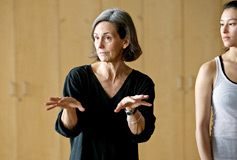 Meet this year’s winner of the Metcalf Cup and Prize for Excellence in Teaching.
-
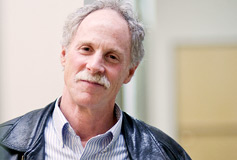 Professor Doug Starr profiles the pioneers of forensic science.
-
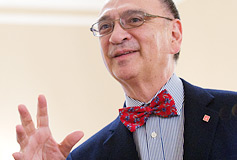 The new CFA dean conducts himself well.
-
 Learn more about BU’s master’s in forensic anthropology, the only program of its kind in the nation.
-
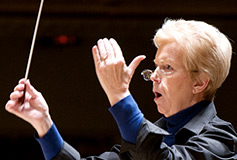 Meet College of Fine Arts (CFA) professor Ann Howard Jones.
-
 College of Arts & Sciences Associate Professor of Anthropology Fallou Ngom won a Guggenheim Fellowship, which will support his study of Ajami. What’s Ajami? Watch the video.
-
 Bacevich and Prothero ponder the role of religious impulses in American foreign policy.
What did you do during your lunch hour?
- Read email
- Ate a sandwich
- Won a Guggenheim
That’s exactly what Fallou Ngom did one day. The College of Arts & Sciences associate professor of anthropology applied for a Guggenheim Foundation Fellowship two summers ago while sitting on a bench outside his office, facing the Charles River. He calls the bench his arbre a palabre, an urban variation on the African baobab tree, a traditional gathering place.
“I have a routine,” he says. “I sit outside and eat my lunch, check email, and look at things I haven’t had time to look at.” An email led him to the Guggenheim application. He spent the rest of the day completing it . . . and then promptly forgot about it.
So news of his win this spring came as a bit of a surprise, albeit a very pleasant one. It means that he will have more
time for research and writing, he says, which is “what I’d hoped to do, if I had the time.”
Frequently referred to as mid-career grants, the Guggenheims are awarded to people who have already demonstrated “exceptional capacity for productive scholarship or exceptional creative ability in the arts.” The foundation confers about 220 fellowships a year, chosen from 3,500 to 4,000 applicants.
As director of the University’s African Language Program, Ngom is a leading expert in a written derivative of Arabic script called Ajami. Although long ignored by colonial powers and the West, Ajami is found in villages all over Senegal, Guinea, and Niger, where it remains a leading written language of commerce, legal documents, journals, and even poetry.
The Guggenheim grant will help Ngom nurture other Ajami scholars, as well as continue his work in his home country of Senegal.
“The amazing thing is, we don’t even know what’s in most of these texts, because they have never been translated.”
Fallou Ngom
An Important Tale to Tell
For half of her adult life, Isabel Wilkerson, a Pulitzer Prize-winning reporter and a College of Communication professor of journalism, has been working to bring the story of America’s black migrants to life—and to embed that history in America’s cultural consciousness.
The result, published last fall, is The Warmth of Other Suns: The Epic Story of America’s Great Migration. The book follows three of the some six million black Southerners who migrated to cities in the North and West between World War I and the end of the civil rights era. A sweeping documentation of a mostly overlooked mass movement, Suns examines the motivations and dreams—and under the South’s Jim Crow laws, the fear and oppression—that compelled so many African Americans to leave the towns and farms where their families had lived since slavery.
“Wilkerson has taken on one of the most important demographic upheavals of the past century—a phenomenon whose dimensions and significance have eluded many a scholar—and told it through the lives of three people no one has ever heard of,” Harvard historian Jill Lepore writes in The New Yorker.
The book is also Wilkerson’s journey: the story of a daughter of migrants seeking to understand her forebears’ need for fulfillment, for a chance, in the words of 20th-century African American writer Richard Wright, to “respond to the warmth of other suns and, perhaps, to bloom.”
“Wilkerson has taken on one of the most important demographic upheavals of the past century—a phenomenon whose dimensions and significance have eluded many a scholar.”
Jill Lepore, The New Yorker
World-Class Brilliance is Everywhere at BU
This spring, President Robert A. Brown named three new William Fairfield Warren Distinguished Professors, BU’s highest honor for faculty.
 Thomas Kunz, a College of Arts & Sciences biology professor, celebrates his 40th anniversary at BU this year. Kunz studies bats, and his research made news last year when a team he assembled predicted the possible eradication within 16 years of the little brown bat—a once common and still ecologically essential creature—by a lethal and little-understood disease, white-nose syndrome.
 H. Eugene Stanley of the College of Arts & Sciences is observing his 35th anniversary at the University. A statistical physicist, Stanley studies unpredictable events, such as the possible outcomes of Japan’s nuclear crisis. His eclectic research has also included the study of water’s structure; the onset of Alzheimer’s disease; and common statistical patterns governing disparate phenomena, such as the distribution of stock price fluctuations and the speeds of air molecules.
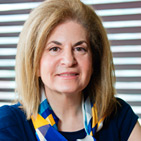 Wendy Gordon of the School of Law is an expert on copyright, trademark, and fair use law. Last fall she co-taught an Honors College course with Aaron Garrett, a CAS associate professor of philosophy. The course involved “the history of ideas, philosophical questions, and judicial decisions about property,” she says. The syllabus spanned the spectrum from classic philosophy texts by Hobbes, Locke, Hume, and others to legal decisions and even fiction. Collaborating with teachers from other walks of life, like actors and philosophers, reflects Gordon’s view that the law is “the stuff of life.”
The Warren Distinguished Professorships are named for the University’s first president, who led BU for three decades, beginning in 1873. The appointments of Kunz, Stanley, and Gordon bring the total number of Warren Professors to eight; the University hopes ultimately to name as many as 15. The endowed professorships are supported by the William Fairfield Warren Fund.