

All things considered...

This is the section of the annual report where you want to learn how we fared over what was probably the most challenging financial year in BU’s history. So we won’t keep you in suspense. Indeed, we may even surprise you: we had one of our best years ever. The two big highlights:
- We were able to transfer a record $113 million for use in academic programs, support of faculty and research, facilities, student services, and other essentials.
- Our net assets are slightly lower this year, but considering the decrease the endowment took, we’re very pleased—and feel that we are well positioned moving into 2010.
Of course, nobody could have predicted all that back in August 2008 when the financial crisis hit. But BU was one of the first universities to recognize that things were becoming problematic, and we took firm steps to ensure the crisis would be contained. We communicated with parents, students, staff, faculty, and all the parties impacted by an economic downturn. Significantly, the goal was not just to solve the problems for this year but to enact long-term solutions that would set us up to be stronger for many years to come:
- We halted capital spending.
- We increased our lines of credit and capital liquidity.
- We froze salaries for senior administrators.
- We initiated a non-academic hiring freeze.
- We established the target of removing $10 million of recurring expense permanently from the operating budget.
- We created seven task forces, each of which has been focusing on different areas for potential savings.
Combine all that with an increase in auxiliary revenue (e.g., filled parking lots at Red Sox night games), solid fundraising from alumni, and a general trend toward stabilization in financial aid awards, and it’s clear we had a strong year.
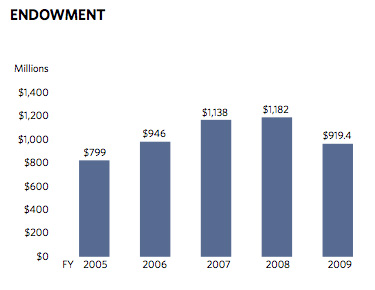
Still, there’s no escaping the fact that the tumbling stock market took its toll. Boston University’s investments returned -21.7 percent, and the endowment value was down from $1.2 billion a year ago to $919.4 million today.
The relative good news is that unlike schools whose earnings from much larger endowments sustain their annual budgets, BU’s operations do not rely nearly as heavily on investment earnings. While some universities rely on endowment income for 30–40 percent of their operations, BU uses only 2–3 percent. And even though that particular income source has gone down, we’ve been able to make it up elsewhere.
That doesn’t mean we shouldn’t take a good hard look at how we can improve our financial health. In fact, we’ve used this year as the impetus to institute many changes, which include:
- Transferring our management of the Sargent Center for Outdoor Education to a third party.
- Reducing subsidies to several external organizations.
- The closing of the University Computer Store and the redesign of services for the sale of PCs, and consolidation of PC service into the Personal Computing Support Center.
- The elimination of paper versions of course catalogs.
- The re-tasking of the Residential Computing Laboratories into study spaces and the redesign of printing services for students in the residences and other spaces on campus, developed around the ubiquitous ownership of laptops by our students today.
- The investment of $2.5 million to create a modern and expanded Information Commons in Mugar Library to meet the needs of students doing information processing on campus, but without their laptops.
- The restructuring of conference and event management for the University to reduce costs and create a single point of contact for these services.
Move forward confidently. And carefully.
The goal is to continue the fiscal prudence we instituted last September. Nobody knows, of course, what this year will bring in terms of the economy, the stock market, or the credit crunch. But all the hard work from the last 12 months has set us up well at the end of the fiscal year:
- We’re putting the funds we’ve saved through the cost-cutting process into a financial aid reserve to support students even more.
- We’re tracking a whole range of indicators to see how we’re doing against benchmarks from previous years.
- We made no across-the-board cuts for 2010.
- We were able to keep recruiting faculty as other institutions scaled back, helping us keep to our goal of new faculty hires and raising our reputation among recruiters and the recruited.
- We’ve worked with students and families who faced unexpected financial difficulties so they could remain enrolled.
- We’re already modeling the financials for 2011 to ensure we’re ready for anything.
For more information on the numbers, download the PDF of our financial statements.
Our growth as a research university.
In 1970, 131 years after its founding, Boston University was a regional university struggling to make ends meet. Total research activity for an institution enrolling nearly 25,000 students was $6.2 million.
In 2009, less than 40 years later, Boston University is a major, private, research university with an extensive residential campus and a total enrollment of nearly 33,000, equally divided between undergraduate and graduate students.
- Federal support of expenditures in science and engineering rose from under $10 million in 1972 to over $255 million in 2008.
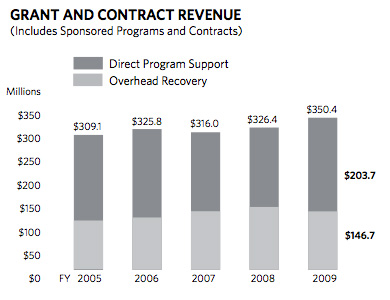
- Sponsored programs revenue went from $174.5 million in 1998 to $350.4 million in 2009, placing BU among the leading research-intensive private universities in the country.
- The University faculty includes three MacArthur Award winners, our first Howard Hughes Medical Investigator, and three Nobel Laureates, the most recent being Professor Emeritus Osamu Shimomura (School of Medicine), who shared the 2008 Nobel Prize in Chemistry.
FY 2009 Revenue and Expense

Performance Benchmarks

A (very) quick look at last year
As anyone can tell you, a year at BU moves pretty fast. See for yourself: one academic year in under four minutes.

Show us the money!
So where did three Nobel Prize-winning economists stash their cash when the economy tanked? Find out here.

Sojourn by the sea
At Professor John Walker’s summer home in Maine, CFA students bond, talk about art, and learn how light can change a landscape over the course of an entire day.

Our latest Nobel Prize winner
School of Medicine adjunct professor of physiology Osamu Shimomura wins the Nobel Prize in Chemistry for discovering green fluorescent protein (GFP) in jellyfish.
