
This article was originally published in the 2026 issue of focus magazine, the annual publication of the BU School of Theology. This article can be found on page 8. By Marc Chalufour.
10 years after the assassination of Vincent Machozi (’15), the STH community reflects on his legacy
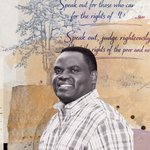
Vincent Machozi arrived at Boston University’s School of Theology in 2006. He had spent the previous three years earning a master’s degree at Boston College, after fleeing his native Democratic Republic of the Congo (DRC), where his efforts to call attention to human rights atrocities and the exploitation of the country’s natural resources had made him a target for military and rebel groups.
“His commitment was to peace and reconciliation on the ground in Congo,” says Dana Robert, one of Machozi’s PhD advisors. And BU, the alma mater of Martin Luther King, Jr. (GRS’55, Hon.’59) among other civil and human rights leaders, could help him develop the skills he needed for that mission. He’d planned to earn a PhD in social ethics and mission studies at STH, then return to DRC.
But by 2012, Machozi (’15) had decided to pause his studies and return home. Robert, a William Fairfield Warren Distinguished Professor and director of the BU Center for Global Christianity & Mission, recalls the last time she saw him, standing outside Marsh Chapel. “He told me that he was going to take a leave and go back [to DRC], that they needed him, they needed his leadership,” she says. “When my students tell me God is calling them to do something, I believe them. This was coming out of the core of his being.”
Machozi had launched the website Beni Lubero while in Boston, publishing graphic accounts and photographs of violence in DRC. He wanted to show the world what was happening there and didn’t flinch from assigning blame to powerful officials. He’d even accused Joseph Kabila, the president of DRC, of working with Rwandan militias who were terrorizing the eastern region of the country. Soon after his return to DRC, three members of the Assumptionist Catholic religious order, which Machozi had joined as a teenager, disappeared and were presumed murdered. Undeterred, Machozi began moving between safe houses as he continued to report on human rights atrocities and the plunder of the country’s natural resources such as coltan.
In 2015, realizing he would not return to BU, he accepted a master’s degree in sacred theology.
On March 20, 2016—Palm Sunday—a group of armed men found Machozi in a small village where local leaders had gathered to discuss peace. Witnesses said they wore DRC military uniforms. Machozi’s last words before they shot him were, “Why are you killing me?” Beni Lubero published photos of his body.
A decade later, the people who knew Machozi best during his time at BU recall him with clarity. They cite the strength and consistency of his character. They describe him as humble, quiet, calm, peaceful, strong, and respected. And they still hope that his memory will bring peace to people who are suffering.
“The whole definition of mission studies is crossing boundaries to serve people and to serve God and to witness,” Robert says. “And, of course, a witness is a martyr, a martyr is a witness.”
Destined to Lead
Vincent Machozi was born in the small village of Vitungwe-Isale in the province of North Kivu in eastern DRC. The resource-rich region spans open savanna and dense mountain rainforest and holds large deposits of gold, diamonds, and other minerals, like coltan, a metallic ore used in the manufacture of cell phones and computers. North Kivu also shares a border with Uganda and Rwanda, making it vulnerable to rebel incursions.
After joining the Assumptionists as a teenager, Machozi studied in France, where he was ordained as a priest before returning to DRC in 1994. That same year, Rwanda’s genocide sent refugees fleeing into North Kivu, destabilizing the region. A Rwandan-sponsored invasion followed two years later. “There’s been constant war ever since,” says Timothy Longman, a professor of international relations and political science and associate dean for academic affairs at BU’s Frederick S. Pardee School of Global Studies.
Violence and mass displacement have led to catastrophic humanitarian crises in DRC. The International Rescue Committee attributes approximately 5.8 million excess deaths in DRC between 1998 and 2007 to violence and conditions like malaria, pneumonia, and malnutrition exacerbated by the unrest.
Longman visited DRC in 2000 during a civil war. “People would say, ‘We’re a wealthy country with a poor population.’ There was real frustration,” he says. “The region that [Machozi] was from never saw peace, and nobody seemed to notice. It did not get a lot of attention from the world. His experience is a warning to us that if we don’t care about what’s happening in the rest of the world, terrible things will continue to happen.”
Against the backdrop of violence and instability, Machozi became an important figure in his region. “A Catholic priest in Africa is a community leader,” says Robert, pointing out that the continent has more Christians than any other. “The church infrastructure is more reliable and more powerful than the government infrastructure. The church is more functional.”
Friend, Scholar, Witness
BU offered Machozi the chance to further develop the skills he would need to bring change to his country. “The School of Theology is a school where people go because they want to transform the world,” Longman says. “It was the heart of BU originally, and I think helped to set the stage for BU as an inclusive and progressive place.”
At STH, Machozi studied with Robert and with John Hart, a professor emeritus of Christian ethics. The school had just launched a conflict transformation program, and he was one of the first to enroll. He also worked at the African Studies Center (ASC) at the College of Arts & Sciences (and now part of Pardee) and developed friendships with peers from other African nations.
Derrick Muwina recalls joining Machozi at one of the ASC’s weekly Walter Rodney Seminars. A visiting professor was discussing China’s burgeoning relationships in Africa— including mining in DRC—and how she saw them as an improvement upon Western exploitation of the continent. The discussion had nearly ended when Machozi asked, “Why don’t you just leave us alone?” Muwina (’10,’18), a priest and rector in the Episcopal Diocese of Massachusetts, remembers the room going silent. “I think that he really made a point. He was much more clear about what was going on than most people in academia.”
Even as Machozi progressed with his PhD studies, he remained focused on calling attention to what was happening in DRC. With a network of sources risking their own safety to send him photographs, Machozi was exposing DRC’s ongoing atrocities on Beni Lubero. “I was pierced by the weight of the work he was doing,” says Elizabeth J. A. Siwo-Okundi, another friend from STH and an organizer of his memorial service. “It was something you don’t want to see—and that was the point.
“He reminds us of what is actually going on out there that we don’t pay attention to. And his life is a witness to what it means to be a peacemaker, to offer your life for something greater than yourself.”
—Derrick Muwina (’10,’18), friend
“For some people, their presence is the impact. He was definitely one of those people,” she says.
But Siwo-Okundi (’05,’18), a visiting researcher in the ASC, also worries that the power of Machozi’s image could overshadow what he fought for. “There’s a fear when someone is killed: Have they become a martyr on paper, but what caused their death is forgotten? My hope is that we remember Machozi from a human perspective and that he does not become a trophy.”
Muwina’s native Zambia borders DRC, but he has never had to fear for his safety if he returns. From Machozi he learned that people who come from more peaceful places need to consider how they can help the world’s most vulnerable. Machozi put “a spotlight on parts of the world that are usually ignored. His life is a witness to what it means to be a peacemaker, to offer your life for something greater than yourself,” Muwina says.
Going Home
Machozi told few people that he was leaving BU. Most found out weeks or months later and few had the opportunity to speak with him again. “Missionaries who love the people are prepared to suffer the same fate as the people,” says Robert. “If the people are poor and being murdered, the missionary expects to be poor and be murdered. That’s what it means to follow Jesus to the cross. That’s what Dr. King stood for…. In terms of Boston University tradition, [Machozi] is part of a cloud of witnesses that hover over the school.”
Unfortunately, little has changed in DRC since Machozi’s death, and his pleas to pay attention to what is happening there remain as relevant as ever. On its 2024 Global Peace Index, the Institute for Economics & Peace ranked DRC 158th out of 163 developed nations—between the warring countries of Russia and Ukraine. And, despite a US-brokered peace deal between DRC and Rwanda in 2025, the United Nations reported that hundreds of civilians were killed or kidnapped in the weeks after the deal was signed. “We all benefit from DRC’s resources on a daily basis but have not taken the time to learn about what is really happening there. It’s never-ending. There seems no light in sight,” Siwo- Okundi says. “Machozi’s decision to go home was so that we can have a direct association with DRC. We need to journey to DRC with him, otherwise it’s as though we do not care.” She recalls Machozi’s final words before he was killed— “Why are you killing me?”—and says, “We must ask, ‘Why did they?’ We must wrestle with that in a profound way and not let that go unanswered.”
Colloquium honors Machozi’s legacy of peacemaking
BU represented just a small portion of Machozi’s life, but his community at the University is keeping his legacy alive. The first Fr. Vincent Machozi Colloquium: Ecologies of Peacemaking, was held February 26–28, 2026, with the goal of making it a semiregular event. Dana Robert delivered a plenary address, “The Legacy of Father Vincent Machozi,” and panel discussions covered topics related to issues like climate justice, peacemaking, and social movements.
This story relies on reporting by Art Jahnke for BU Today and Bostonia in 2016.