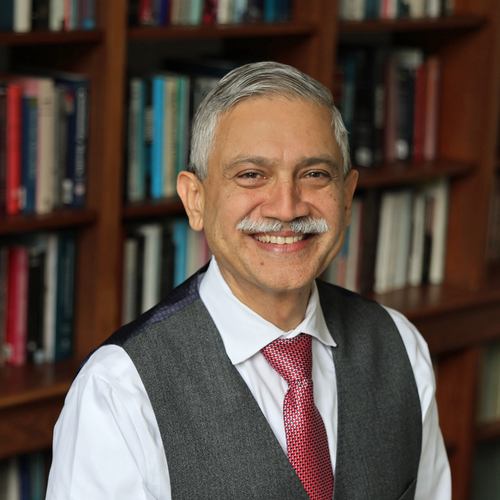
World Health Summit Shows Why Public Health Must Cross Borders.

Photo: Steffen Kugler/World Health Summit
World Health Summit Shows Why Public Health Must Cross Borders
The summit, held this year in Berlin on October 11-13, provided a vital opportunity for global engagement that US academia must continue to maintain, despite the current challenges.
Last week, I had the honor of attending and speaking at the 2026 World Health Summit (WHS), which arrived at a particularly difficult moment for international health cooperation. Global aid budgets are shrinking, the United States has withdrawn from its 78-year membership in the World Health Organization (WHO), and the WHO itself is preparing to choose its next Director-General amid this uncertainty.
Yet across more than 75 sessions at the WHS, one message kept returning: the evidence and work that protects populations is generated across borders, with cooperation built on sincere engagement, and it weakens when countries and academic institutions retreat from their roles.
The summit’s origins reinforce this point. Founded in 2009, the World Health Summit rests on a secure academic foundation: the WHS Academic Alliance, a network of leading research institutions around the world. This year’s program was organized around several central topics, including global health architecture, future-ready health systems, conflict and health, and the environmental drivers of health. None of these are problems that one country’s scientists, or the faculty of any single institution, can solve alone.
I share the belief of many of the summit’s speakers that the bilateral flow of information is key to health, that we are better off because we learn from our colleagues across borders, and that our colleagues are better off because they also learn from us. The idea of thousands of delegates coming together from across the globe to share information, ideas, knowledge, and to network, is incredibly powerful. It is also a vital opportunity for global engagement that US academia must continue to maintain, despite the current challenges.
I was delighted to see other colleagues, such as the president of the Association of Schools and Programs of Public Health, executive director of the Consortium of Universities for Global Health, and dean of the University of Texas Southwestern O’Donnell School of Public Health, amongst others. It was reassuring that there are parts of our national research and educational public health enterprise that value global solidarity.
Several of the Summit’s most notable moments were the release of large, multinational research and innovation efforts—exactly the kind of work that only international engagement makes possible.
The Wellcome Global Monitor 2026 launched in Berlin. Billed as the world’s largest survey of public attitudes toward science, it gathered responses from more than 140,000 people in 140 countries. The Lancet Commission on 21st Century Global Threats to Health also presented its findings, identifying two threats—the malicious use of artificial intelligence and nuclear conflict—with the potential to cause human extinction. The Global Preparedness Monitoring Board delivered its final report, distilling eight years of tracking the world’s readiness for pandemics. And Gallup, in partnership with the Summit, released new data on the complicated relationship between social media use and well-being.
The Summit also showed how shared evidence becomes shared investment. The Gates Foundation and Wellcome Leap announced Uzima, a joint stillbirth prevention program designed to demonstrate that stillbirth rates can be brought down. The Government of Bangladesh and the European Investment Bank outlined a €250 million program to improve women’s health and strengthen district hospitals and critical care.
For public health, global engagement cannot mean wealthy institutions setting agendas and collecting data elsewhere. It means equitable partnerships in which the countries carrying the heaviest disease burdens help shape the questions, govern their own data, and share in the results. The WHS is one of the largest gatherings of global health leaders outside of the WHO, convening policy makers, practitioners, transnational companies, NGOs, private sector firms, and academia. Boston University School of Public Health was represented there because we feel that this type of engagement is both vital for our growth, critical for our education and research enterprise, and consistent with Boston University’s “North Star” and global orientation.
We value this connection deeply, and despite the contextual challenges, we will continue to strive for it in responsible and ethical ways.

With gratitude,
Adnan A. Hyder, MD, MPH, PhD
Dean and Robert A. Knox Professor
Boston University School of Public Health