
Questrom Students Tackle Real-World Sustainability Challenges
August 24, 2026
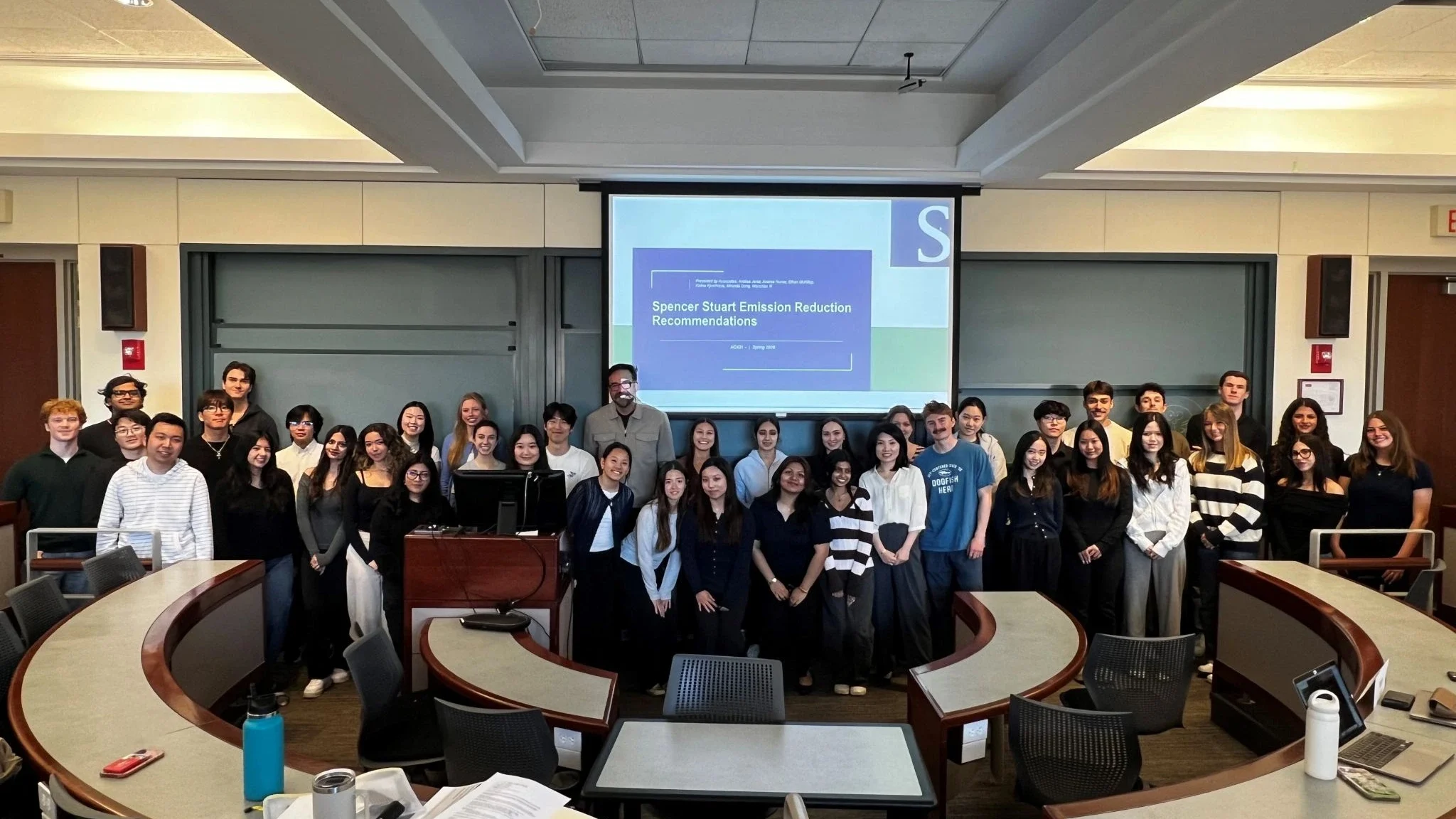
In today’s business landscape, sustainability is no longer a niche concern—it’s a strategic imperative. For students at Boston University’s Questrom School of Business, the AC431 Sustainability Reporting course, taught by Professor Estelle Sun, offers a unique opportunity to bridge academic theory with real-world practice. This past semester, students in the course took on a consulting challenge for global executive search firm Spencer Stuart, delivering innovative solutions to help the company reduce its environmental footprint.
What is AC431 Sustainability Reporting?
AC431 is an undergraduate course at Questrom that addresses the rapidly evolving field of sustainability reporting.1 The course is organized into three core modules: the first explores major sustainability reporting frameworks like the Task Force for Climate-Related Financial Disclosures (TCFD), Sustainability Accounting Standards Board (SASB), and the Global Reporting Initiative (GRI). The second module dives deep into environmental, social, and governance (ESG) topics, while the third covers current issues such as rating agencies, external assurance, and ESG activism.
However, this is not your typical lecture-based course. The experiential learning component is what sets AC431 apart, students learn by doing, applying their knowledge to live client projects that mirror the challenges they will face in their careers.
The Consulting Challenge: Spencer Stuart’s Sustainability Journey
Spencer Stuart, a premier global executive search and leadership advisory firm, has been actively exploring realistic ways to reduce its carbon emissions, particularly around business travel—a significant source of their environmental footprint. As a firm committed to sustainability, they saw a valuable opportunity to partner with Questrom students to develop fresh, innovative ideas to consider.
The client challenge was clear: help Spencer Stuart identify actionable strategies to reduce its environmental impact while understanding how the next generation of the workforce views sustainability. Students were tasked with analyzing the firm’s current practices, researching market trends, and developing comprehensive recommendations supported by financial analysis.
The Student Solutions: Innovative Ideas in Action
The student teams approached the challenge with creativity and rigor. They presented a diverse range of innovative recommendations, from leveraging specific software providers and using alternative accommodations like Airbnb instead of hotels, to gamifying sustainability efforts and offering wellness incentives. Some groups even created template emails and surveys that Spencer Stuart could immediately implement.
What made the experience particularly valuable was the real-world application. Students analyzed companies of similar size and industry to understand market approaches, supported their recommendations with data, and presented their findings to Spencer Stuart professionals—elevating the learning experience beyond the traditional classroom setting.
What Students Gained: A Firsthand Account
For Sydney Pitts, a Questrom student who took the course, the experience was transformative—both academically and professionally. She describes AC431 as “perhaps one of my favorite classes at Questrom thus far,” noting that she entered with a strong interest in sustainability and left with a much deeper appreciation for the field.

“One of the most valuable aspects of working with a live client project was the opportunity to present to professionals rather than just peers. This experience elevated the learning process and provided a meaningful step toward real-world application.”
Sydney also highlighted the rewarding nature of working with Spencer Stuart, emphasizing how their genuine engagement made the project feel like a true client engagement rather than a typical academic assignment.
“They provided internal materials and approached the project with genuine interest, which made the experience feel like a true client engagement rather than a typical academic assignment. Their attentiveness during presentations reinforced the importance of our work.”
On Professor Sun’s role in bridging theory and practice, Sydney added:
“Professor Sun played a key role in helping us translate classroom concepts into practical solutions. Her consistent feedback and support ensured that each group remained on track while maximizing learning.”
What Clients Valued: A Partner’s Perspective
Vivian Chin, a representative from Spencer Stuart, described the partnership as a “perfect opportunity to partner with a younger generation to develop innovative ideas.” The firm had been exploring ways to reduce emissions, particularly around business travel, and saw Questrom students as a fresh source of creative thinking.

“We were very impressed with Questrom’s students. Their oral presentations, written reports and analyses, and overall recommendations were outstanding. It was great to hear from these students, the next generation of the workforce, talk about the importance of setting tone from the top to help drive behavioral and cultural changes.”
Beyond the quality of the work, Vivian was struck by the students’ perspectives on sustainability and their ability to back up their ideas with data. She noted:
“The sources and real-world examples shared helped us understand what’s happening in the market and how companies of similar size and industry are also approaching these challenges.”
The impact extended beyond the classroom presentations. Vivian highlighted Professor Sun’s hospitality and the students’ professionalism, noting that one student even reached out afterward on LinkedIn. She shared:
“After the program ended, one student even reached out to me via LinkedIn, and I was very happy to pass on accounting, CPA, and general career advice.”
Her final reflection captures the broader significance of the program:
“Overall, we found the program to be very meaningful and impactful, and it has inspired us to explore more student action learning programs in the future.”
Looking Ahead
The AC431 Sustainability Reporting course exemplifies Questrom’s commitment to experiential learning, preparing students for careers in sustainability and consulting while providing real value to industry partners. For more information about hands-on learning opportunities across all programs at Questrom, visit the Questrom Experiential Learning (QXL) page.
Written By: Leslie Garcia
Notes
- Boston University Questrom School of Business, “QST AC 431: Sustainability Reporting,” accessed August 10, 2026, https://www.bu.edu/academics/questrom/courses/qst-ac-431/ ↩︎


