BOOKS
321
tion represents a temporary paradise. He ecstatically discovers this tem–
porary paradise only to lose it; his kingdom is an eternal exile forever
to be wept over. Unlike the temporary calm of other men, the ardent
flames of his hallucinating tendency can never be extinguished. There
can be no quiescence of this reaching toward the great, the mighty and
the powerful. As Virgil would have said, there are paradoxes of things
that are nowhere more lucid than in the abject saintliness of the homo–
sexual artist. For this reason, every homosexual artist, like Symonds, is
at once greater and more perdurable than his art - or than it ever can
be in his estimate. In his most opulent condition, hallucination con–
quers the most painful memories, and by so doing, it conquers his art
as well. Nowhere else does nature tyrannize over art and enslave her
to prosecute her will more than in the case of the enchained homosexual
artist-victim. R. L. Stevenson, his tubercular friend, seems to have com–
prehended the paradoxes of Symonds' paradise-exile when he said at
his death, "now the strange, pathetic brilliant creature is gone into the
night."
The peculiar relation between Symonds the "Urning" and the
homosexuality of his decadent age -like that of every artist and the
particular malaise of his time - has yet to be explained. Two volumes
of his letters have now appeared and his autobiography will be released
for publication in 1976. Perhaps then we may learn what the stones of
Venice were really like.
G. S.
Rousseau
II
r.
f . f
.
J.
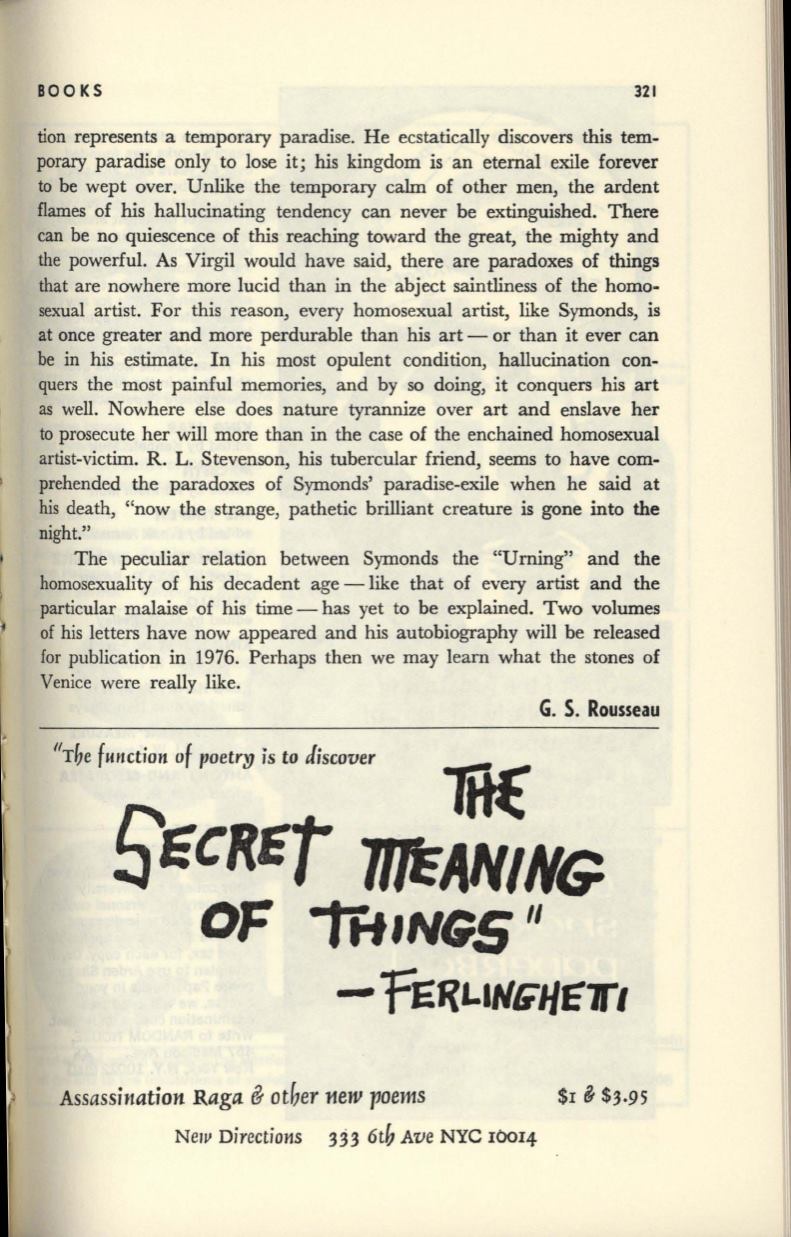
Trye IHlctlOn 0
poetr~
IS to ",scover
lit(
SECRet
7IfEANING
OF
1H'NGS
II
--
fE~LI"/illc1f1
Assassination Raga
&
other l1ew poems
$r " $3.95
Nelv
Directions
333
6tb
Ave NYC
roor4


