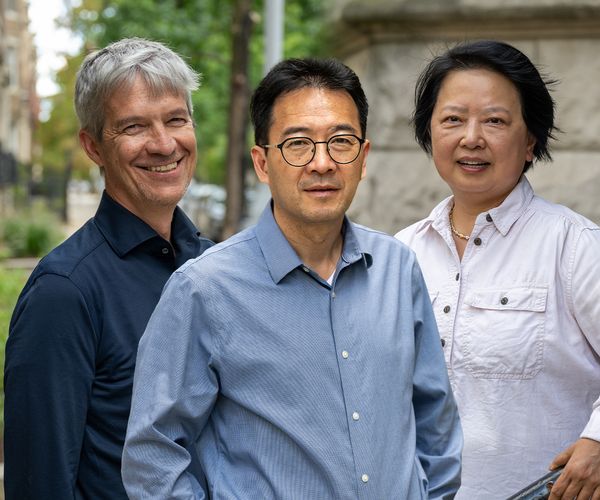
On September 23, Boston University President Melissa Gilliam and Provost Colin Duckett announced five new William Fairfield Warren professorships, three of whom are ENG faculty: David Boas, Ji-Xin Cheng, and Xin Zhang.
Established in 2008, the professorship, named after the University’s first president, is awarded to senior faculty members who remain actively involved in research, scholarship, teaching, and BU civic life. The professorship comes with an annual allowance of $50,000 for research, travel, and other scholarly work.
There are few groups at BU as exclusive as this collection of esteemed senior faculty members. To date, only 16 professors have been named to the professorship, the highest distinction for BU senior faculty.
“I am incredibly proud to recognize Xin Zhang, Ji-Xin Cheng, and David Boas for being selected as William Fairfield Warren professors. Their groundbreaking research exemplifies the excellence and innovation that define our College of Engineering. These three faculty members represent the caliber of scholarly achievement and creative problem-solving that advance what is possible in engineering discovery and reflect the values of Boston University,” said College of Engineering Dean and Maysarah K. Sukkar Professor of Engineering Design and Innovation Elise Morgan. “Recognition of these three exceptional individuals as Warren Professors is well-deserved and reinforces our commitment to fostering an environment where transformative research and discovery flourish.”
In their own words:
Professor David Boas (BME, ECE), Director of the Neurophotonics Center
 It’s humbling. I see it less than recognition of anything I’ve done on my own and more as a recognition of the community of students and postdocs in my lab, and the faculty across the University who have been willing to step outside their own fields and try something new with us through the Neurophotonics Center. Personally, it’s a reminder of how fortunate I’ve been throughout my career to work with so many at the intersection of many fields.
We are always chasing new ideas to lead to the next grants, but it can be hard to support those efforts. The research allowance gives my team more freedom to chase new ideas.
When I started, measuring brain activity with light was a niche idea. Seeing it grow into a worldwide community of researchers, and seeing BU become one of its centers, has been one of the great joys of my career. As a next step, I am excited to go beyond functional brain imaging in traditional, constrained laboratory environments. Light lets us watch the brain while people walk down the street, hold a conversation, or drive a race car. That’s where I think many of the next discoveries about human brain function will come from.
Distinguished Professor Xin Zhang (ME, ECE, BME, MSE)
One funny thing about receiving a senior-faculty honor is that it makes you sound as though you are supposed to have figured everything out. In some ways, more than twenty years of being a professor have taught me almost the opposite. I have become more comfortable with uncertainty, more interested in questions I don’t know how to answer, and more aware of how much we continue to learn from the people around us, including our own students.
 That is certainly true in research. An important direction can begin with an unexpected conversation, an experiment that doesn’t work, or an idea that failed at what it was originally supposed to do but turns out to be useful years later for something completely different. Research requires rigor, patience, and hard work, but it is also a creative process. You need room for something you didn’t plan.
That is what makes the flexibility of the Warren Professorship particularly meaningful to me. At this stage of my career, I want to take bigger intellectual risks, not simply for the sake of risk, but because important problems sometimes require us to question things we have learned to accept. Some of my favorite research has started with very simple questions: Does this limitation really have to exist? Is there another way?
The College of Engineering is much more than the ideas or technologies we produce. Almost everything meaningful in my own career has been shaped by other people—mentors who showed me what was possible, colleagues and collaborators who introduced me to worlds I knew little about, and students in our classrooms and labs who challenged my assumptions and pushed me to think bigger. We are educating people who will eventually ask their own questions, make their own discoveries, and contribute in ways we cannot predict.
I don’t see this recognition as a period at the end of a sentence. I would rather treat it as permission, and responsibility, to keep asking questions, help other people ask theirs, and hopefully leave a few more possibilities open than I found.
Professor Ji-Xin Cheng (ECE, BME, MSE)
 The Warren professorship is a true honor to me, both professionally and personally.
Twenty-five years ago, the field of chemical imaging was very small, and people thought the sensitivity was not enough and that it was not promising. Through persistent efforts, we have converted this seemingly impossible situation into something not only possible but also impacting health in positive ways. I am very glad such efforts and achievements are recognized by the Warren Professorship.
I haven’t been restricted to the lab; I co-founded a company, Photothermal Spec Corp., to bring my techniques and methods into mIRage, which are commercially available chemical microscopes now used in labs across the world for early detection of everything from Alzheimer’s disease to microplastics.
The Warren Professorship funding will go toward more high-risk, high-impact research. I will continue using different methods to reach the same goal as I have throughout my whole career.