CBR Interns Selected for UROP Funding
Interview with CBR Interns Amelia Andre and Helen Blans

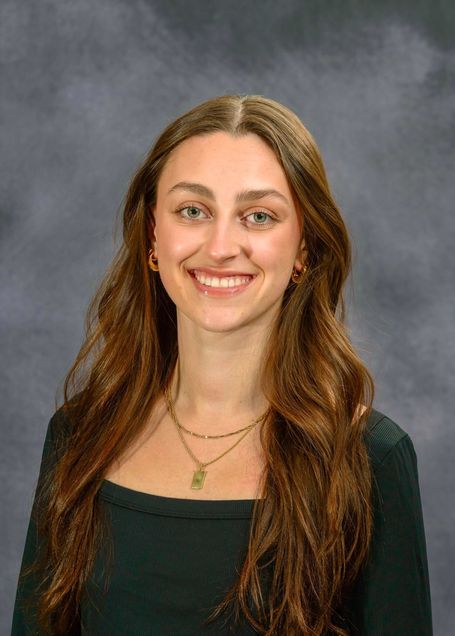
This semester, two CBR interns were selected to receive UROP funding for their research project applications. Congratulations to Amelia Andre and Helen Blans, both undergraduate students in the neuroscience program in the College of Arts and Sciences.
Amelia and Helen both joined the Center for Brain Recovery in June 2025 as summer interns, and have continued with the program into the 2025-2026 academic year. Amelia’s UROP project will be co-mentored by Maria Varkanitsa, CBR’s Assistant Scientific Director, and Michael Scimeca, a PhD Candidate. Helen’s project will be mentored by Shalom Henderson, a Postdoctoral Associate for CBR.
Amelia’s project is titled, “Examining the relative contributions of memory and language during rereading in individuals with aphasia”, and Helen’s project is titled, “Resting-State Functional Near Infrared Spectroscopy Across the Alzheimer’s Disease Spectrum”.
Why did you join the Center for Brain Recovery?
Amelia: I had been volunteering with the CHAT group, where I really enjoyed the patient-focused, supportive, and fun atmosphere. That experience motivated me to look for more ways to get involved. As a neuroscience major, I found the work at the Center incredibly interesting and significant.
Helen: I wanted to join the Center for Brain Recovery because I am very interested in research, particularly regarding neurodegenerative disease, dementia, etc. and I’m hoping to continue a career in research.
What made you decide to apply for UROP?
Amelia: I applied for UROP because I am really interested in pursuing research in the future. UROP seemed like a great way to gain hands-on experience and be a part of the full research process. I had already been involved in some exciting projects before joining, but the program allowed me to deepen my engagement and take on more responsibility.
Helen: I decided to apply for UROP so that I could get experience running my own project, designing experimental methods, and ultimately writing a research paper.
What is your UROP project focus and research goals?
Amelia: My project compares eye tracking data and memory task performance to investigate the cause of rereading behavior in individuals with and without aphasia. I aim to determine if rereading behavior has a higher correlation to visual memory, verbal memory, or aphasia. I also plan to develop a model that can predict rereading duration based on performance on memory tasks.
Helen: I will collect and analyze resting state functional near infrared spectroscopy data in individuals on the Alzheimer’s spectrum. My aims are to first extract both whole- and region-specific brain resting-state fNIRS (Functional Near-Infrared Spectroscopy) data, with particular attention to functional connectivity, and then identify functional connectivity differences between groups along the spectrum.
What motivated you to focus on the questions your project addresses?
Amelia: While administering clinical testing, I found myself especially drawn to tasks related to memory. I became curious about the role memory plays in sentence processing, and rereading behavior seemed like an interesting lens to explore this through. Since rereading impacts people with and without brain injuries, I thought it would be interesting to explore how this behavior shows up in both groups, and what that might reveal about cognitive processing.
Helen: I am also a part of Shaz’s research team and have had the opportunity to work with fNIRS. While this work has primarily focused on task-evoked fNIRS responses, there may be clinically useful information in resting-state brain activity dynamics when compared across different groups.
What methods or approaches will you use in your project?
Amelia: I’ll be using eye tracking data from individuals with and without aphasia as they read sentences and answer comprehension questions. Additionally, I will be using clinical data that includes performance on visual and verbal memory tasks. Using R, I plan to analyze correlations between memory performance, aphasia, and rereading behavior, and develop a model that can predict rereading patterns based on those measures.
Helen: I will use a variety of cognitive assessments followed by fNIRS imaging.
What impact do you hope your research will have— either within the field or for the broader community?
Amelia: I hope that my research contributes to the development of better clinical recommendations and strategies for improving reading post stroke. Additionally, through investigating the relationship between memory and language, the findings from this project can potentially benefit individuals with memory impairments, cognitive injury, and language impairments.
Helen: I hope my research can provide some more insight into how dementia affects the brain, help indicate where individuals fall along the continuum, and show how functional connectivity changes with disease progression.
What are you hoping to take away from this experience?
Amelia: I am hoping to grow as a researcher through experiencing the full research process. This is a really valuable opportunity to sharpen skills that I will need to pursue a career as a scientist.
Helen: I hope that this experience will help me expand my research skills and I hope to become acquainted with new research techniques, technological methods, and different approaches to obstacles that arise throughout my project.
What advice would you give to other students interested in joining the CBR internship program?
Amelia: Be ready to learn a lot, and make sure you have time to commit. Being a CBR intern requires a lot of hard work, but the community is very supportive, and the work is rewarding!
Helen: I would highly recommend becoming a CBR intern and investing a good amount of time into the projects. Working at the CBR and having a research team is so rewarding and I have already learned so much about research. I would advise students to properly commit to the internship and push themselves to become comfortable and proficient enough with their project to run parts of it independently since that is the best way to get the most out of the experience.
Interested in joining the CBR Internship Program?
Learn more by reading our CBR Internship Program blog post, and reach out by emailing brainrec@bu.edu.