Videos by
(346) videos
 Watch this video
What's the Secret to Living to 100?
Thomas Perls is the director of Boston University's New England Centenarian Study, which has been studying the lives of Americans over 100 since 1995. He summarizes what it takes to be a centenarian with an invented word: SAGEING, an acronym for [...]seven behavioral and other factors that can get many of us to age 90—and a lucky few beyond that. Check out the video to find out the wisdom behind each letter.
More info
- 121 love it
- 0 comments
- 3 views
 Watch this video
Who Are the Stateless? Director of BU Center on Forced Displacement Explains.
The scale of the global refugee crisis is widely reported—and staggering. According to the United Nations High Commissioner for Refugees, over 110 million people globally have been forced to flee their homes; that’s more people than live in [...]Egypt, Germany, or the United Kingdom. But less well understood, less seen—some would say invisible—are the four to six million people around the world who have no home country at all. These people are described as “stateless,” meaning they are not formally recognized by any state or government. “As far as the state is concerned, they actually do not exist,” says Muhammad Zaman, director of Boston University’s Center on Forced Displacement and a College of Engineering professor of biomedical engineering.
Zaman grew up in Pakistan, where as many as a million ethnic Bengalis are forced to live on the margins, without access to government identification, schools, or hospitals. “They are not part of any census, they’re not part of any counting,” says Zaman. “And because of that, their numbers may be even greater than we estimate.” Stateless people often live in informal, urban settings that leave them vulnerable to the worst effects of natural disasters and the impacts of climate change, he says. For these same reasons, stateless communities can pose challenges for researchers attempting to understand just how they came to be citizens of nowhere, and what can be done to help. “Simply recognizing that these people exist is an important first step,” says Zaman.
In our latest video mini explainer, Zaman tells us how so many people fall through the cracks—even here in the US.
More info
- 146 love it
- 0 comments
- 355 views
 Watch this video
How Will Generative AI Impact My Field of Study?
It’s been nearly a year since OpenAI first unveiled ChatGPT, its large language model–based chatbot. That served for many as the introduction of the formidable capabilities of generative AI technology. In the ensuing months, we’ve witnessed the [...]emergence of numerous generative AI applications.
How is this new technology likely to impact students’ majors and professional lives? We reached out to Terriers representing a broad range of disciplines—computing and data sciences, the arts and humanities, education, and healthcare—and asked them to talk about the potential impact they think generative AI could have on their fields of study and their careers. In our video, some students talk about how they’ve embraced the possibilities the technology offers, others express concerns over the threats they worry it poses. Regardless of where they come down on the topic, everyone acknowledges that AI is poised to leave an indelible mark on society moving forward.
More info
- 181 love it
- 0 comments
- 940 views
 Watch this video
"A Robot on a Mission" Feature: Assembly Line Module
https://www.bu.edu/bu-article/a-robot-on-a-mission/
More info
- 82 love it
- 0 comments
- 2054 views
 Watch this video
Book Historian Explains Why Some Famous Novels Have Different Titles in Britain and the US
Back in the late 1990s, when the first Harry Potter book was becoming a global phenomenon, children in Britain and the United States were actually reading two different books–okay, the content of the books was (mostly) the same, but the titles were [...]different: "Harry Potter and the Philosopher’s Stone" in the UK, "Harry Potter and the Sorcerer’s Stone" in the US. From Jane Austin to Agatha Christie, it turns out that this kind of thing has been happening for centuries, although not always for the same reasons. Joseph Rezek, Boston University associate professor of English and director of BU's American and New England Studies program, is both a scholar of literature and a book historian. In our video mini-explainer, Rezek breaks down the complex history behind why the same book often ends up with different titles in Britain and the United States.
More info
- 192 love it
- 0 comments
- 723 views
 Watch this video
Improving the Science Behind Bloodstain Pattern Analysis
Detectives have been using blood evidence to help solve crimes since the days of Sherlock Holmes. The science of bloodstain pattern analysis—using the configuration of blood left at a crime scene to reconstruct details of the incident—is as [...]critical to crime scene investigation as fingerprinting or DNA analysis. But as with any century-old science, it’s having to update its playbook to keep up with the technology of our everyday lives and the modern materials found at crime scenes.
At Boston University’s Fluid Lab, James Bird has made a career out of studying the interaction between fluids and their surroundings—and his latest research could help give forensic scientists new tools for analyzing bloodstains. With support from a National Institute of Justice grant, Bird's lab is doing a range of experiments designed to simulate the kinds of blood evidence found at crime scenes: everything from the complex scatter patterns associated with stab wounds to the dynamics of a single drop of human blood falling onto a surface.
In our deep dive video, we take a seat alongside Bird and his colleagues as they study the complex interactions of human blood on different surfaces—and see how their work could shape future crime scene investigations.
More info
- 183 love it
- 0 comments
- 764 views
 Watch this video
Mini-Explainer: Dr. Nahid Bhadelia on the Push for a Global Pandemic Accord
In this insightful 90-second video, Dr. Nahid Bhadelia, the founding director of Boston University's Center for Emerging Infectious Diseases Policy & Research, delves into the implications of the Pandemic Accord, a potential global response plan to [...]future pandemics discussed during the United Nations General Assembly's recent high-level talks in New York. As a former senior policy advisor to the White House's COVID-19 Response Team, Bhadelia offers a comprehensive breakdown of the accord, addressing critical issues such as global information sharing incentives and equitable vaccine distribution. Explore the prospects of a unified global strategy in tackling future pandemics with Boston University's renowned infectious diseases expert.
More info
- 239 love it
- 0 comments
- 301 views
 Watch this video
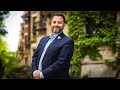
Meet Jason Campbell-Foster, BU's New Dean of Students
Jason Campbell-Foster will serve as Boston University’s next Dean of Students, assuming a role he’s held on an interim basis since July 2022, the University announced Thursday. Campbell-Foster emerged as the top candidate after a competitive, [...]yearlong national search.
“I am deeply humbled by the responsibility that has been given to me,” he says. “If you had told the 13-year-old me, growing up in rural New York, selling chrysanthemums with my grandfather, that I would one day become the Dean of Students at a world-class institution of higher education, I would have assumed you had the wrong person and directed you to my classmate down the road.
More info
- 88 love it
- 0 comments
- 445 views
 Watch this video
Advice to the Class of 2023: "Remember your Hustle and Remember your Passion"
Class of 2023, you have faced challenges you couldn’t have dreamed of when you first arrived at BU: a freshman year upended by the COVID-19 pandemic, which sent everyone remote; a sophomore year defined by hybrid learning and social distancing; war [...]in Europe and a continued reckoning on race and inequality here at home. Throughout it all, you’ve demonstrated resilience, fortitude and grace.
Now, as you prepare to graduate, we’ve reached out to some members of the BU community and asked them to share some words of advice and inspiration with you before you depart.
Congratulations to all you’ve accomplished during your time here. We can’t wait to see what you do next!
More info
- 126 love it
- 0 comments
- 908 views
